I’m the sort to equate convergence with insight, even though I know it’s wrong. Rather, I don’t know it’s wrong. I only know it’s a sin against rationality. That doesn’t make it wrong, just irrational, which means “wrong” according to certain narrow and wholly defensible points of view. In other words, I am regularly wonderstruck by a stream of significance that might appear as nonsense, or not appear at all, to another reasonable judge. I am not the likeliest reader, then, of what is called analytic philosophy. Yet I’ve spent a fair number of supposed leisure hours over the past year or two treading slowly and unsystematically through the work of Ludwig Wittgenstein, an undertaking for which I have no academic license, merely a suitcase of relevant books: the two he wrote for publication; a few collections of notes and transcripts compiled by his students and various editors; a monograph about the house he designed for his sister; and assorted critical texts on his philosophy, some of which I’ve owned since college, most of which I’d not read before. In July, I took my suitcase library to a resort-cum-school for artists in western Canada. There I planned to prepare a handful of talks about reading Wittgenstein while coteaching a six-week pilot art school foundation course.1
To leave jfk by plane in the morning and head west on a highway through the center of the Rocky Mountains that evening, is to leave jfk by plane in the morning and travel headlong into a postcard some hours later. Less banal comparisons would only embarrass language. I arrived within a few days of the solstice. The sky was lit until almost midnight. Inside the airport van, a video monitor played a montage of local scenery. My attention oscillated between screen and window in a pan of mountain vistas, arsenic-hued lakes, and close-ups of solicitous wildlife. Experience had never aligned so neatly with its advertisement.
By the evening of the second day, no fewer than three staff members had informed me indigenous people found the area “too powerful” to settle. I was told to expect vivid dreams. Initially, I didn’t sleep more than three or four hours at a stretch. I woke in the middle of the night. I watched infomercials on mute until dawn. I didn’t dream. I looked in the direction of the television and fretted thinly about oneiric communiqués I was missing.
Following our morning seminar meetings, I bided sleepy afternoons in front of my laptop at a folding table in the office I was allotted. I adopted a routine of restacking the library, sometimes in multiple configurations, then staring through my window onto a scene that didn’t fix. I could observe weather come across the valley from nearly an hour off. When clouds approached, shadows spread over the mountains like a spill soaking through a paper towel.
I passed a full week in restless awe before finally turning off the late-night programming and attempting to read On Rules and Private Language, a book by philosopher Saul Kripke about a single section in Wittgenstein’s posthumously published second book, Philosophical Investigations. In short, On Rules is a 145-page attempt to describe a paradox. The question is whether a rule can be thought to exist for only one person. Wittgenstein says no. In these oversimplified terms, the matter seems hardly worth arguing, but the concept of truth in logic and mathematics is tied up in the issue. So, too, are workaday concepts like meaning and value, since these trace back to truth on some level, even if most of us aren’t thinking in a technical way about it most of the time.
Before Kripke, the so-called private language argument was generally located in latter sections of the Investigations pertaining to expressions of sensory experience, like the perception of color or of pain, but Kripke focused his study on an earlier section (202) where Wittgenstein writes: “… “obeying a rule” is a practice. And to think one is obeying a rule is not to obey a rule. Hence, it is not possible to obey a rule “privately.” Otherwise, thinking one was obeying the rule would be the same thing as obeying it.” In other words, rule-following is subject to verification by others. To think that one is obeying a rule by thinking one is obeying a rule, would be to misconstrue what obeying a rule entails, because the “thinking one is obeying” wouldn’t be verifiable. Per Wittgenstein, the same goes for linguistic expressions. Language is shared publicly; its meanings (which is to say, meaning) only exist through an ongoing practice of verification among a community of speakers. By extension, meaning is not an introspectible experience. In fact, the very concept of unique experience is logically insupportable.
Kripke had been with me long enough that his spine was bleached white from exposure. Extensive underlining and dog-earing indicate that I read the book at some point prior to the summer, though I had no memory of its contents. In a semi-illiterate, insomniac state, I ventured again as far as the preface, page ix, where I discovered the material in On Rules was delivered in 1977—the year I was born—as a series of lectures, including a colloquium held in the very place I was now staying. I took no small pleasure in the coincidence of the book returning to its place of conception, the timing of which concurred with my own, and in this—our squared convergence—having something to do with a philosopher whose death preceded the incidents and who would otherwise seem to have nothing to do with any of it, at least not in a determinate way. I put Kripke down and turned off the lamp.
In the morning, I went to the library before class to knock on the archivist’s door. She told me no records of conferences at the center were kept until the early 1990s. That afternoon, she sent an email with the contact information of a retired philosophy professor who attended the colloquium and was responsible for transcribing Kripke’s lectures. I looked for him online. I learned he had been a popular teacher at a university just south of the center. He published a book two years after Kripke’s visit. I found a brutal review of it. According to the reviewer, the book was “limited in both scope and orientation,” and was a failure “both internal (on his own terms) and external (what is outside his scope).” I was suspicious. Aren’t scope and orientation defined by their limits and therefore necessarily limited? The criticism seemed insufficiently qualified. But I took note of the warning. Questions of orientation (Where are you looking?) and scope (What are you seeing?) all but contain us. Though it does sound glib when put so baldly.
In one of the more emphatically dog-eared and underlined passages in On Rules, Kripke reverses his orientation, or his subject’s. You can almost see him doing a touchdown dance as he writes: “Wittgenstein has invented a new form of skepticism. Personally I am inclined to regard it as the most radical and original skeptical problem that philosophy has seen to date … The main problem is not, ‘How can we show private language—or some other special form of language—to be impossible?’; rather it is, ‘How can we show any language at all (public, private, or what-have-you) to be possible?’ … Wittgenstein’s main problem is that it appears that he has shown all language, all concept formation, to be impossible, indeed unintelligible.”
Judging solely by my markup, this reversal may well be the climax of the book. I don’t claim to understand it—by my reason, it would be impossible to conceive of universal unintelligibility, except within an intelligible language, which then precludes universal unintelligibility, but maybe this is the very problem, or paradox, Kripke means to draw.
The first talk I delivered to the students was about color. It was about green, to be specific, though not exact, which was partly the point. It was about a group of people looking at the same thing, inevitably seeing something different, yet using common words to describe their experiences. The idea was to demonstrate the imprecision of language. And to further demonstrate, despite this presumed imprecision, that we can’t make a logical argument that would distinguish our individual experience of perception from our conscious (linguistic) awareness of it, which is to say, from our shared terms.
Ordinarily, we think of experience preceding language. We assume sensation is a phenomenon we may describe once we’ve experienced it. We point to the world and then we make a sign stand in for the part of the world we’ve pointed to. I see an instance of green, and I say, “green.” I’ve posited a one-to-one correspondence between the instance and the word, with the occurrence preceding my knowledge of it. This is known as the correspondence theory of language. Wittgenstein sketched a version of it, dubbed the “picture theory,” in his first book, Tractatus Logico-Philosophicus, which he wrote in his twenties. The picture theory had antecedents, tracing back at least to Augustine, who likewise assumed that learning a language is primarily a matter of acquiring vocabulary in a point, name, repeat manner. Historically, the idea was fairly uncontroversial. But later in life, Wittgenstein was increasingly disturbed by a logical inconsistency in the theory. Namely, if meaningful propositions are restricted to that which corresponds to the world as a picture, then the theory itself would fall outside this realm of meaning. In the Tractatus, he attempted to illuminate a structure, to make a complete outline of a fixed system one could observe, objectify, and explain, but this approach begged the question—if we can’t speak from outside language, how can we encapsulate it in a comprehensive theory?
Following the Tractatus, Wittgenstein reformulated his idea of how language works. On the way, he significantly altered the form of his writing. By the time of the Investigations, more than twenty years later, he no longer attempted an axiomatic thesis or an overarching theory. Instead, he combed through specific instances of inappropriate usage to identify and address common misunderstandings on a case-by-case basis. He gradually reentered concepts like meaning through sidelong passages. He came to see philosophy akin to therapy: “The philosopher’s treatment of a question is like the treatment of an illness.” This was a plodding process of clarification by degrees.
Imagine, for example, trying to explain to someone with no concept of color what green is. If I point to pine trees outside my office window, then to an apple on the windowsill, then to an aqua book jacket, each time repeating “green,” how would a color-ignorant person assimilate the idea? How have I come to know by green that pistachio ice cream and Amercian money and AstroTurf and envy have this in common? According to the later Wittgenstein, understanding is not the process or the act of identifying a particular instance of green. It’s the ability to identify green in general. This is analogous to the ability to play a game. Take chess. He asked his students, “When do you know how to play chess? All the time? Or just when you’re making a move?” Understanding is not a mental state one arrives at, attendant on immediate perception. When you understand, you have the ability to generate acceptable moves within a shared framework. When I describe a color, what I describe is the framework within which the experience of the color can be described.
One implication is that by describing something, I am potentially modifying the way in which experience can be understood, which in turn affects what can be experienced. Ergo, the idea of green is unstable, but that doesn’t mean green—the color, the concept, the experience, the thing—doesn’t exist, only that we can’t speak about it definitively, rather adequately and contingently. The meaning of green is its use.
One of the challenges of teaching Wittgenstein, and the reason why doing so makes sense in a foundation course, is that his primary concern is technique. For him, thinking—like understanding—is a particular ability. It is a skill for drawing distinctions, for fracturing the arbitrary unities we construct, and thereby making new ones. Thinking is not a matter of possessing and cataloguing knowledge. To teach his work, then, is not just to teach what he said, though that’s important. It’s to teach how to extrapolate what he would say, and to formulate further questions that would extend beyond his. That is to teach teaching. Or in my case, to learn it. Or, moreover, to create circumstances where teaching and learning are indistinguishable. The problem is, the initial variables—understanding, or the meaning of green, let’s say—can seem arbitrary. The stakes, abstract. Or worse, irrelevant. And all this talk about what it is to understand may seem recondite at a time when what passes for thought often comes down to issuing and compiling one’s likes and dislikes of cultural products—a pursuit that may offer greater immediate rewards than parsing the ambiguities of green. So, another significant challenge, beyond teaching the ability to abstract and transfer an analytic technique from one example to another, is to animate the value of doing it.
While preparing to talk about Wittgenstein talking about color, I looked up the color plates in artist Josef Albers’ Interaction of Color. Albers was one of the preeminent teachers at the Bauhaus in the 1920s. He and Wittgenstein were contemporaries, both reputed prodigies. Interaction was first published in 1963, about ten years after the Investigations appeared. The book contains descriptions of the exercises Albers taught in his foundation course on color at the Yale School of Art, plus numerous reproductions of graphic works, which were used to demonstrate the principles in the lessons, most of which have to do with noticing how our perceptions of colors and shapes change based on adjacent colors and shapes. Albers and Wittgenstein worked in different fields on different continents, but they harmonize well. As teachers, both eschewed erudition in favor of direct experience. They compelled students to unravel spurious assumptions buried in seemingly obvious notions. Albers’ book begins:
The book “Interaction of Color” is a record of an experimental way of studying color and teaching color … As a general training it means development of observation and articulation. This book, therefore, does not follow an academic conception of “theory and practice.” It reverses this order and places practice before theory, which, after all, is the conclusion of practice.
The introduction to the first exercise could be a page from the Investigations:
If one says “Red” (the name of a color) and there are 50 people listening, it can be expected that there will be 50 reds in their minds. And one can be sure that all these reds will be very different. Even when a certain color is specified which all listeners have seen innumerable times—such as the red of the Coca-Cola signs which is the same red all over the country—they will still think of many different reds. Even if all the listeners have hundreds of reds in front of them from which to choose the Coca-Cola red, they will again select quite different colors. And no one can be sure that he has found the precise red shade. And even if that round red Coca-Cola sign with the white name in the middle is actually shown so that everyone focuses on the same red, each will receive the same projection in his retina, but no one can be sure whether each has the same perception. When we consider further the associations and reactions which are experienced in connection with the color and the name, probably everyone will diverge again in many different directions. What does this show?
Compare the passage to a few of Wittgenstein’s about color perception found in the so-called private language sections of the Investigations:
273. What am I to say about the word ‘red’?—that it means something “confronting us all” and that everyone should really have another word, besides this one, to mean his own sensation of red? Or is it like this: the word ‘red’ means something known to everyone; and in addition, for each person, it means something known only to him? (Or perhaps rather: it refers to something known only to him.) 278. “I know how the color green looks to me”—surely that makes sense!—Certainly: what use of the proposition are you thinking of? 279. Imagine someone saying: “But I know how tall I am!” and laying his hand on top of his head to prove it.
Wittgenstein and Albers both circle ambiguities in the language we use to describe perception. Each is keen to guide us through specific examples towards broader realizations—that we commonly misconceive perception, and/ because conventional linguistic expressions belie the logical relationship between conceptions and perceptions.
And why do they bother?
When I was a student, I couldn’t fathom an answer. I was expected to buy an inexpensive paperback copy of Albers’ book for a drawing course, which I was required to take. The drawing course was taught by a former student of Albers, who never referred to the text in class. I opened it once. Mystified, I shelved it immediately. Fifteen years later, the pages of my books have yellowed slightly, but the texts haven’t changed. That I am now enthralled by them could only mean I have changed. For me to answer the question of why Wittgenstein and Albers should bother, would be to register a fifteen-year difference in my own orientation and scope of interest. But if posed at the wrong moment, the question of what matters and why can be a toxic solvent for that fragile solution of concerns that hold a person in some semblance of mental equilibrium. Fifteen years had taught me this much, at least.
We were in the middle of week two. Wildflower season was coming up on butterfly season. I was still largely unsure of Wittgenstein on color, and even less sure of myself in front of a class. This, I discovered while standing in front of a class, attempting to channel Wittgenstein on color.
The sections in Investigations on red and green directly precede several sections regarding pain, the perception of pain, and the relation of “knowing” to pain. Wittgenstein says I can know someone else is in pain, but I can’t know that I am in pain. I know someone else is in pain because I observe him faltering, grabbing his stomach, wincing, moaning, and falling to the ground. It would be possible, if I weren’t familiar with these indicators, to not know a person who is faltering, grabbing his stomach, wincing, moaning, and falling is in pain, just as it would be possible to not know whether someone who is pricking his finger in front of me but not exhibiting any signs of pain is indeed in pain. However, if I, myself, am in pain, I cannot not know it, properly speaking, because there would be no way, then, to verify my state of pain. By the same count, I cannot know I am in pain, either. I am in pain or I am not, i.e., the issue isn’t whether or not I feel pain; it’s the meaning (the proper use!) of what it is “to know” something. Similarly, if no one saw me skip lunch after class, retreat to the privacy of my resort-school accommodations, and bury my face in a synthetic pillow, no one—not even I—could know I was distressed by the talk on color, though I was certainly distressed.
The logical structure of our language precludes the possibility of knowing whether our own sensory perception precedes our thinking awareness of it. We can’t speak sensibly from our experience of experience preceding thought, even if instinct surges in protest to say of course we feel a thing before we report it (whether internally, in our thoughts, or publicly, through speech and writing). An oft-quoted, possibly apocryphal exchange alleged to have occurred between Wittgenstein and one of his students, philosopher Elizabeth Anscombe, pertains. She says to him—one can understand why people used to think the sun circled around the earth. When he asks why, she replies—because it looks that way. He asks—and how would it look if the earth were turning on its axis instead?
The biggest surprise about public speaking is that you receive almost no feedback. If you’re someone who is inclined to listen and adapt to others’ signals, the sudden dearth of social cues comes as a shock. If you’re someone who is not only inclined to adapt, but prefers to respond, then addressing a group—especially about a subject you’re not entirely comfortable with—feels like auditioning naked for a singing part.
Wittgenstein was still a student, himself, when Bertrand Russell first lauded his talent and proclaimed him the teacher. By the time he returned to Cambridge in midlife, his concentration and his formidable analytic facility had long since congealed into myth. About a year ago, I read in a biography that during his seminars, he would sit in a humble wooden chair, hold his head in his hands, and think. Periodically, he would lift up to release some new formulation to an audience of students, who were duly rapt. Something like focused dialog would ensue, with Wittgenstein dominating. The tension in the room during these sessions would be palpable, the master’s articulation precise, the devotion of his devotees, discipular. He wasn’t talking about a historical subject. He was making up questions and attempting to answer them on the spot. This caused physical strain.
I am skeptical of biographies, autobiographies, and memoirs. I usually amble through them. I pick one up, read two paragraphs, jump to another chapter, read two more, put it down. This picking and putting happens to fall in with the typical pace of getting to know an actual person. The difference is that in the case of an actual person, getting to know rarely comes down to anything like the sum of what you’re told. The effect of a body—tones, habits, rhythms, gaits, tics, manners of dress, manners of speech, manners of breath, manners of all sorts in distinctive combination—can’t be approximated by descriptions, no matter how thorough. And body odor isn’t the only thing missing from a page. To compose a life story with any degree of fidelity to a life lived is improbable. This much is obvious. Interstices will always obtain. Readers will always interpolate. That the limits and license of a teller’s perspective are implicit in the telling is also obvious. Still, one quickly inures to the mechanics and limitations of the medium. A well-issued narrative seduces the reader, and when you’re seduced, you’re not skeptical. You forget to ask what you haven’t been told.
Some months after learning about Wittgenstein’s pedagogical persona, I was astonished to read in the same account that his voice was high-pitched. In my memory, the biographer mentions this fact of vocal tone in passing, almost inconsequentially, in one short line, hundreds of pages into the story, apropos of nothing, which probably explains why I was affected by it—it jarred my self-consciousness as a reader. I may as well have bumped into Ludwig at my kitchen table, eating Jell-O with a fork. I wasn’t moved by the particular specificity of the high-pitched male voice so much as the general specificity of a voice—any voice. I hadn’t thought of him having one. I hadn’t thought I hadn’t thought of it. In my mental images, his mouth was always closed. Often, he was staring into the distance. Occasionally, he was writing in a notebook. I had read that he was a formidable interlocutor, but this, too, occurred in my mind’s eye through a combination of forceful glaring and adamant hand gestures.
Once fitted with the idea his printed words originated in a distinctive tenor, I lost the ability to read them as thoughts unmoored from a body—his body, and my own. My orientation as a reader shifted. I engaged, as with a correspondent. I was amused. I was reflexive. I was listening. It was personal. There’s a line in a letter from John Keats about the poems of Wordsworth, that “axioms in philosophy are not axioms until they are proved upon our pulses: We have read fine … things but never feel them to the full until we have gone the same steps as the Author.” Keats was taking the escalator up with Wordsworth, whereas I had taken it down with Wittgenstein. Was this detail about his voice trivial? Possibly, but if a trivial detail—the suggestion of a voice—could deliver us—writer and reader—from abstraction to immanence, what does “trivial” mean?
Wittgenstein used the word in a talk he gave in 1929, halfway between the Tractatus and the Investigations. He had been on hiatus from philosophy for about eight years when he was invited to Cambridge to deliver a lecture to the Heretics, a student society. He chose for the occasion to speak about ethics. His intent was to clarify the major misapprehension of the Tractatus’ readership—that the book concerned anything other than metaphysics. He maintained the Tractatus regarded implicitly everything it didn’t regard explicitly. His conclusion, “Whereof one cannot speak, thereof one must be silent,” indicated that one conjured what couldn’t be spoken of by delineating all that could be spoken of. (Over the years, Wittgenstein was repeatedly disappointed to realize that what was exceedingly obvious to him could be utterly lost on others.)
The “Lecture on Ethics” was the only talk he ever gave. It redefined, for me, the scope, which is to say the meaning, which is to say the value, of aesthetics. It was my impetus for talking to artists about reading Wittgenstein. And it is fairly short and relatively accessible. So, for week four, I decided to conduct a walk-through, from top to bottom, with accompanying slide show. By then, I had rebounded from week two’s crisis of confidence. I had produced a mediocre but altogether non-mortifying talk during week three. I hadn’t polled the group to find out whether the Vaseline grasp I had of our topic during week two was evident, but I had learned that when speaking to an audience about whatever you are supposed to know, it is easier on everyone if you embrace the performative aspects of the role. Even as you admit what you don’t know, even if you know almost nothing, even if you’ve only stumbled into the wrong room and are bewildered to find yourself facing an expectant crowd, it is strictly insensitive to confront empathetic people with a show of diffidence.
Wittgenstein begins his lecture with a working definition of ethics as the “general enquiry into what is good,” then opens the umbrella to cover aesthetics, which he considers the most essential part of ethics. He doesn’t dwell on this relationship or provide a further definition of aesthetics in the prelude, but the term acquires significance as he proceeds. He adds that he could have called ethics the enquiry into what is valuable, important, meaningful, etc.—the definition is not a definition, more of a sketch—and that each of these terms is used in two distinct senses: the trivial, relative sense and the ethical, absolute sense.
In the trivial sense, a word like “good” accords with a predetermined standard. i.e. Something is “good” if it meets a quantifiable mark. Think of a good athlete or a good chess player or a good canoe. We know how to tell good from bad in each case because we have certain agreed-upon metrics. That’s relative good. That’s the trivial sense. This trivial sense is, in turn, the basis of a metaphor we use to say something is good in the ethical sense. e.g. When I say, “Wittgenstein is a good person,” my meaning is conveyed because we understand “good” in the relative sense and can draw on that sense of goodness as a metaphor for something that can’t be measured—an absolute good, a good “beyond” facts.
One way to detect whether a word is being used in the trivial or in the ethical sense is to try replacing it with other terms. If I say a canoe is good, and I mean the canoe is seaworthy and will hold three people without sinking, that is a defensible use of the word “good.” But if I say Wittgenstein is good, I can’t replace “good” in the same way, with a standard measure. I have to rely on ethical arguments to substantiate my description. I am not dealing in facts. My meaning is ultimately indefensible. In the first case—the canoe—I’ve made a logical proposition. It involves facts that can be vetted. In the second case, I’ve issued an aesthetic statement. It can’t be verified.
In his own words:
Although all judgments of relative value can be shown to be mere statements of facts, no statement of fact can ever be, or imply, a judgment of absolute value … … a certain characteristic misuse of our language runs through all ethical and religious expressions. And these expressions seem, prima facie, to be just similes … if I can describe a fact by means of a simile, I must also be able to drop the simile and to describe the facts without it. Now in our case as soon as we try to drop the simile and simply to state the facts which stand behind it, we find that there are no such facts. And so, what at first appeared to be simile now seems to be mere nonsense.
What do we have in mind when we say something is absolutely good or absolutely valuable, then? Wittgenstein gives the example of remembering a pleasurable scene—being in the forest on a sunny day and feeling at peace. He relates a sense of wonder expressed with a phrase like, “How extraordinary that this should exist.” He gives a second example of the feeling of absolute safety—the sense that one cannot be injured, no matter what. His argument against the viability of these descriptions is analogous to the argument about pain and what it is to know something—it is nonsense to wonder at the existence of the world, because we cannot imagine it not existing. It is nonsense to say that one is safe whatever happens, because to be absolutely safe implies that “it is physically impossible that certain things should happen.” He concludes that which pertains to ethics is ineffable; the verbal formulations we attempt to convey it are illogical:
… if I contemplate what Ethics really would have to be if there were such a science, this result seems to me quite obvious. It seems to me obvious that nothing we could ever think or say should be the thing … Ethics, if it is anything, is supernatural and our words will only express facts; as a teacup will only hold a teacup full of water and if I were to pour out a gallon over it…
Using language in a strictly meaningful and logical sense is not the way of using language to talk about what doesn’t afford logical terms. In his words, again:
… it is absurd to say “Science has proved that there are no miracles.” The truth is that the scientific way of looking at a fact is not the way to look at it as a miracle. And I will now describe the experience of wondering at the existence of the world by saying: it is the experience of seeing the world as a miracle.
To wonder at something in these terms, is to misuse language. It is not to make a logical proposition, rather to make an aesthetic statement.
Then comes the mind-bender:
Now I am tempted to say that the right expression in language for the miracle of the existence of the world, though it is not any proposition in language, is the existence of language itself.
This sounds like the “radical and original” problem Kripke identified in On Rules.
But what then does it mean to be aware of this miracle at some times and not at other times? All I have said is again that we cannot express what we want to express and that all we can say about the absolute miraculous remains nonsense.
(But nonsensical is not the same as inconsequential.)
You will say: Well, if certain experiences constantly tempt us to attribute a quality to them which we call absolute or ethical value and importance, this simply shows that by these words we don’t mean nonsense, that after all what we mean by saying that an experience has absolute value is just a fact like other facts and that all it comes to is that we have not yet succeeded in finding the correct logical analysis of what we mean by our ethical and religious expressions. Now, when this is urged against me I at once see clearly, as it were in a flash of light, not only that no description that I can think of would do to describe what I mean by absolute value, but that I would reject every significant description that anybody could possibly suggest, ab initio, on the ground of its significance.
Signification is relative. What is absolute is, by definition, not relative. If a description signifies, in a logical sense, then it cannot serve in an absolute sense. From the moment (ab initio) a description, as such, purports success, it fails. Finally, he pulls out all the stops:
That is to say: I see now that these nonsensical expressions were not nonsensical because I had not yet found the correct expressions, but that their nonsensicality was their very essence. For all I wanted to do with them was just to go beyond the world and that is to say beyond significant language. My whole tendency and, I believe, the tendency of all men who ever tried to write or talk Ethics or Religion was to run against the boundaries of language. This running against the walls of our cage is perfectly, absolutely hopeless. Ethics, so far as it springs from the desire to say something about the ultimate meaning of life, the absolute good, the absolute valuable, can be no science. What it says does not add to our knowledge in any sense. But it is a document of a tendency in the human mind which I personally cannot help respecting deeply and I would not for my life ridicule it.
Wittgenstein believed (he believed he had proven) the ambition to attain knowledge outside the logical structure of language is foredoomed. That doesn’t mean the effort is pointless. An aesthetic statement often begins along the lines of “I’m interested in …” or “I wonder about …” or “I care about …” and is followed by a logically indefensible—meaningless—expression. But to say such statements are meaningless is not the same as saying they are inconsequential. In fact, we often use “meaningful” in the absolute, ethical sense to categorize aesthetic statements because they are of such immense consequence to us.
Part of the value of reading Wittgenstein is in better equipping oneself to assess one’s own values. The equipment includes a working understanding of the difference between defensible and indefensible senses of “meaning.” From that understanding follows the realization that the meanings of significant value to us are often the indefensible kind.
I tend toward tautologies and scare quotes when I try to describe “The Lecture on Ethics.” I much prefer to share it in its entirety than to attempt a synopsis, but it’s not easy to persuade someone to read Wittgenstein, even “fairly short” and “relatively accessible” Wittgenstein. I catch myself resorting to vague, qualitative assessments and testimonial. “It’s eloquent,” I say. “It’s profound.” “I cry when I read it.” A friend had referred me to it with similar deference after I told him about ducking out of an insufferable artist’s talk. He’s an architect. He attends a lot of talks. He was sympathetic. I tried to put handles on the problem: It was a promising start, I said. Someone whose interests were apt to be of interest sat in front of a projected image and began, “Lately, I’ve been interested in …” But then she rambled forth like an incontinent stranger at a bus stop, listing all she had been trawling from the internet recently. Neither her particular interests nor their arrangement as a talk coalesced in a meaningful way, I complained, but I couldn’t articulate the terms of the failure or of my frustration.
The lecture gave me a vocabulary: logical propositions, aesthetic statements. It taught me a skill: the ability to discern between logically supportable and insupportable arguments. And it suggested an answer to my question “Why bother?”: The most meaningful (absolute) form eludes meaningful (relative) articulation, but the process of attempting articulation is, itself, the practice of giving form to ethics. And that is what artists do.
What bothered me about the artist’s talk was the implicit ethic—that the concoction of items and interests one ingests automatically constitute a meaningful (as in valuable, as in good) whole. This is a “shopping cart” method of thought. It conveys that collection is more important than digestion, acquisition more valuable than comprehension. It’s a consumerist approach to form-making that trivializes aesthetics. That’s half of what bothered me. The other half was the awareness that I was in a roomful of people—artists, mostly—who saw themselves as a liberal political vanguard, yet there we were, packed shoulder-to-shoulder on a Friday night, watching and listening attentively as one of our own displayed her second-hand bits and bobs like a trend vendor. I remembered what one of my friends told me about his job directing television commercials—that he spent most of his time at the office sifting through footage and treatments, making snap judgments of the “cool/not cool” variety. He longed to get back to the more meaningful activity of “making his work” as an artist. When I was a student—when I was mystified by Albers’ book—an ability to draw a connection between his exercises, which seemed staggeringly banal, and the commotion of my life in the larger, apparently more complicated world, was far beyond me. I thought his techniques were politically irrelevant. What could be the point of observing and articulating “red”? I didn’t understand abstraction. I hadn’t grasped that the public practice of giving form to meaning (and meaning to form) is the foundation of politics. I hadn’t grasped that to define one’s scope and orientation is an ongoing process, not a singular event.
Wittgenstein had been an engineer before he was a logician before he was a philosopher. He moonlighted as a designer. He lived modestly, but he was very particular about the design of his clothes and his furniture, both of which he ordered to specification. Between 1926 and 1928, right before he delivered the lecture, he collaborated on the design of a house for his sister in Vienna with the architect Paul Engelmann, who was an old friend and had been a protégé of Adolf Loos. At least, it looked from the outset like a collaboration. It concluded as a solo show. Wittgenstein managed the construction with characteristic meticulousness. His friendship with Engelmann didn’t survive.
The house, known as the Kundmanngasse, still stands, with some modifications. It is a grand building in the early Viennese Modernist style—essentially an imposing agglomeration of boxes with rectangular windows and doors subtracted in a rhythmic pattern from the flat, white facade. One can see that Wittgenstein focused a great deal of energy on minute details like the design of hardware, joinery, and finishing. He had parts fabricated, then precision fitted. He designed a pulley system for the elevator, which he enclosed in a glass column in the center of the building. Judging by interior photographs, the entire structure is an excuse for this exquisite lift.
Wittgenstein’s grandfather had been a successful businessman, but his father, Karl, was a phenomenally successful businessman. He made a fortune in steel. He almost single-handedly financed the Vienna Secession. The Wittgensteins were also patrons of the Wiener Werkstatte, a precursor to the Bauhaus. Gustav Klimt painted a well-known portrait of Wittgenstein’s sister—the one whose house Ludwig designed. Their childhood home was literally a palace. It contained seven grand pianos. Brahms and Mahler played there.
Wittgenstein rejected his inheritance when he was in his twenties. Most of his would-be fortune went to his siblings. The only house he ever owned was a remote cabin in Norway, built on a piece of land he bought before he gave away his money. He lived there off and on, notably in the late 1930s when he was working on the manuscript that would become the Investigations. Of course, it would be specious to correlate the changing architectural backdrop of Wittgenstein’s life with the changing form of his thought and his writing.
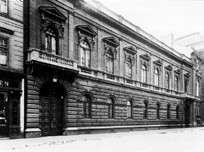
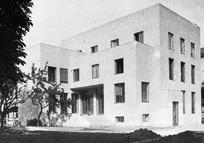
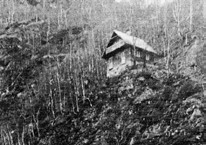
Following the course, I spent the last three weeks of summer in San Francisco, doing very little. I was staying at a friend’s place in a luxury high-rise downtown. I would wake up at a respectable hour, fold the sofa bed, make coffee, sit down at the kitchen table to write, then pass much of the day staring past my laptop at the bump of highway and vast swath of map visible through another window, this one as wide and high as the entire two-story apartment. I watched traffic. I watched neighbors. I watched fog. I conjectured with nervous frequency what actions to take in the event of an earthquake. As I was on the ninth floor, I reasoned there would be no chance of surviving a big one. By this light, there would be no real point in knowing what to do if one occurred. So these speculative commutes never culminated in the three minutes of online research that would have made them unnecessary. Instead, I applied my internet skills to less imminent, more fanciful distractions like how to move my life from an apartment in upstate New York to a marina in Marin County. I considered whether to store or sell my books. I priced boats. I checked airfares from San Francisco to destinations around the world. Technically, I was waiting for August to end, when my subletters would leave, when I could return to the East Coast, but I wasn’t counting days. I thought about time only enough to notice I wasn’t thinking about it more. I was a living cliché of boundless indeterminacy. I was a negligible speck in an arbitrary universe. I was a thirty-four-year-old woman looking out a window, thinking about the relationship between experience and thought. When I got back to New York, the first thing I did was unplug my clock. This detail may be trivial, in the absolute sense, but I’ll let it be read, because I can’t claim to know, and, anyway, it seemed meaningful.
This essay originated at the Banff Centre in Alberta, Canada, in 2011, during a six-week residency program called From the Toolbox of the Serving Library—the Serving Library being a non-profit artists’ educational organization I co-founded in 2010, along with Stuart Bertolotti-Bailey and David Reinfurt of Dexter Sinister, which publishes a house journal, among other art and education-related activities. The essay later evolved into a dramatic lecture delivered by an actor next to an endlessly looping film of several thousand distinctive shades of green, and this film, also called Why bother?, subsequently became an exhibition of its own. “Why Bother?” from The Bulletins of The Serving Library, 2, eds. Stuart Bertolotti-Bailey, Angie Keefer, and David Reinfurt (Berlin, Sternberg Press: 2011), 79–100.