Futures
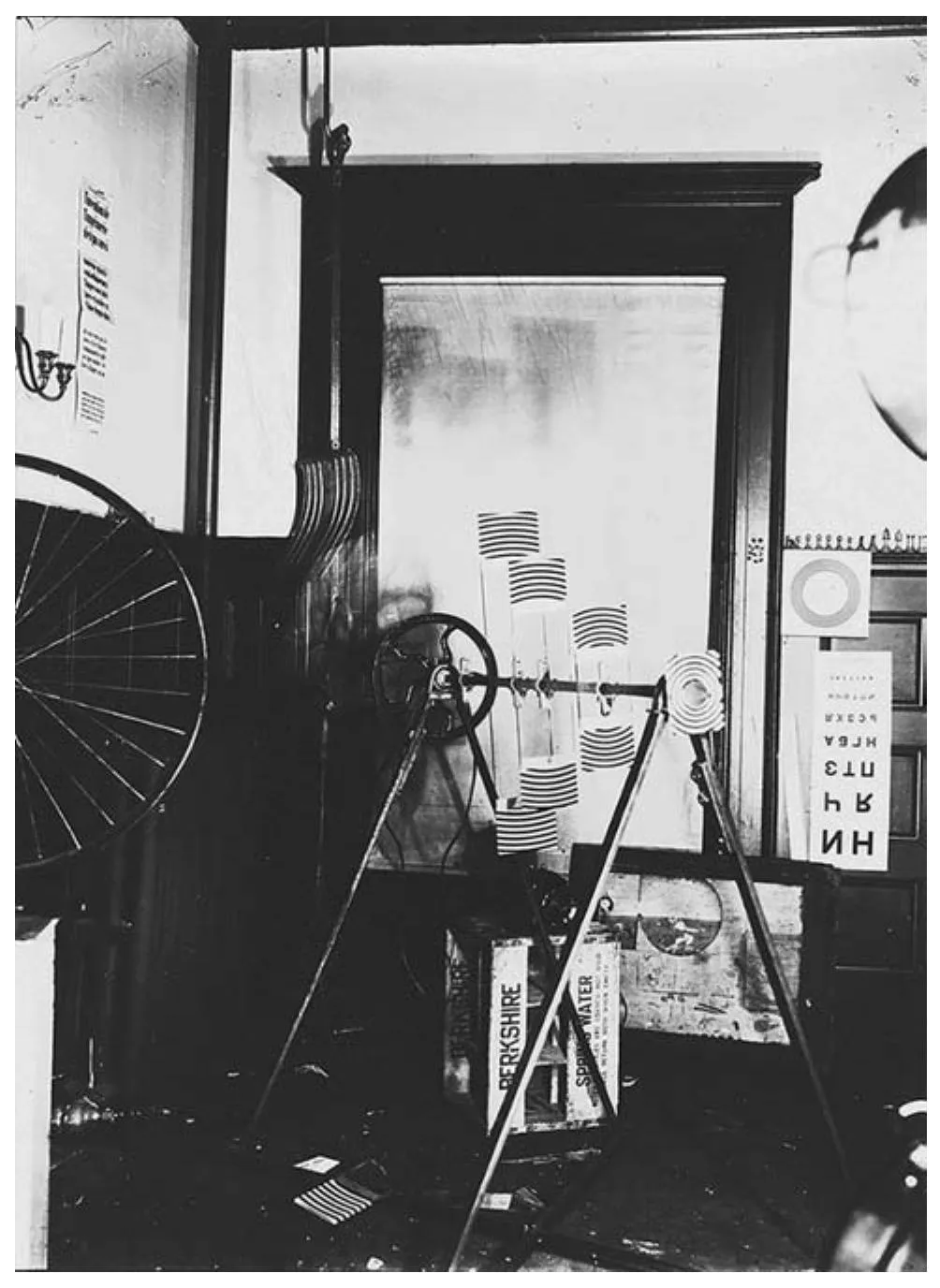
One of the first concepts I learned as a kid in art class was “value,” as in the difference between any two tones on a scale from light to dark.
The definition combined the vocabulary of hearing (tone) with that of touch (scale) with that of optics (light), connecting aural, haptic, and visual senses. Value was fundamental for observation, and for reflection. Form could not be discerned, or created, without invoking this source. Our job, as amateurs of the oil pastel, was to forget about drawing edges where we thought they belonged, and focus instead on fields, surfaces, relationships. Understand value, we were told. How things begin and end will take care of itself.
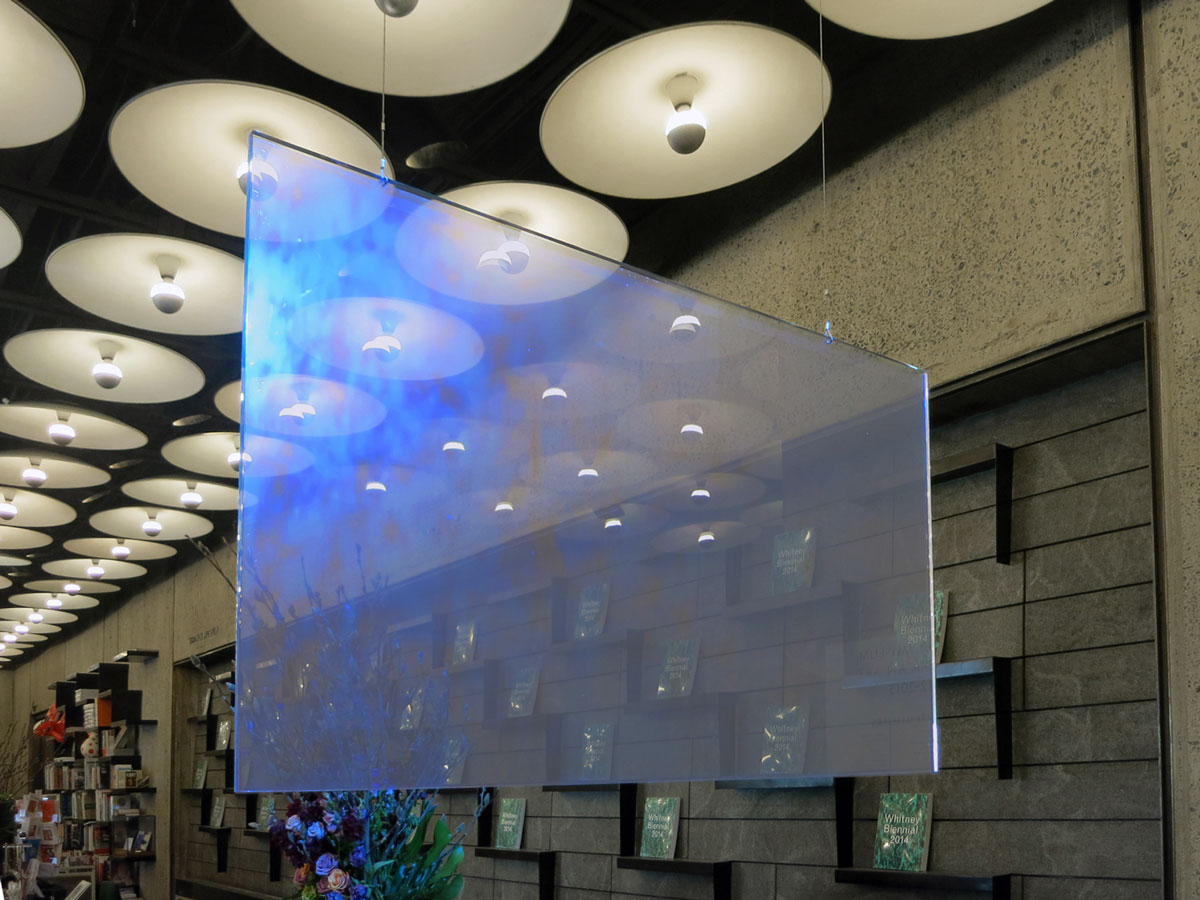
Decades later, I read “Where Do We Go from Here?,” a brief polemic Marcel Duchamp delivered a few years before his death. The “here” Duchamp plotted then was the surface of the retina, which, in his assessment, had been colonized during the preceding century by a succession of -isms, from the realism of Courbet and Manet through Abstract Expressionism and whatever others in between. Here, the profound work of artists “to bring to light startling new values which are and will always be the basis of artistic revolutions” had been neglected in favor of inconsequential debates over trivial distinctions between “representative” and “non-representative” forms. Stripped of its moral function to illuminate new values and unduly burdened by popular demand for “aesthetic satisfaction,” art had become “a ‘commodity’ … a commonplace product like soap and securities.” The “enormous output” of artists therefore amounted to the “enormous dilution” of artistic value—runaway inflation set off by a flood of counterfeit currency.
Duchamp made this speech during a symposium at the Philadelphia Museum College of Art in spring 1961. He was seventy-three years old. The United States was in the midst of what would turn out to be the longest economic boom in its history. The first of the postwar babies, who had grown up in this period of stability and affluence, were rounding the corner to adulthood and would soon be heading off to college—and art school—in record numbers. Meanwhile, Jim Crow laws were still in effect across the South, and military involvement in Vietnam was escalating. A disaffected fringe had already begun to protest what they saw as a blithe consensus mentality. Allen Ginsberg reported their nonstrategy as early as 1955: “the best minds” of his generation “threw potato salad at CCNY lecturers on Dadaism,” but the Beats’ antics didn’t inspire mass dissent. Plenitude was the pride and the anesthetic of the newly endowed middle classes. Duchamp concluded his talk by charting a course for tomorrow’s young artists through a “revolution on the ascetic level,” to occur at the edges of a “world blinded by economic fireworks.” Where do we go from here? It’s the sort of question people ask in the aftermath of a crisis, once the dust has begun to settle but before the air has cleared. “Underground”—literally out of sight—was Duchamp's answer.
Ascetic derives from the ancient Greek word for “monk,” as in hermit, as in askētes, which derives from the verb askein, meaning “to exercise.” Askein referred to athletic exercise in the sense of a rigorous and disciplined regimen to condition the body and mind. Today, the English word ascetic usually just means “self-abnegating.” An ascetic is someone who refuses sensual pleasure, often in pursuit of spiritual or philosophical ideals. The word’s connection to a body is connection to a body denied.
A friend of mine recently married the sister of a Buddhist monk. The monk had given up money and possessions and was living in a monastery, so he wasn’t able to attend the wedding. Instead he sent a message that was read aloud over a shoddy public-address system during the post-ceremony meal: “Lower your expectations.” At the time, this sounded like plausibly sage advice for a new couple, albeit an unusual recommendation to make during a wedding celebration. Expect less of each other, and you are less likely to be disappointed by all the ways you will inevitably disappoint each other. But some weeks later, I heard it differently: “Lower your expectations” may also mean, “experience is what you don’t expect.” So, “pay attention.”
I met with Duchamp’s remains thirty-five years after his call for an ascetic revolution, while I was living an ostensibly monkish existence during another apparent economic boom that would turn out to be one in a series of enormous market bubbles. At the time, I was attending an expensive college by way of financial aid that included some scholarships, but otherwise consisted of government-subsidized loans, work-study, and easy credit—not in that order. The operations department of the university art museum advertised one of the highest paying jobs on campus. I talked my way into the position, then spent nineteen hours a week there for the next two years, changing lightbulbs, installing exhibitions, and preparing artworks from the collection for loan to other institutions.
I had attended public schools before then, including one dedicated to the arts, which had been founded in 1968 by a handful of recent MFA graduates, the sort of people who would’ve had Duchamp on their radar. The concept was a little like Fame—the 1980s television series about an arts high school in New York City—if Fame had been set in central Alabama instead of a metropolitan hub on the global cultural circuit, which is to say it wasn’t much like Fame, except that students committed to an extended class day to develop a concentration in their respective artistic fields in addition to the usual high school curriculum. I passed an inordinate percentage of late-adolescent leisure hours poring over the school library’s collection of Artforum, vicariously acquainting myself with contemporary art’s greatest hits. At eighteen, my fix on Duchamp was accordingly half-toned and two-dimensional. That changed a few weeks into my first semester in college and the museum job, when I wound up underground, in the basement woodshop beneath the exhibition galleries, alone with one of his readymades—the snow shovel—In Advance of the Broken Arm. I was to outfit a shipping crate in made-to-measure foam so as to safely send the shovel off to some other institution. While this was not an especially interesting job in terms of the labor involved, three long afternoons with In Advance of the Broken Arm did expand the scope of my mental Duchamp to encompass the patently obvious: what had registered primarily as a disembodied idea, transmitted through images and texts in books and magazines, was indeed a thing. No “as-if” attached to the task of packing it. I was not performing an absurd and rather boring piece of theater. I was working for an hourly wage. And this banal material reality was supposed to be beside the point.
Don’t get me wrong; I’ve read the transcript. Duchamp’s readymades clearly articulate the enunciative paradigm diagrammed by historian Thierry de Duve—that the statement “This is a work of art,” uttered (or otherwise demonstrated) in the proper circumstances (say, art institutions like museums, galleries, and magazines) among anointed subjects (artists and other assorted audiences), confers onto the work the status of art, and that this status is henceforth the work’s only essential quality. The ritual makes the totem. Specifics are relatively irrelevant. Anything will stand (though some things will be easier to sell). Granted. But if that’s all there is, then why doesn’t the intrigue simply end there, behind the curtain, with all of us exposed as the sham wizards we are?
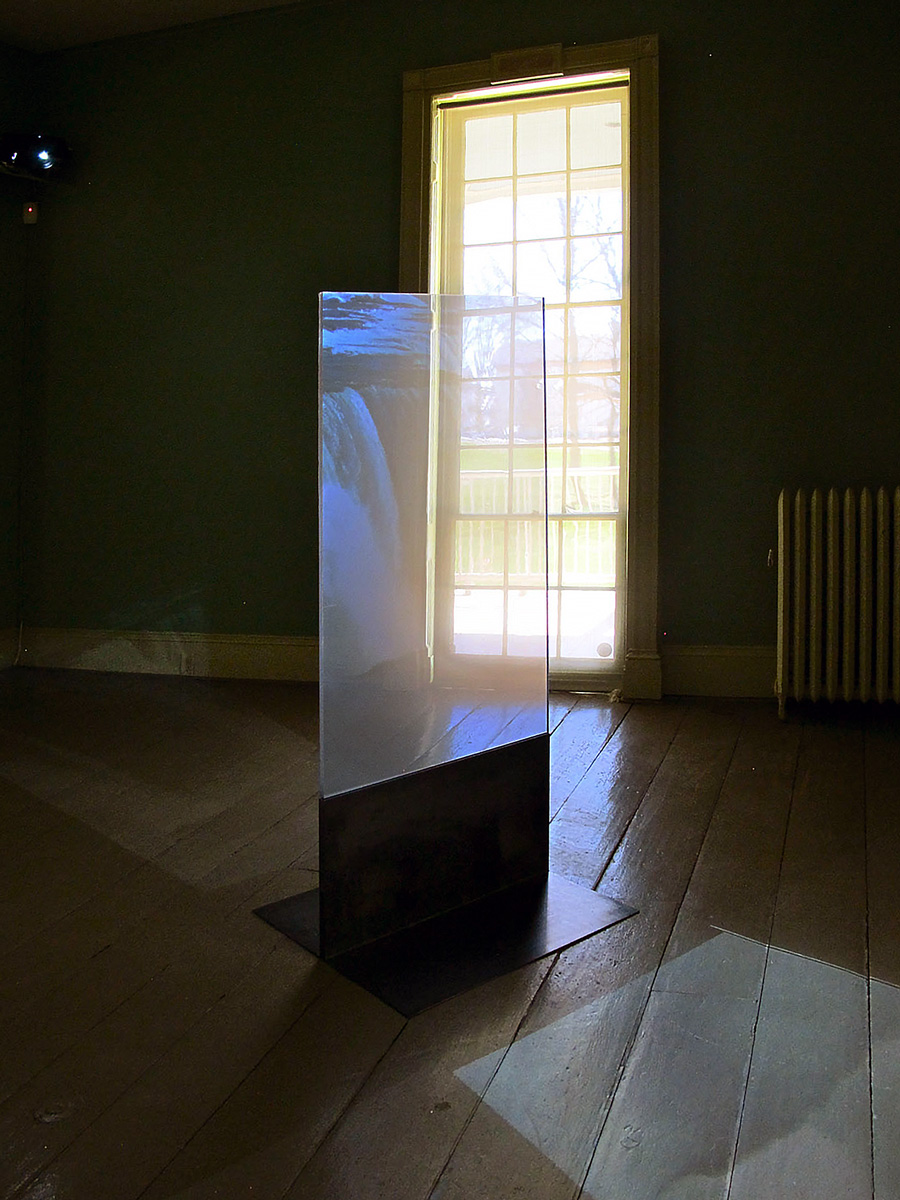
If you focus for a little while on something moving steadily in one direction, like a waterfall or a rotating spiral, then shift your gaze to something stationary, that immobile thing will briefly appear to move. Aristotle first reported the phenomenon, noting after watching a river that “things really at rest are then seen moving.” Lucretius caught it 300 years later, adding that things really at rest are then seen moving in the opposite direction. Neither philosopher’s account created much of a stir in his day. Ptolemy left Aristotle’s version out of his Optics; others cribbed from Ptolemy, and the idea disappeared from thought for almost two millennia, until the nineteenth century, when it reemerged in northern Scotland as the “waterfall illusion,” and in several other, unrelated accounts occasioned by the movement of trains.

The perceptual experience of the motion aftereffect is paradoxical. Stationary objects seem to move without changing position. Though the effect is known to involve multiple stages of analysis in different parts of the brain, it is not yet well understood, and the question remains as to why this “misperception of the world” has survived biological adaptation.
Joseph Plateau, a Belgian physicist, studied the illusion in the mid-1800s. He developed a special device for the purpose, a black disk with a thin white spiral line drawn from the center to the outer edge, that could be rotated at various speeds. If an observer were to stare at the moving disk, then look away, whatever she looked at next—Plateau’s head, for example—would appear to grow or to shrink depending on the direction of rotation. The disk, which other scientists frequently employed over the next half century, came to be known as Plateau’s spiral. By the time he described the motion aftereffect in 1849, Plateau himself was blind. His wife acted as his reader and secretary. His sister, an artist, drew his illustrations. (Are these details about how the work was done and who did it beside the point, too?)
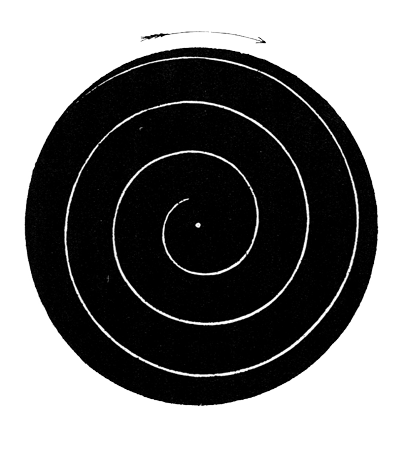
Since Plateau’s time, the field of neuroscience has matured. According to current research examining the minute workings of the brain, information processing occurs at a cellular level, and cells adapt to persistent stimulation. When you look at a static object, its horizontal contours stimulate detectors in your visual cortex for downward and upward movement, but since both directional sensors are equally stimulated, they cancel each other out, and the object appears static. However, if you look at something moving in one direction, perhaps downward, as in the case of a waterfall, for example, cells consistently stimulated by the ongoing motion will become fatigued and therefore less reactive. When you shift focus from the waterfall to a static object, cells that sense an opposite motion will be newly stimulated, and their signals won’t be effectively counterbalanced. The object will appear to rise. That is, cells develop expectations, and these expectations inflect perception. At least, this is the theory.
The motion aftereffect is an awkward reminder that thoughts emanate from bodies—an abiding source of frustration to thought, which would prefer a more predictable framework, one operating on less particular terms, less connected to specific befores and afters.
Page 201 in The Complete Works of Marcel Duchamp is a one-word chapter titled THERE IS NO SOLUTION BECAUSE THERE IS NO PROBLEM. The text reads:
Indeed
No punctuation follows. The word floats on the page. Indeed, the word couldn’t float without its oversize page. Even nothing needs something to point to it. And since, in the end, Duchamp defined a field of problems—something to do with value, something to do with movement, something about where to go from here—the absent punctuation in his Complete Works reads to me as an ellipsis. There’s always something missing in a model. Models are useful, even necessary, but wrong. Like edges. Every model we know today will be replaced over time. According to the enunciative model, the authority that confers the status of art draws its agency from the success of its own enunciation, not some exogenous source, not some underlying artistic “value,” whatever that might be. In other words, the structure is solipsistic. It thinks it is, therefore it is, and that thought is all the it there is. Keep your eye on the rotating spiral; the world begins to shrink.
Markets also tend to shrink when value is systemically indeterminate. Economist George Akerlof published a paper in the Quarterly Journal of Economics in 1970 called “The Market for ‘Lemons’: Quality Uncertainty and the Market Mechanism.” His subject was the problem of mistrust in markets. For argument’s sake, he describes a market for cars in which vehicles can be either new or used, and they can be good cars or lemons. New cars are likely to be good, but there is less certainty about used cars. The seller of a used car has more relevant information about its value than its prospective buyer. “Consider a market in which goods are sold honestly or dishonestly; quality may be represented, or it may be misrepresented. The purchaser’s problem, of course, is to identify quality. The presence of people in the market who are willing to offer inferior goods represented as quality goods tends to drive the market out of existence. The cost of dishonesty, therefore, is not only the amount by which the purchaser is cheated; the cost must also include the loss incurred from driving legitimate exchange out of existence.” In a market of lemons, the bad tends to drive out the good. Eventually, exchange comes to a halt.
Akerlof uses the lemons model to assess several real-world scenarios in which a lemon-market mechanism stifles market activity. He also describes counteractive, legitimizing institutions that address the problem of trust in markets. These include guarantees, brand names, and professional licensing, some of which operate within the enunciative paradigm. But the situations Akerlof describes—health insurance for the aged, the employment of minorities, and credit markets in economically underdeveloped societies—entail actual commodities and financial services, so the reputations of his institutional arbiters are ultimately kept in check by the quality of whatever they endorse. Quality may be uncertain in a lemons model, but shades of it exist.
The growth of published research on the motion aftereffect began to increase exponentially around 1960. Today, the total amount of research continues to double about every dozen years, in keeping with a general trend in scientific publishing. (This would be more remarkable if publishing technology hadn’t changed dramatically and if the population of research scientists hadn’t increased exponentially during the same period.) Financial markets also evolve with technological and social change. In times of economic growth, they multiply and become more abstract, not unlike the midcentury art Duchamp characterized.
For example: opportunities to purchase finished goods on the open market in Edo-period Japan were meager, so samurai were typically paid in rice. Not every samurai had a use for gold (what could he do with it?), but every samurai needed to eat. A koku, the amount of rice an average samurai was expected to consume in an average year, was the basic economic unit. When the harvest was good, rice was abundant, supply overwhelmed demand, and the trade value of a koku was relatively low. When the harvest was bad, rice was scarce, demand exceeded supply, and the trade value of a koku was relatively high. A good harvest could render a strapped samurai, whose pay in koku was worth less, while a bad harvest might render a strapped shogun, who would have to scramble to meet his obligations. The balance of power in society hinged on a single, unpredictable grain.
In the early 1700s, the merchant class in Edo was small. They enjoyed the status of an ugly, industrious insect, generally reviled but tolerated. During the preceding century, they had developed officially condoned, member regulated exchanges for rice, but also illegal exchanges, likened to gambling venues by some. At the illegal exchanges, contracts for a specific quantity of a standardized grade of rice to be delivered at a particular, future date could be bought and sold. These contracts were called rice bills. The market for rice bills provided buyers and sellers with a means to bet on the future availability of rice. These bets in turn affected future prices of rice.
Let’s say rice is trading low, the market is flooded, but you’ve read the skies or the seas or what have you, and you know a drought is coming. You might decide to buy contracts at a fixed price today for a few dozen koku to be delivered in six months, effectively placing a bet that rice prices will be higher in the future since the rice supply will be relatively meager. Even if you have to pay more today for six-months-in-the-future rice than for today rice, the amount you’ve paid today will be less than what others will have to pay for today’s rice six months from now, as long as your weather forecast proves correct. In the middle of the drought, there won’t be enough rice to satisfy demand, and the price will jump. You’re trading today to minimize risk tomorrow for rice you plan to own. Alternatively, your game might be to anticipate future price changes and to pocket profits from buying low and selling high. In that case, you simply plan to sell your contract in the future for more than you will pay for it today. In any case, if the market is reasonably efficient—which means that the same information about trading prices is available to all traders at the same time—then price volatility will decrease.
The opportunity to transfer risk (and rewards) back and forth by trading rice futures was sufficiently enticing to Edo merchants that many chanced arrest and punishment to participate in the illegal market. As their economic status grew, so did their political power. In the late 1720s, the shogunate first relaxed then lifted the ban on futures trading in Dojima, Osaka, at the merchants’ urging. The price of rice decreased and stabilized.
The first American market for commodities futures opened in Chicago in 1865. Futures for financial instruments developed in the 1970s. Options on futures—the right to buy futures in the future for a price determined today—were introduced in the early 1980s. Futures and options are known as derivatives since the activities of these markets derive from underlying markets. Investors use futures markets to hedge against risk from potential price changes in commodities they consume or to profit by speculating on potential changes. Buyers’ and sellers’ judgments about future prices will naturally be affected by new information related to supply and demand, which might include weather, war, or the price of tea in China, and their actions will then have a direct, stabilizing effect on spot prices in underlying markets. At least, this is the theory.
In fact, as financial markets have transformed over the past thirty-plus years—roughly, that is, in my lifetime—large commercial investors, with multibillion-dollar funds operated by professional financiers, have been permitted to take purely speculative positions in commodity futures markets. These investors may have little to no material stake in the markets. In other words, they are able to buy futures contracts at enormous volume, greatly increasing demand in the derivatives markets, without reflecting demand (or supply) in the physical markets. Unlike the Edo speculators, these investors do not resell their contracts. They profit by expanding the futures market while driving up futures prices (because the demand for futures increases). But the bubble they create in the futures markets in turn has a real effect on prices in the underlying markets. It’s as if perception of a motion aftereffect actually causes something in the world to move. Without the reality check of a material commitment to transport, store, and distribute commodities, pure speculation in futures markets furthers biologically errant values (not “merely” morally errant ones). Human suffering—starvation, for example—results. How did we end up here? And where, exactly, are we going?
Cultural value—broadly adjudicated in terms of aesthetics and morality by numerous institutions, such as law, that derive from these but are more readily discerned as political—mediates the fundamental incompatibility between markets and bodies, between want and need, between immaterial concept and the reality of material existence. Its essential relevance to civilization, often obscured within esoteric channels of artistic discourse, stands out against the stark opposition between market speculation and starvation. It is not autonomous. Where we are going, therefore, should not be toward incremental reform of a conceptual paradigm that precludes the reality of artistic value. The obsessive self-referentiality of purportedly autonomous art only indicates the collapse of exchange, a critical impasse winding an ever-tighter coil. Nor should we (or could we) head toward rematerialization; art has yet to dematerialize. It involves people, and none of us live outside material circumstances, bodies, and markets. Where we are going must be toward the realization that every horizon is a misperception—Indeed—not a solution. That is, we inhabit the surface of a sphere, not the path of a spiral; there is no underground, no edge on the world; there are only constantly changing relationships among values. If that’s a cliché, it’s one that hasn’t been fully incorporated into our common, bodily sense. The work of art can be the ongoing re-incorporation of agency. The work of art must be to lower expectations.