To Whom It May Concern
Water inevitably finds the most efficient way to get wherever it’s headed, which is always the same place, the place where gravity draws it, toward the center of everything.
Water flowing down a hill will run directly into an obstacle in its way if the path of least resistance leads directly to that obstacle. Suppose the obstacle is a boulder. Eventually, oncoming water will either undermine the boulder, or the obstinate boulder will succeed in splitting the flood of water into two smaller streams that gradually form trenches around the sides of the rock, hence cutting a more efficient path in the direction of gravity’s allure. Suppose the obstacle is not a boulder, but something you would prefer to keep dry. Let’s say it’s your house. To protect your house from runoff, you would need to perform water’s labor for it by digging trenches a few feet from the perimeter walls then laying a perforated pipe inside the trench and covering the pipe with loose fill. Water will seep into the fill, pass through the perforations, and zip down the slope via your pipe like a commuter on a high-speed train. This ingenious detour is called the French drain after its inventor, Henry Flagg French, who was born in New Hampshire, in 1813, and spent his adult life as a lawyer, judge, and public servant—he was even the national postmaster at some point—not to mention engineer-agronomist-inventor and author. In 1860, when publishing norms dictated that titles fully inform rather than merely entice their prospective readership with regard to a book’s contents, French published on the topic of his drain under the title The Principles, Prospects and Effects of Draining Land with Stones, Wood, Plows and Open Ditches and Especially Tiles: Including Tables of Rain Fall, Evaporation, Filtration, Excavation, Capacity of Pipes, Cost and Number to the Acre of Tiles. A few years later, French moved his family to Concord, Massachusetts, where they became neighbors of Ralph Waldo Emerson and the Alcott sisters, who reportedly cast a spell of enchantment over French’s son, Daniel Chester French, then a teenager, soon to become a highly esteemed artist and, eventually, the sculptor of Abraham Lincoln’s statue at the Lincoln Memorial in Washington, D.C. Thus, the French drain and the Lincoln Memorial, which have no symbolic coherence, have a great deal to do with one another. The first leads directly though not significantly to the second.
While directly insignificant relationships between objects, events, people, and thoughts are ubiquitous, they are almost impossible to discuss cogently. Insignificance operates like kryptonite against the superpowers of narrative. It weakens and may destroy a story. “Insignificant” is another way of saying “opposed to pattern,” is another way of saying almost nothing while still making legible sounds.
An aside on the French drain and Lincoln’s statue marks the end, rather than the beginning, of the thoughts to follow. The association dropped anchor in the front of my mind after a long period of seemingly fruitless meditation on the work of storyteller Spencer Holst, and serves as an analog to my experience of that work, a reading experience unlike any I can compare. I was delighted to be asked to write about Holst, even to write in a fanciful way to Holst in the form of a letter, some many months ago after reading just two short fables of his I found online, as one should be delighted to discover work with which she isn’t already familiar and to be given cause to make something of that discovery, but as the winter months wore on, my delight grew dimmer like the days. Talking about the work of Spencer Holst is like extemporizing on the relationship between draining the earth and cutting marble in the shape of a great man. The activity is surely possible, even supportable, but not necessarily sensible. Or maybe it’s more like writing about music, a fine idea that probably doesn’t do much for the music itself and definitely can’t be well understood without the music beside it. That’s because Holst was primarily a storyteller, secondarily a writer, while all we have left of his work is the page, which is like saying he was primarily a musician, secondarily an abstract painter, while all we have left of his music are his paintings. Writing and storytelling are not much alike. For one thing, a writer’s audience is imaginary at the time of writing, whereas a storyteller’s audience is a living, breathing, stirring, squinting, guffawing, booing, clapping presence. The storyteller is in live exchange with that audience, who will register and convey their degrees of boredom and captivation presently. And the storyteller’s audience is watching-listening, which is an altogether different activity from reading, one that uses altogether different perceptual tools. Spoken words come through bodies—moving, gesturing bodies—and voices, and are unique to their bearers’ existence and physiques. The written word, on the other hand, creates an illusion of permanence. It typically survives its writer, and can even appear anonymously. Printed words can, in fact, be destroyed or lost, but spoken words undoubtedly disappear as soon as they’re heard, without producing any illusion of stability. Holst’s legacy of words is a small body of very short stories skillfully erected but half-abandoned with almost no deference to posterity. What remains on the page is more like a tower of pebbles poised at the edge of a gorge than a timeless monument, or even a book. But don’t take my word for it. Allow me to quote Holst at length; here is a characteristic passage chosen almost at random:
It is something! these rare occasions—and this is one of them—when a fresh breeze blows in off the Atlantic and fills the streets of New York City so that an afternoon in June becomes the epitome of something, and something in everyone arises to the occasion.
Isadora Duncan. Martha Graham. Merce Cunningham. Not unlike those troops of previous eras that become sets of toy soldiers, whole sets of troupes of modern dancers now flood the Christmas toy market. It is noted with amusement and amazement—but without comprehension—that boys, as well as girls, like to play with the troupes of dancers, and that they are toys that boys and girls play with together. But note that significance: like the first step in a performance of a complicated dance it may mark a first sign, an initial intimation, a revelation in miniature of the peaceable nature of man—a noteworthy minor beginning of peace without end among men of all nations.
He builds a flamboyant chandelier that sets aflame stars at the ends of its arms, builds beauty with bits of cobalt glass that can tinkle in a breeze, and sends solid black shadows of trembling shapes and bright purple forms dancing on white walls, where crystals coalesce into worms of light and rainbow-splash from candles swinging in porcelain cups of fragile freckleware.
The Pocatello Idaho Potato Parade is led each year, not by a Queen, but by the King of Potatoes, carried not by a coach, but by white horses drawing a perfectly plain, open wooden wagon, perfect for the display of a gigantic potato.
Hunger of the fishmonger for a good steak is his motivation for breaking the law, for being a thief, so that he could sit in a regular restaurant, first having something strong in a small glass, before eating red meat, that would be capped by a beautiful giant Portobello mushroom.
Ordinarily, I begin a letter one of two ways, either with reference to an intimacy shared by my correspondent or with what would otherwise be the bottom line. The first mode of address applies to relationships of affection, the second to formal transactions. In this case, neither pertains; I don’t know Spencer Holst, and since one of us is dead, a transaction (or a reply of any kind) is a highly unlikely outcome. So I’ve begun instead by sidestepping and quoting. I imagine Holst would argue that a peculiar circumstance warrants a straightforward approach, beginning with the matter of beginning and ending there, too. A complete idea from him typically takes the form of a sentence or a short paragraph, like those above, or like so:
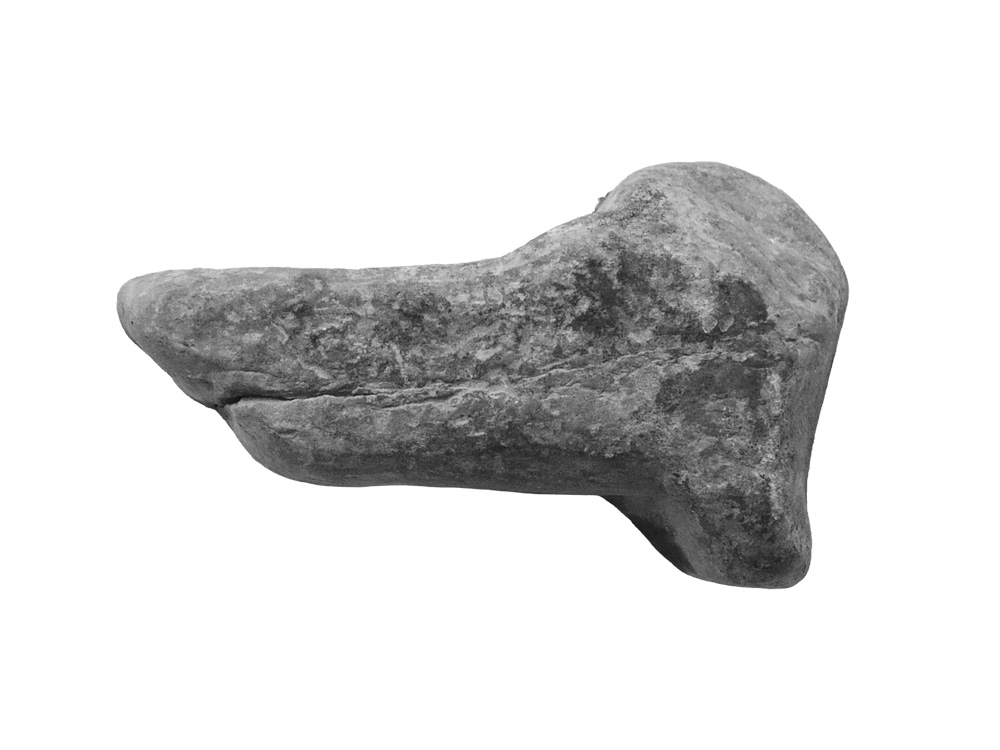
A boulder is transported a great distance on an Ice Age glacier which on melting drops the erratic traveler in what is to become a Massachusetts meadow, places it precisely atop a smaller taller rock, where it remains balanced for ten thousand years. During that time the surface of the bottom rock becomes completely covered with a thick mat of dark green moss, while brilliantly colored yellow, orange, purple and red lichen grow all over the larger stone.
If I were Holst, or more like Holst, I would simply begin again now with a fresh line or new paragraph on baseball or magic or the color orange, for example, without ever returning to reincorporate a Massachusetts meadow. (Holst: “With a perfect snap! he throws his fingerprints off his fingertips.”) I’m not much like him, though. I take after Orpheus, always peering over a shoulder into the murk behind me, trying to discern a figure there (“there” being Massachusetts in this instance, home of Holst’s traveled boulder and, incidentally, the ancestral French family), while Holst, who favors Eurydice in my analogy inasmuch as he is profoundly unavailable, eludes exactly that sort of glance. All of the preceding paragraphs are excerpted from a piece or a series of pieces (are they stories? essays? notes? texts?) called Balanced Boulders, subtitled “384 Unconnected Paragraphs In Six Parts.” According to Holst’s notes to the illustrations that accompany the edition published in the collection Brilliant Silence, which are photographs of rocks improbably balanced atop one another made by an artist and friend of Holst’s, George Quasha, “… Axial Stones have a reality that is far beyond what can be conveyed by pictures.” Quasha’s photos of balanced boulders are the visual corollary to Holst’s printed pages.


Deep in the woods, a lost hiker or hunter is surrounded by food and other supplies necessary for survival, all free for the taking. But how many know to recognize the available resources? How many have the skills to identify nutritious, fatty insects? How many can say which vegetation is edible and which will also prevent scurvy? Who can make a compass from a needle, the small amount of oil wiped off the surface of her forehead, two blades of grass, and a little pool of water? (Who happens to carry a needle on a hike?) With only a bit of relevant knowledge, one can survive alone in the wilderness indefinitely. Or one can perish rather quickly from ignorance. As Holst’s reader, I felt at first like an ignorant hiker, physically fit but mentally unprepared. No map of his terrain, nothing of the sort I’m accustomed to picking up automatically from other writers, would impress itself upon my brain. I could take in only one or two pages at a time before growing tired.
He makes a turban out of a patchwork quilt and wears a bulletproof vest in order to walk without injury into a Texas hailstorm. His toes sticking out of his sandals are the only vulnerable targets for the walnut-sized hailstones, but soon he has four broken toes—on each foot—and he stumbles in pain, falls to the ground, and finds it impossible to reach the other side of his backyard to save the chickens from certain death.
I would not manage to save the chickens, either, if my chickens were narrative coherence and emotional registration.
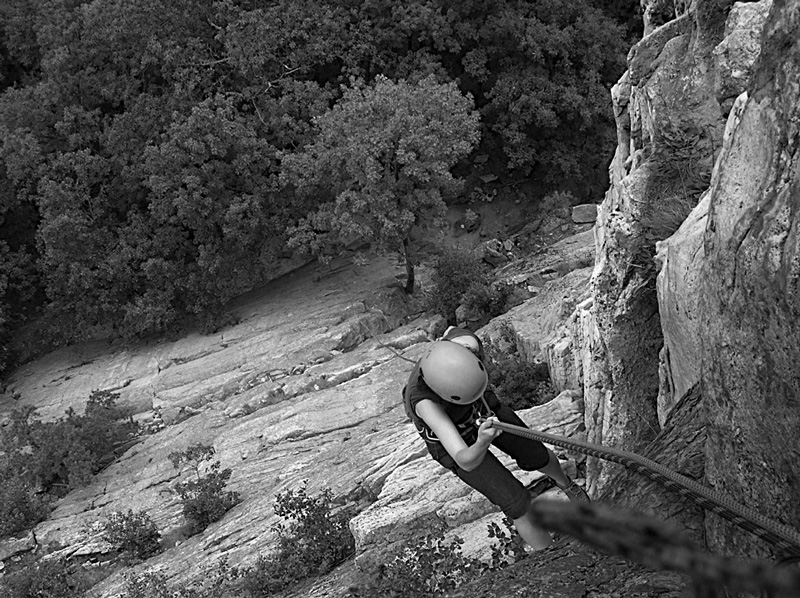
I spent two days rock climbing with a handful of friends once. I hadn’t initiated the trip or made the arrangements, so I didn’t have a clear sense of what was in store. In my naiveté, I anticipated a two-day hike interrupted by an occasional boulder, the way an occasional water feature might interrupt a pleasant garden path, adding a coy element of “safe danger” to an entirely safe experience. Imagine my surprise on day one when the hired guide of our small group, a man named Bill, distributed helmets and harnesses and, after tethering us to a constellation of large rocks and double-checking our rigging, instructed us to step backwards off a cliff the height of a townhouse. By the second day, we were following Bill on what is called a “multi-pitch” climb up the side of a mountain wall more than 200 feet high. In this case, we were tethered to one another. Bill went first, inserting steel pins into cracks in the rock face, through which our safety cables were threaded as we trailed behind him. Not quite halfway up the cliff, my panicked psyche split neatly in two. I began a conversation (aloud) between a frightened child and a coaxing parent, fully inhabiting both roles at once. It was necessary to talk to myself as this pair in order to progress upward at all, an inching I achieved only by way of minute movements, every muscle of my body rigidly flexed in an effort to defy gravity and stick to the mountain.
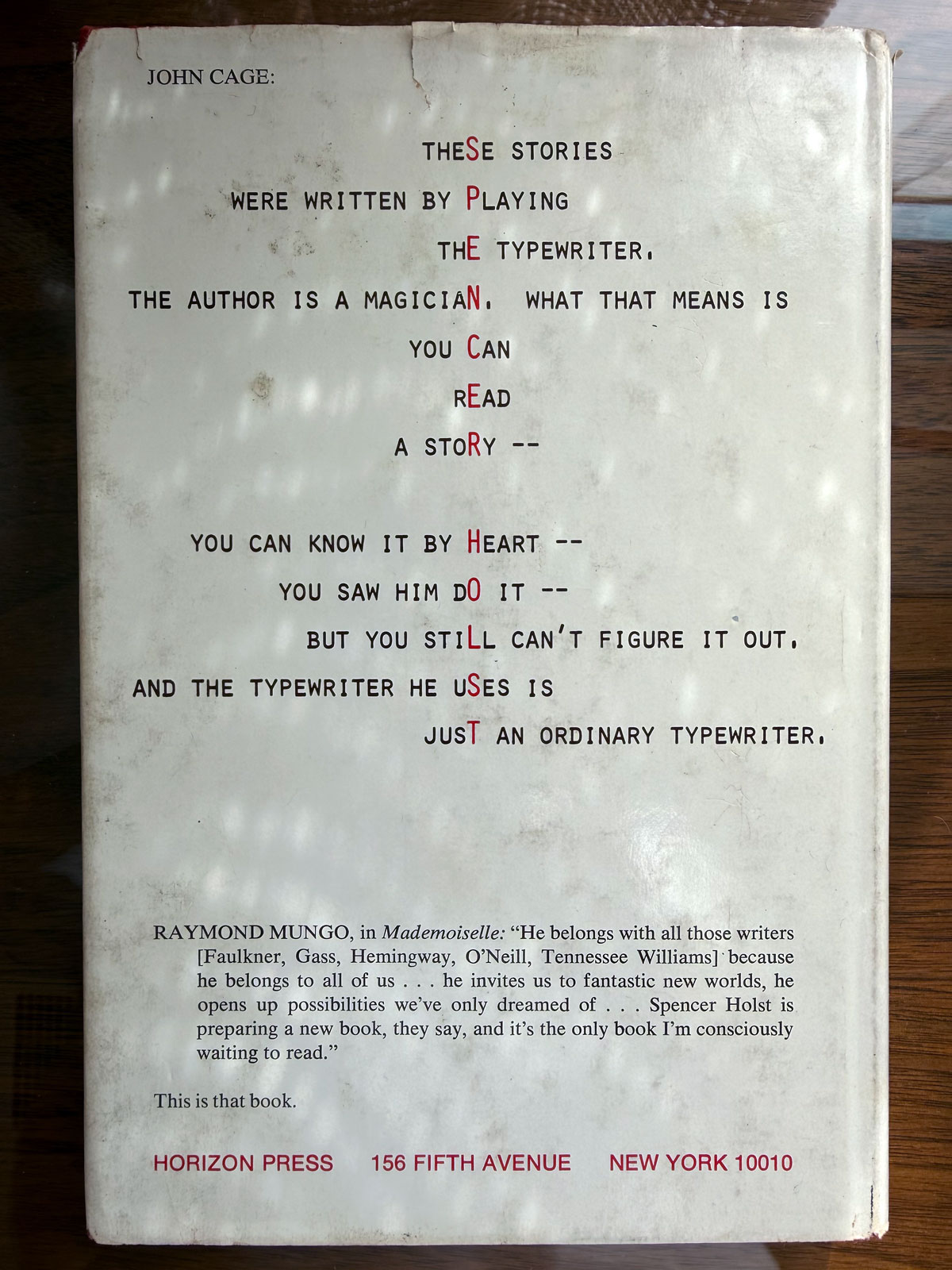
For a stranger who will read aloud, and to one who listens—this book is dedicated; but then … to such a pair all of literature is dedicated.
Exoskeletal and supremely focused, I became an insect, albeit a self-aware one, which is to say an utterly terrified one. I spent most of the day aquiver, despite the unmitigated late-summer sun overhead. Intellectually, I knew my safety equipment could be expected to save me if I were to lose my footing. Physiologically, “safety equipment” was just another string of meaningless sounds. At the top of the cliff, Bill, who had begun climbing as a teenager almost three decades earlier, informed me that I would be rappelling down the rock, and that the first forty feet would be a straight descent, since the rock face would be too far from the edge of the precipice for me to reach with my toes. Bill barely spoke, but he had a solid knack for timing a delivery. In fact, his entire pedagogical approach amounted to a spare and rather elegant form of information control. I asked if there were some other option, like walking down the backside of the mountain on foot. Bill squinted into the distance, the opposite direction of the backside of the mountain, and paused for effect, as if he were considering the possibility, though he was probably thinking about something else. He shook his head, “No trails. It’ll take you two days.” No invitation to further discourse followed. A minute later, I pushed myself away from the mountaintop into an invisible net of thin air and trust, well above the tips of the tallest trees below. There, spinning 360-degrees on a thread at the start of an anticipated freefall that never occurred, I finally exhausted my capacity to fear the circumstances, and gave over instead to the exquisite, effortless pleasure of floating in the part of space-time that extends infinitely before the end of our mortal lives. The ensuing endorphin high lasted nearly two weeks, during which time I seriously considered decamping to the mountains to take up the sport full-time, inasmuch as I was capable of seriously considering anything at all from that ecstatic state of mind and body. What I experienced that day was a kind of learning that couldn’t be anticipated or taught.
The turtle paddles upon a pond staring up at a crisp crescent moon in the deep blue sky, its neck stretched out into the air, and then it dives down and swims along the gravel bottom among the fixtures of the fish, among those uncanny pairs of stones, one balanced on the other, that sit in the sand like underwater furniture—the whole scene being the set for a Lincoln Center dance concert in which my reader takes the lead and dances the part of the turtle, the author being your audience.
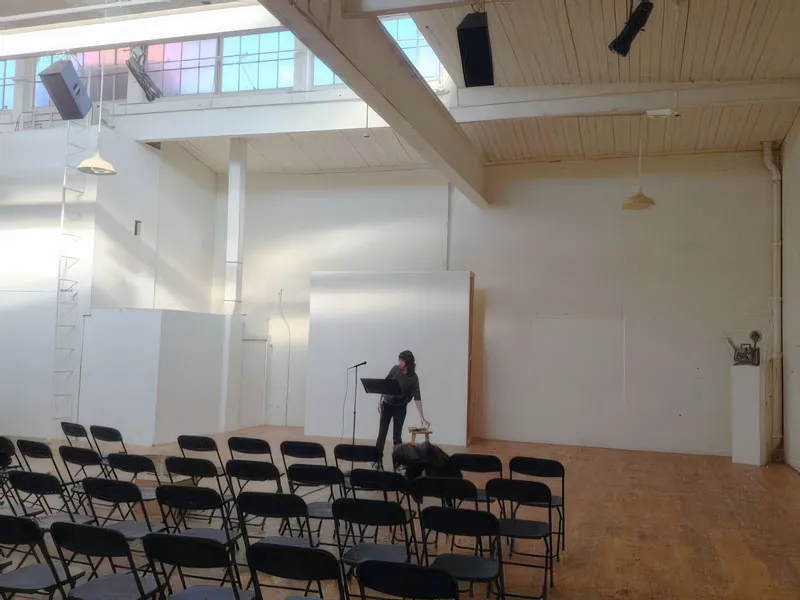
Gravity is the medium of dancers. They inhabit its truth with acute bodily awareness. I wrote to renowned choreographer Yvonne Rainer about Holst after learning from a show bill in a New York archive that they had worked together. “Dear Yvonne Rainer, so-and-so gave me your email address so that I could contact you regarding Spencer Holst.” She replied immediately to say she couldn’t remember exactly how she met him, but that he “freely gave” permission for her to use two of his texts in a 1963 performance at the Judson Memorial Church of a piece called Terrain in which six dancers combined recitations with movement in a series of solos. That was fifty years ago. What did he sound like, I wondered. How did he speak? How did he move?
He was a very short elf-like man. I was drawn to the whimsy of his writing. The recitations ran independently of the dance movement but occasionally, and fortuitously, converged, as when the dancer uttered the lines “My father told me that he remembers when he was a child that my great-grandmother used to bake huge round cookies, and no matter what animal my father named, my great-grandfather could quickly bite the cookie into that shape.” Naturally, at that moment, whatever “shape” the dancer embodied mimicked the words.
I learned from Rainer that Holst’s small body of short works matches what was his body—not as frivolous an observation as it may seem, considering his predilection for characters whose physicality or physical predicament conveys all there is to know about their stories, as in, “It’s hard to hold a hammer with your arm in a sling while carrying a gong during the rush-hour on the subway in Tokyo.” Characters don’t do much talking in most of Holst’s tales. Instead of telling, they are themselves told, which has the knock-on effect of turning elements of a scene into characters, as well, since a house or a tornado or a fish, like a man, is each built of the same basic material, and finished from the same palette, as in, “The bloodthirsty macaw that killed raccoons spoke Dutch.”—a personal favorite from the category of preposterous stories composed of fewer words than the category description itself.
Occasional, fortuitous convergence; whimsy; what you remember as a child: are these synonymous? In a memory that may be a dream, I am walking through shady pinewoods behind my grandparents’ house when I come upon a circular clearing colored by bright warm sunlight. That’s the whole story. I am walking in a place I know well, the light changes, I’m in a place I haven’t been before. End. This memory comes to mind with some frequency, though I can’t be sure whether it appears once every few weeks or once every few years, only that it returns rhythmically from wherever it is lodged, and as it does, it marks a tempo too slow to track. The vision—and it is a vision, nothing more, nothing less—is as uneventful as it is vivid.
Here’s another Holst story: “When I write, I worry about what things mean, but when I paint, it’s just dab … dab … dab … dab … ” I don’t believe it. It isn’t evident that Holst worried much about what his stories meant, for one, though he may have worried plenty over their syntactic arrangement. His phrases and paragraphs are carefully formulated, but they seem to mean only as much as visions. That is, they simultaneously mean plenty and not much at all, in the way of riddles and koans. Too, words are dabs—fingerprints with a shape and color of their own, independent of a writer’s conscious intentions or worries. In the case of a storyteller whose word was primarily embodied in voices, gestures, and ears, these prints are even more visceral than their typographic counterparts. They smudge and all but disappear when the voice stops and its audiences disperse, forget, and die. The same words may remain on a page, bound between covers, sorted on a shelf, but they do not adhere as texts so much as scores. They lie fallow for bodies to revivify.
I searched for Holst’s fabled voice, but discovered only that a few questionable tapes exist beyond reach in an archive somewhere in Texas. The single audio sample I wrangled from the Internet was of a 1972 performance from poet Jackson Mac Low’s Stanzas for Iris Lezak that involved multiple readers and noise-makers, one of whom is Holst, though I don’t know which. His sound and intonation match either a nasal-inflected security guard type, or a newscaster from the age of Edward R. Murrow, or a plaintiff’s lawyer in a courtroom drama, though none of these options match his elfin physique. Perhaps he is the speaker who comes in close to the end—the mellow middle tone with a barely detectable lisp, whose delivery conveys a paradoxically disconcerting and soothing immediacy, rather than an overtly dramatic persona. The voice belongs to a stranger who leans over unexpectedly to say something in your ear, but who finesses the invasion so smoothly that your defenses aren’t provoked. I could contact one of the other, still-living voices to ask who’s who, but I’d rather let Holst bounce among the possibilities, while remaining approximate, indefinite.
Although it’s on the edge of my consciousness, although it’s on the tip of my tongue, I know it’s gone forever. Last night I awoke several times with the same dream—on a blazing desert I heard a lovely voice pronounce the title for this book, but now I can’t remember it and I know I never will. On a blazing desert I’ve been deserted by that voice, and must now be satisfied with the desert’s brilliant silence.
A few nights ago, I dreamed a beloved aunt recommended that I dye my eyebrows pink. She had done that, herself, in my dream, and the look did flatter her. I thought she was the most beautiful woman I had ever seen, and I told her this, which is something I’ve heard small children tell their mothers. They always mean it. The most-ever happens every day when you have almost no experience. Each encounter with a new most feels magical, in a way that is specific to early childhood. That same stock of magic dust coats Holst’s stories, even when they’re not strictly about magicians: “If you’ve never swallowed a gumball you won’t know what I mean.” Or—
He built his house over the elevator shaft of an abandoned salt mine, and in his house there was a small room whose only window was a trap door in the floor. He was a collector of cymbals, and whenever he got hold of a cymbal he would drop it down the shaft, and listen to it echo as it fell. He was a writer like me.
Anyone can describe gravity’s effect. Few can convey it.