Found Wanting
“Are questions of purpose or urgency necessitated or afforded by the current state of contemporary art in relation to economic, political, or ecological conditions?” he asked, adding that responses should be “1400 words” to allow for adequate space to develop “a position.”
To need something badly—an organ donation, let’s say—is to need it urgently, whereas to want something badly is merely to really, really want something the way kids in stores desperately want brightly packaged things displayed on low shelves. You cannot urgently want anything the way you can urgently need a heart transplant. It is possible, on the other hand, to desire what one needs. Conceivably, need is the basis of all desire, in which case want and need may indeed be imagined as a continuum. Practically speaking, though, to meet one’s needs is essential to survival, while to fulfill one’s wants is just very nice. That is, want pertains to desire as need pertains to survival. And since survival relates directly to mortality, so, too, does need relate to mortality. Urgency, then, has something more to do with avoiding death than it does with pursuing desire. “Urgent” means almost too late already. Urgency is a state of duress.
Tragic drama necessarily entails urgency. Hence the disproportionate representation of cops, soldiers, doctors, armed criminals, terrorists, psychopaths, and vigilantes in film and television productions. Sports events, too, construct a theater of urgency—figure skaters, like stunt performers, tempt gravity, fate, death. Within the acknowledged bounds of fiction and games, the threat of imminent danger is evidently thrilling to watch. There, entertainment equals the difference between urgency and its suggestion. (An air raid in a dramatic film represents urgency; an air raid in a news video documents it; an air raid above my head or yours is it. You and I are likely to remain seated during the former and to be moved by fear during the latter. One might also be provoked by a depiction of urgency to respond with significant action—a petition, a protest, a poem—but that response would be an inspired choice, not a reflex.) An urgent question demands an immediate answer, some form of “do” or “die,” just as an urgent issue requires action or else it isn’t actually urgent. Thus, urgency tends to simplify matters—there are no options to weigh, only imperatives to abide. Does it follow that circumstances that force decisions are preferable to those that afford choices? The anxiety otherwise attached to setting priorities may be wholly relieved by the insistence of an urgent need—crisis evokes a kind of euphoria for some—but a state of sustained urgency is a hell of a place to live. People who settle there can look forward to shortened life expectancy, a fact that should serve as a warning to anyone who hankers after urgency, “Be careful what you wish for.”
The anxiety otherwise attached to setting priorities may be wholly relieved by the insistence of an urgent need—crisis evokes a kind of euphoria for some—but a state of sustained urgency is a hell of a place to live.
Ten years ago, I wandered into an exhibition at the Metropolitan Museum of Art called Art of the First Cities: The Third Millennium B.C. from the Mediterranean to the Indus. It wasn’t a particularly well-publicized show, and there was nothing ostensibly urgent about the ancient artifacts on display, but the year was 2003, the place was New York, and the political context was the onset of what would ultimately become a long, extremely violent, and destructive U.S. military occupation of the region represented by the exhibition. Considering the lead-time involved in organizing anything on an institutional clock the size of the Met’s, the show’s prescience was probably a fluke. Nevertheless, Art of the First Cities assumed incidental significance against the backdrop of news media propaganda that had created a caricature of place and people from the Mediterranean to the Indus, emphasizing fundamentalism, oppression, exploitation, anger, and sand to the neglect of fertile minds and resources, and seminal literary, philosophical, scientific, and technological contributions to world civilization. As a spectator, I did experience a feeling of urgency at that show—I remember thinking, “I must remember this”—but the urgency welled in me not as a museum patron at an exhibition, rather as a witness of false consensus, against which the First Cities exhibition, fastidious and self-assured as any at the Met, stood out like a glaring error.
Art itself isn’t urgent, it’s important. Importare: Latin, “bring in.” In contemporary usage, important means consequential. The work of artists, curators, publishers, and anyone else involved with the institutions of art is to bring within its purview that which they deem to be of consequence. Consequently, the form they give their work indicates what they value, how they choose. By contrast, to desire urgent circumstances is to desire not to be responsible for what and how, rather to find oneself compelled.
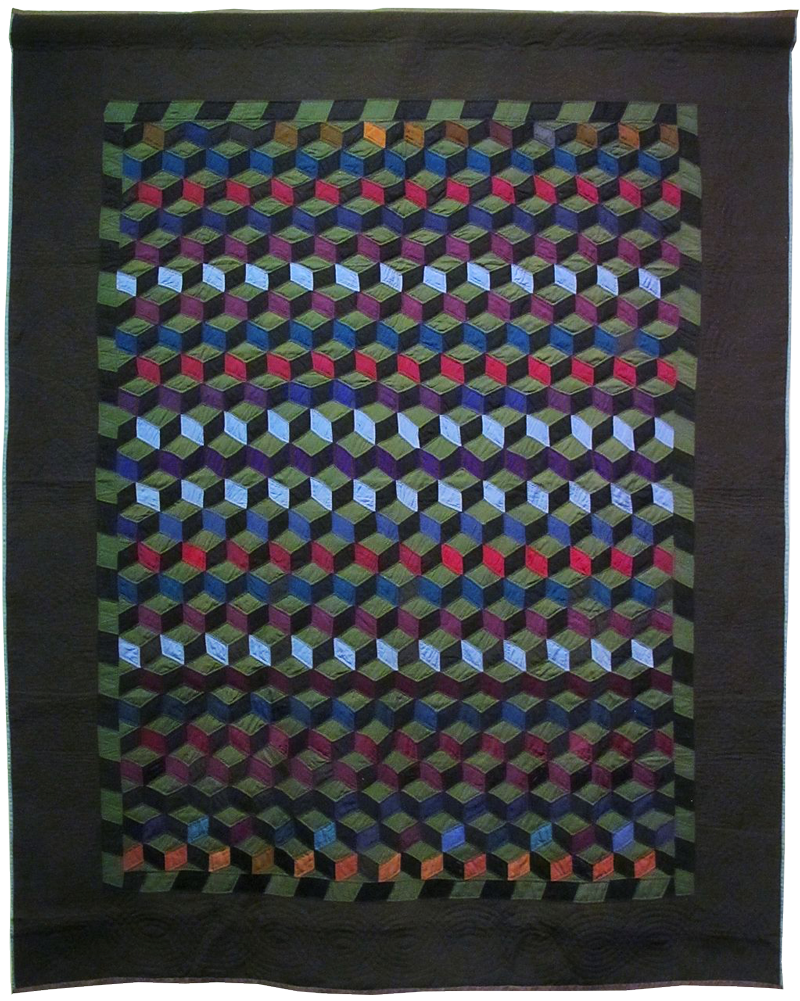
Someone asked me recently whether I could recall the first time I was affected by a work of art or an exhibition. I do remember learning to read. I remember the special intensity of reading fiction when language was new. And I remember learning in a first-grade drawing class that eyes sit somewhere near the middle of the head, not at the very top, a fact that surprises me still. The first exhibition I remember seeing occurred around the same time I discovered language and the rudiments of anatomical proportion. It was a touring show of Amish quilts that passed through the art museum in my town. The Amish, a Christian sect committed to communal, agrarian living, reject electricity, motorized vehicles, birth control, military service, and Social Security. They drive horse-drawn carriages and wear simple, dark clothing reminiscent of American pioneers: ankle-length dresses and bonnets for women; long pants, vests, and flat-brimmed hats for men. In large part, they preserve the habits and mores of their eighteenth-century Swiss-German founders, including exquisite handcraft. Amish quilts, often made of the same violet, indigo, and madder colors as their clothing, are, however, startlingly graphic, somewhere between the black-on-black paintings of Ad Reinhardt and the cubic neon landscapes of the video-arcade game Q*bert. What I remember best about the exhibition, aside from mental images of particular quilts that deeply impressed me, is the explanation I was given as to why every regularly patterned quilt contained a conspicuous deviation—an error. “That’s to let God out,” I was told. What is this god, I wondered, and what would happen to it if there were no mistake? What kind of fallout are we talking about in the event God gets stuck in a quilt? I was too intimidated to ask. I accepted that a perfect quilt would be an affront to the gods and internalized that whatever warranted display in museums rivaled divine perfection. Now, when I consider exhibitions, I bounce between two poles. At one extreme, I wonder, “why in the world has someone done this, when anything at all was possible?” while at the other, I perceive “all the world is here, in this,” but my axis is subject to all sorts of vagaries, from time to weather to war. Sometimes it bends round, and the two poles meet to form a circle.
At one extreme, I wonder, “why in the world has someone done this, when anything at all was possible?” while at the other, I perceive “all the world is here, in this.”
William H. Gass writes about awareness as a sensation that floats along a circular path between sources—the head, the stomach—and objects of attention:
Our own awareness, too, is always being drawn toward its objects, as if it were being sung to by sirens, at the same time that it’s withdrawing, in the company of the cautious self-regarding self, into the safe citadel of the head; unless, of course, desire is doing the driving, for then the same sensation that is sharply focused on the being of another (an exposed chest, a piece of moist cake) will find itself inside of hunger’s stomach. 11 William H. Gass, “The Book as a Container of Consciousness,” from Finding a Form (New York: Alfred A Knopf, 1996), 338–39.
The awareness Gass describes shifts between mind and middle, from meandering want to direct need, from airy connection to sharp focus. It is semi-autonomous, stretched between choice and compulsion, voluntary will and involuntary attraction. When compelled by the urgency of hunger, awareness “will find itself” somewhere, the way a drunken passenger awakens to find herself delivered to a place she didn’t expect to be. To want for urgency, to find oneself wanting to be compelled, is to have already surrendered one’s awareness and, with it, one’s agency. The point of importing—the point of bringing whatever one chooses to bring into public purview, thereby making it important—is to continuously redraw the balance between choice and compulsion, desire and need, lest the stakes for participation in public life rise to survival (urgency) or fall to nothing (irrelevance).