Good Faith After Bad
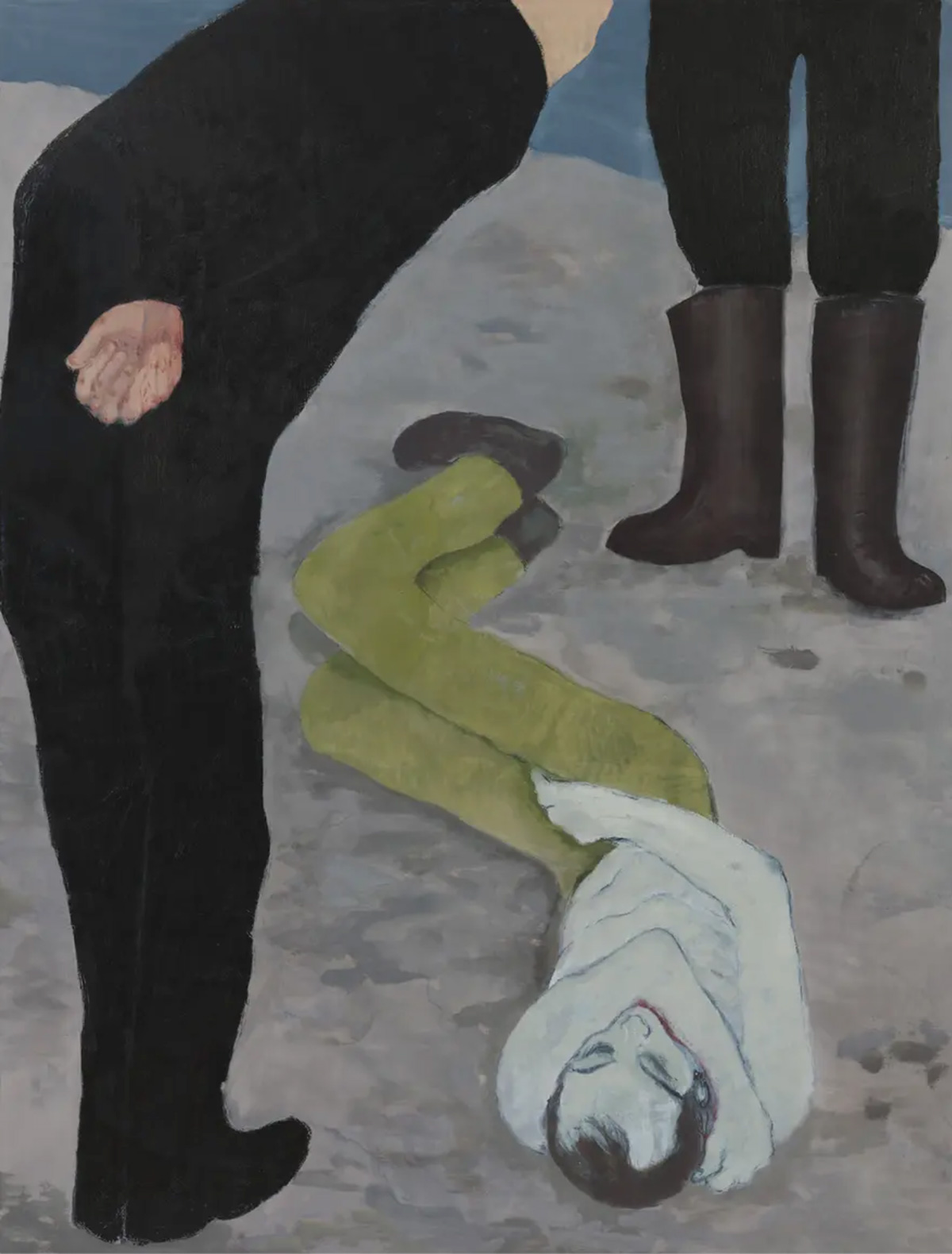
We are standing over a fallen man a few feet behind two other observers in dark clothing, the finer details of which we can't fully discern, though the one farthest from us, whose imposing posture we glimpse from the waist down, wears martial boots, while the one nearer to us is elegantly dressed in black civilian suiting and matching shoes, which merge like night shadows to form a single, opaque shape.
For SANYA KANTAROVSKY
This nearer man bends forward at the waist as he peers down to examine the fallen figure, his pink hands politely clasped behind his back. He has adopted the pose of a disingenuous elder humoring a small child, as if to underscore his dominance over the man on the ground by literally disarming himself. Meanwhile, the lain man, shirtless and raw, turns blue with cold. He pulls his knees in and wraps his scrawny arms around his exposed head and torso, exhibiting the full-body cringe of an addict entering the throes. Whatever may have come to pass before our arrival on the scene remains unclear, though, of course, it's really too bad about the whole situation, isn't it? We scan the blue man's receding, unkempt hair, his skullish face, and his one visible nipple with the same effete detachment as the guy in the inky suit. And why not? We know very well how paintings work. This fallen "man" is only a figment. He doesn't see us, and we don't owe him anything.
Then we are back in the little nowhere room again with the unlovable child. Either she is quite large, or her short-legged stool is unusually small. It's impossible to tell with no other points of reference in this space, which isn't indisputably a space, either, rather a brusque wash of thin strokes behaving like dim light in a dirty room, darker in one upper corner and brighter around the toddler's head. That is, she could be a toddler. She could also be an old woman who feels like a child, and not in a pleasant sense—the girl is full of woe, her eyes fixed to the floor with a pensive shame that belies her tender age. She was probably born on a Thursday. And now she will live out her days here, contemplating her misfortunes and missteps for as long as the painting survives, most likely until she is very old, indeed. But it's impossible for us to pity her. We have nothing in common with that submissive wretch, who is actually just a few hundred daubs of paint. No one is pretending otherwise.
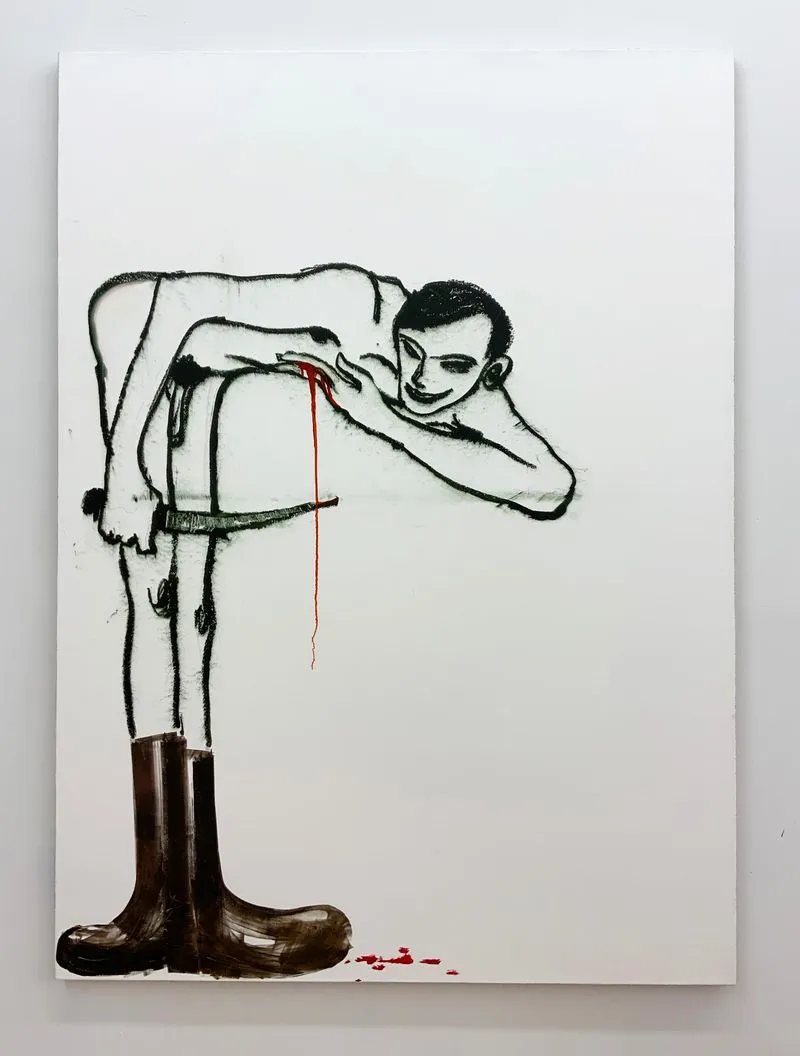
Over there, two youngish men on separate canvases hail from the same bright, blank world. They are comparably lithe and smug, like brothers or accomplices. One crouches on a knee as he mounts a swirl of thick, earthen paint, looking out from under his brow with the ready stare of a predator. The other, naked except for a pair of shiny boots (those boots again!), has apparently stabbed himself with a karambit and is bleeding a long line of cherry paint, a few drips of which have already collected at the bottom of the frame. He looks off in the same sidelong direction as his twin on the mound, grinning with evident delight and possible malice, though, as far as we can tell, his self is his only target. Apart from the blood and their minimal costumes, the two figures are primarily outlines, broadcasting to us that they are drawings as much as characters, as plain-spoken as they are dubious. They taunt us for our credulity—an act of aggression no mere picture should manage, as far as we're concerned.
"Who do you think you are?" isn't necessarily a rhetorical question. The words don't insist on landing like a maul, but the line's usual purpose is to put the receiving party in their rightful place: you certainly are not whom you seem to think you are, and you certainly are not entitled to behave as you have, and the speaker is obviously equipped to judge. Furthermore, if your self-perception were properly aligned with the speaker's righteous assessment, then you would know better than to have committed your (alleged) transgressions. "Who do you think you are?" signals disdain. It implies the questioner's superior surmise while admitting their unwillingness to persuade us of their position on the merits. It also imposes a logic of bad faith, as it precludes the possibility of a good-faith reply by discrediting our ability to truthfully represent even our own mind. But what if we know ourselves to have been falsely maligned? What if who we think we are is, in fact, "misunderstood" and "grossly mischaracterized"—how then can we, and, moreover, how then should we answer the other, supposing we intend to restore good faith to the conversation? This question invokes the political conundrum of our polarized era, when the grounds for ordinary social trust are evidently eroding in all directions. And it is a question that a new group of paintings by Sanya Kantarovsky seems to raise.
Kantarovsky's paintings are good faith representations of bad, which demonstrate, paradoxically, that there is no such thing. That's because bad faith constructs rely on oversimplifications, eliding difference and specificity to substitute one thing for another: a straw man for a disputant; a category for an individual. Therefore, bad faith representations tend to collapse under good faith consideration—i.e. scrutiny—that niggling executor of nuance, complexity, and specificity. So, what at first appear to be compelling scenes with literary aspirations soon disassemble into brushstrokes and pigments, as supposed faces, bodies, and settings, when probed by our attentions, refuse to state for the record their precise significances. Wait—what has happened here? Is it still happening? Are we bystanders? perpetrators? victims? But, oh—never mind! Aren't they wonderful?! Just look at how the artist has depicted the soldier's fingers gripping her calf. And check out those nice, moody hues in that one with the severed head … Like all disobedient artworks, Kantarovsky's paintings formally reconcile purportedly irreconcilable points of view, simultaneously toeing the lines of conflicting agendas, obliging audiences to grapple with unanticipated messes. They prod us to scrutinize anew the activity of moral judgement itself, asking us who we think we are, to the exact extent that we ask the same of them.