Costumeless Consciousness
Two women, two images, two events, two times, two coordinates. One subject?
There’s no easing into the fog that clings to Appalachian highways on damp winter mornings. Either the thickness is up ahead of you, like a soft white wall, or you’re inside it, surrounded by its dingy blankness. That is, until you’re simply not inside it anymore, until you’re suddenly returned without warning to the infinite spread of sublime but unremarkable details the fog briefly obscured: meandering blacktop, dry brown hills, mile markers, billboards, distances. Traveling at the specific speed of a car on a highway forces dissociation between these two dimensions, one thick, the other thin, one formless, the other infinite, whereas if you were to cross the hills slowly, by foot, you would enter and exit the clouds gradually, acclimating to subtle changes with every step. At an ambulatory pace, the transition would grade so quietly as to disappear from sense altogether. There would be no separate dimensions, just one varied but seamless atmospheric quality. Then again, if you could travel at an even much faster speed, the two conditions would merge into a single, milky landscape, forging yet another unity, as when rhythm becomes tone, or a sequence of still images produces an illusion of motion.
Similarly, you could see the world the way Aristotle did when he wrote in his Metaphysics that “the same attribute cannot at the same time belong and not belong to the same subject and in the same respect … This is the most certain of all principles …” or you could peer through the book of Zhuangzi, a near-contemporary of Aristotle: “That which is one is one. That which is not one, is also one,” in which case your perspective would incorporate Aristotle’s, just not on Aristotelian terms. Aristotle’s vision belongs to the eye from which it alights. Zhuangzi’s vision alights equally from all it alights upon, such that distinction of one vantage, one eye, one subject from another, if possible, is only ever partial and uncertain. From his driver’s side window, Aristotle glimpses Zhuangzi treading slowly on foot, but disregards the One comprised between the two—the span of time and distance, of which no isolated instant or increment actually exists except in the imagination, as an abstract thought, rather than an observation. And thus continues the interminable tail-chase of subjecthood—Aristotle and Zhuangzi circling each other on a Möbius strip of foggy road in the foothills of the mind.
Every discipline conducts its own variation on the same, disputed theme. Take cognitive science: in 1985, a researcher named Benjamin Libet published a seminal paper on the question of consciousness called “Unconscious cerebral initiative and the role of conscious will in voluntary action.” Libet was working in the School of Medicine at the University of California in San Francisco at the time, and his study first appeared in The Behavioral and Brain Sciences, a Cambridge University journal, where it was accompanied by extensive commentary from Libet’s professional peers in psychology, philosophy, neuroscience, and biology departments at universities and research institutes around the world. The readers’ comments were followed in turn by Libet’s further response to their responses, in which he addressed some of the broad moral implications of his findings and their interpretations. The complete report reads like a contemporary, scientific version of an ancient Greek symposium, minus music and libations.

Libet’s thesis was that a voluntary motor act begins before a person is consciously aware of choosing to act. He concluded that what we typically think of as our conscious will—our mental resolve to take some specific action—arises only at the tail end of a volitional process that actually begins with a measurable change in our physical state of which we are not consciously aware. That is, intent follows initiative. Our conscious will is perhaps only an eleventh-hour veto, the final stop on an otherwise involuntary decision chain.
Libet’s experiment involved observing each subject as he or she made a voluntary decision to move the fingers of her right hand. A “voluntary” or conscious decision in this case meant an internally motivated action, as opposed to a reflex. Subjects were instructed to pay attention to the sensation of desire or the choice to perform the action, in order to register as precisely as possible the timing of its occurrence by noting the position of a graphic marker—a spot revolving along the edge of a clockface—at the exact instant. As they sat with their fingers at the ready and their eyes on the clock, the subjects’ muscle, skin, and brain activity were electronically monitored. Their own reports of conscious awareness were then compared with their electromyogram results, and the time differences between the two categories of inputs were analyzed, with necessary adjustments made to compensate for ambiguity, error, and other lapses inherent in self-reporting. Libet found that “voluntary acts are preceded by electrophysiological ‘readiness potentials.’” The time between the unconscious initiation of a voluntary act and the externally observable action is about 550 milliseconds. That is, a readiness potential is detected 550 milliseconds before a finger moves. However, a person’s conscious awareness of her own decision to act occurs around 350–400 milliseconds after the onset of the readiness potential. This means that awareness of the decision to move the finger occurs only around 150–200 milliseconds before the finger moves, when the process of moving the finger is already underway. In other words, an ostensibly voluntary action is observed to begin close to a half-second before a person is consciously aware of her own intention to act.
In his response to Libet’s study, the philosopher Arthur Danto questioned Libet’s working definition of “intention.” He proposed that intention might involve a spectrum of activity, from unconscious to conscious, and that “instead of the conscious control functions playing the special on-off role of metaphysical switches, we have the play of cerebral processes, in which consciousness informs us of what we have decided to do,” but Danto hedged about the philosophical implications a reversal of volition and action in the process of conscious behavior would have on the concept of subjecthood, only vaguely suggesting that freedom (as in free will) and consciousness “have less to do with each other … than Libet supposes.”
Many respondents criticized Libet for interpreting the data to support a dualistic philosophical bias. In a response titled “Mind before matter?” psychologists Geoffrey Underwood and Pekka Niemi wrote, “If the mind is the product of the physiological activation of the brain, as we shall suppose, then awareness could never precede the observation of such activation. Since becoming aware of intention is but one of a series of mental processes associated with volitional movement, it is quite likely that awareness will follow after the intention itself. We are distinguishing here between conscious intention and the subsequent awareness of having intended to take some action. In other words, observers’ reports can suggest only temporal contiguity, not simultaneity.”
Charles Wood of the Neuropsychology Laboratory at Yale concurred with Underwood, Niemi, and Danto. In a response cheekily titled “Pardon, your dualism is showing,” he wrote,
… if we assume that conscious intention is one of the many brain processes that contribute to the initiation of a voluntary movement, then the explanation for the obtained results is straightforward. According to this view, the brain process(es) that mediate the conscious intention to act must begin before subjects can report that they are aware of that intention. To assume otherwise is to assume that conscious intention arises full-blown, out of nothing, instantaneously (“the Devil made me do it”), a prospect that is decidedly dualistic. Unless conscious experience is totally unlike every physical process we know anything about, it must have a nonzero time course; if its time course is anything like that of other brain processes, then tens or hundreds of milliseconds is certainly reasonable.
Wood’s point is that it isn’t necessary to conclude, as Libet did, that the role of consciousness is limited to vetoing unconsciously initiated actions. It is possible, and according to Wood more reasonable, to conceive of consciousness as a capacity of a physical system that operates over time, not an instantaneous event that occurs outside of a time-based physical process.
Per Aristotle, the same attribute cannot at the same time belong and not belong to the same subject and in the same respect. But “same” refers to a relationship between two or more, which necessarily entails distance, time, and difference. In fact, the very concept of sameness only exists in time, by way of contemplation, itself a process, therefore non-instantaneous. Aristotle’s sameness is as paradoxical in physiological, material terms as Zhuangzi’s oneness is in logical terms.

When I was a student, I occasionally enrolled as a subject of experimental psychology and medical studies. By participating in clinical research, I could pick up a little extra money in a short amount of time for work that required no training, no further commitment, and almost no effort. Sometimes the job consisted of merely filling out a questionnaire. Other experiments were more elaborate. The most lucrative paid $50 for ten minutes of my time, which was primarily dedicated to signing forms and waivers before exhaling into a plastic tube so that my non-smoker’s lung capacity could be assessed. But the experiment that made the deepest impression on me was more complicated, even dubious, something akin to a Brechtian theater piece or a bad episode of reality television.
After completing the requisite paperwork, I was instructed to wait, along with two other subjects, for a researcher who would escort us to a lab. The vast waiting area accommodated far more chairs than we needed and was almost empty of people, but the three of us, who were strangers, chose to distribute ourselves evenly among the available seating, the better to avoid eye contact. When the researcher arrived a few minutes late, clipboard in hand, he called each of us by last name, then invited all three to follow him through a pair of double doors, down several corridors, into a small, windowless room that contained some blue plastic chairs and three student desks, each with a live monitor and keyboard on top and a computer tower below. He explained that we would be connected to sensors to detect our pulse and temperature, and that our saliva would be analyzed before and after we completed some simple visual tests on the computers. He checked the names on his clipboard again then called mine first. He attached a plastic monitor to the index finger of my left hand, and to both forearms he glued the ends of wires with round adhesive pads. These sensors connected to a metal box that I could only see from one side. The technology was certainly hokey, but no more so than a questionnaire, and the awkwardness of the ordeal legitimized the scene. The researcher swabbed my saliva and deposited the swab into a small plastic bag labeled with my name, then realized he hadn’t brought enough swabs for all three subjects, and excused himself to go look for more. Once he left the room, one of the other participants struck up a conversation with the third, which quickly turned from innocuous chitchat about our peculiar circumstances to incidental commonalities—the two discovered they lived on the same street and were taking the same political science survey course. So far, I had only exchanged polite looks with both as the researcher tethered me to the metal device. When I attempted to engage by asking whether they found the survey course worthwhile, the woman who had initiated the conversation turned to me, stone-faced, and replied after a moment’s pause, “That depends,” before turning back to the other woman and rolling her eyes dramatically, as if my question were patently absurd. Her reaction made no sense to me. I began to suspect the computer test and the missing swabs were diversions. Indeed, as the researcher later divulged during my debriefing, the study was intended to gauge physiological effects of social discomfort, and since I guessed correctly that the scene was staged, my results were unusable. I didn’t think to ask what my results had been. I would like to know how my own discomfort looks on paper.

This summer I visited Emily Dickinson’s house in Amherst, Massachusetts. The Homestead, as it is known, is a restless place, befitting someone famous in part for her social anxiety. It seems to compel its occupants and caretakers to endless agitation, judging by their ceaseless modifications and additions. Soon after Dickinson’s father constructed the main house for his family, the Dickinsons were obliged to leave, and the house was split in two. It was eventually returned to use as a single-family home, and the Dickinsons were returned to it. Then a glass conservatory was added, followed by an adjacent house for Emily’s brother and his family. Or perhaps I remember it all out of order. In any case, eventually Emily died, the brother died, the rest of the family died, and the conservatory was removed. At some point, a friend took over the place. At some later point, a university took over. Finally a foundation took over, and now the foundation is attempting to populate the family library with books that didn’t actually belong to the Dickinsons but could have. They’ve installed imitation-wood flooring on top of the original, which protects the old floor by completely occluding it. And they’re excavating the plaster upstairs in Emily’s room, in search of more fragments from her life, like the original location of her desk, or her mind, so that her bedroom, too, now appears as it probably never has before, though it seems more authentic than the rest of the house, since it’s the only spot where any layers show.
I don’t know what I expected to find in Amherst, but a large glass case containing a headless mannequin in a long, white dress, wasn’t on my list. I was surprised to learn that Dickinson had been particular about clothes. All her warm-weather garments were made of white cotton so they could be thrown into the wash bucket together, without concern for colors bleeding and fading. White cotton dresses were uncommon then, especially for someone who could afford dye and decoration, but the solution would make sense for a person who did much of her own housekeeping and spent a lot of time tending a garden on her knees. Based on the cut of the dress, I speculated that Dickinson had done away with corsets, as well.
The ends of the headless, handless, footless form of the dress display at the Dickinson house are hidden inside the completely white garment, so that the entire presentation conveys a gothic, spectral effect, which seems rather misleading with regard to Dickinson’s sartorial convictions—neither romantic nor fainthearted, just sensibly idiosyncratic.
I avoided Dickinson and her ghosts for a long time. When I was a teenager, the age at which most of my peers first encountered Dickinson, I habitually avoided poetry, especially poetry by women, because I had been taught to identify intellectual predilections and traits associated with femininity as inferior. (I also avoided dresses, colorful clothing of any kind, jewelry, handbags, lip gloss, and public displays of sexuality, full stop.) I began to read her poetry only recently, shortly before visiting the Homestead, which was shortly after hearing an a cappella album of some of her poems interpreted as songs, including number 1451, also known as “Whoever disenchants”:
Whoever disenchantsA single Human soulBy failure of irreverenceIs guilty of the whole.
As guileless as a BirdAs graphic as a starTill the suggestion sinisterThings are not what they are –
Over several weeks, I listened to the album repeatedly. Gradually, the singer Josephine Foster’s deep but lilting voice, her emphasis and intonation, became, in my head, the voice in Dickinson’s head. After visiting the house and the dress, I wondered what to do with these strange lines of theirs, especially given what I now knew of Dickinson’s ambivalence regarding appearances. I couldn’t settle whether “failure of irreverence” disenchanted or made one guilty of disenchantment. Or whether “graphic as a star” meant very graphic or not at all graphic. The poem is too odd, its source too conspicuously, intensely absent, though it blurts “Human soul” right up front, which trips my secularized ears like tire spikes at a rental lot; I can drive forward once, but I can’t roll back over again without getting stuck. At first glance, the poem appears to embrace the Aristotelian laws of identity, contradiction, and the excluded middle—
A is A: Things are what they are (as guileless as a bird, as graphic as a star).
A is not non-A: Things are not what they are not.
A cannot be A and non-A, neither A nor non-A: That things are and are not what they are = a suggestion sinister.
But subjected to the slightest consideration, it subverts those same principles, concluding in an un-terminated, indeterminate sentence permanently stapled to doubt by its one, short hyphen—
Things are not what they are –
Möbius highway meets liar’s paradox.
Every phrase elastic, words more like tendons than bones, the poem enchants to confound.
I bought a postcard from the gift shop before leaving Dickinson’s house. A color photograph on the front side shows the white dress, again modeled by a headless, handless, footless mannequin, though she has escaped from her glass box for the photo shoot and is now positioned in the corner of the upstairs landing, at a three-quarter turn toward a sunlit window. The caption on the back reads, “Dickinson (1830–1886) wore white in her later years.”
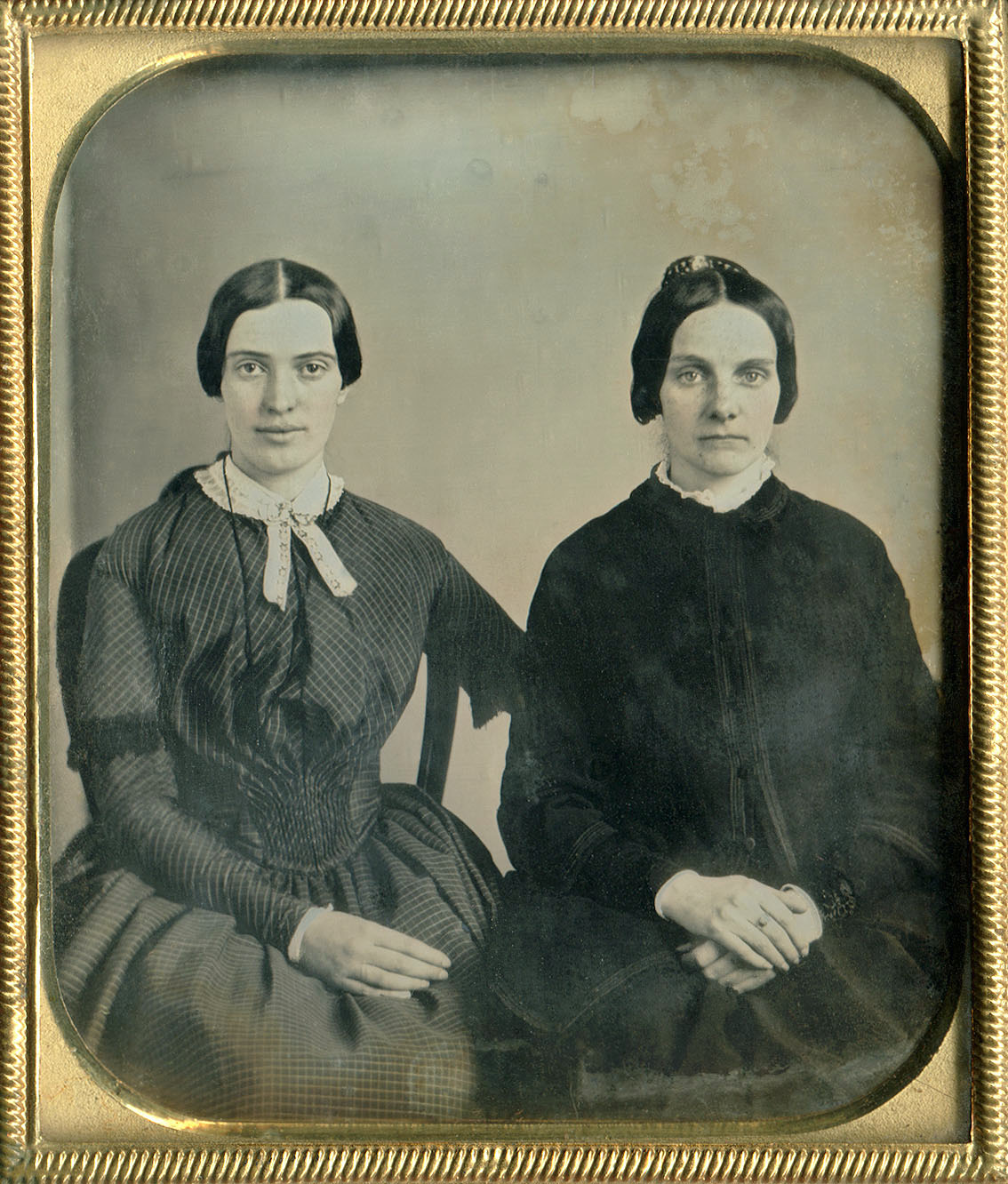
Discovery of a new daguerreotype of Dickinson was announced sometime after I visited the Homestead, following several years of research to verify the sitter’s identity. The image is a double portrait. A woman now believed to be Dickinson sits next to another woman believed to be Kate Turner, Dickinson’s good friend and close correspondent. The date is 1859. Dickinson would have been just shy of thirty. The grown-up head and direct gaze in the new image are a convincing match for the forthright costume depicted in my postcard, though Dickinson did not wear white for the sitting. (These were not yet her later years.) Dr. Susan M. Pepin, associate professor of surgery and director of neuro-ophthalmology at Dartmouth Hitchcock Medical Center in Lebanon, New Hampshire, conducted the comparative analysis of the new photograph and the older, known photograph of Dickinson as a teenager:
Certain eyelid and facial features are distinctive of an individual. Most people have subtle asymmetries of facial anatomy that render them unique. Measurements of these anatomical traits are used by ophthalmologists to document facial asymmetries and follow disease progression. While anatomical features can change some with advancing age and disease processes, attention to details of anatomy reveal the individual traits that make us look distinct. While no one measurement describes this variation amongst individuals, using many measurements allows a quantification of our anatomy that can vary with age and facial expression but holds true due to our individual anatomy. The measurements that follow were taken from the two daguerreotypes and compared using Photoshop … to allow magnification, alignment and precision of the actual measurements.
The anatomical indices measured by Dr. Pepin include the distance from iris edge to lower lid; the distance from central lid crease to upper lid margin; the distance from lateral lid crease to upper lid margin; mouth crease length; and more, all calculated in tenths of millimeters.
Pepin concludes:
While these measurements are limited by the image resolution, variation in lighting as well as the technique of obtaining daguerreotypes, certain trends emerge from these comparisons that make a strong argument that the woman in the 1859 portrait is the same woman in the 1847 daguerreotype known to be Emily Dickinson. The two women have the same eye opening size with the right eye opening being slightly larger than the left. The left lower lid in both women sits lower than the right lower lid. The right upper lid from the crease in the lid has more length than the left upper lid. Also, the left upper lid margin height sits lower than the right upper lid margin height (0.1mm ptosis OS). Other similar facial features are evident between the women in the daguerreotypes. The right earlobe is higher on both women. The inferonasal corneal light reflex suggests corneal curvature similarity, allowing us to speculate about similar astigmatism in the two women. Both women have a central hair cowlick. Finally, both women have a more prominent left nasolabial fold. After a thorough examination of both of these women’s facial features as viewed from the 1847 and 1859 daguerreotypes, I believe strongly that these are the same people.
Two women, two images, two events, two times, two coordinates. One subject? During the century and a half since Dickinson lived and wrote, the poet’s house, the poet’s body, and her body of work have been discovered, decomposed, rediscovered, and recomposed continuously—the sum effect, a mysterious mutability, as in the surface of an intricate collage that at first appears as a plain and unified image, but on closer inspection disintegrates into parts.
In a book called Consciousness, Color and Content, a philosopher of mind named Michael Tye describes a philosophical problem known as the “explanatory gap,” which is roughly equivalent to a modern version of the ancient struggle between Aristotle and Zhuangzi. The idea is that there’s an inexplicable difference between experience and feelings or between what we can explain (say, physically) and what we continue to call consciousness. To demonstrate, Tye recounts a thought experiment starring a woman named Mary who is imprisoned in a black-and-white room. She has never gone out. Everything she knows about the world, she has learned from black-and-white books and black-and-white video and computer feeds. Over the years, Mary has become the leading expert on color and color vision. She knows all the information it is possible to know about the language of color and how to use it to describe relevant aspects of objects and surfaces, and she understands every fact about the physical process of color perception. Despite her vast knowledge and deep expertise, however, she wonders what the experience of color is actually “like.” She wants to understand how it feels to see red. Tye writes, “One day her captors release her. She is free at last to see things with their real colors (and free too to scrub off the awful black and white paint that covers her body). She steps outside her room into a garden full of flowers. ‘So, that is what it is like to experience red,’ she exclaims, as she sees a red rose.”
What is the difference in the kind of knowledge Mary has before she leaves the room versus the kind she has afterward? What is the difference between knowledge and experience? Tye recapitulates a few, common answers: Some, the “believers,” claim that there are non-physical aspects of experiences and emotions; experience is “irreducibly subjective.” It cannot be fully explained in physical, material terms. Others, the “agnostics,” hold that the explanatory gap between subjective and objective perspectives may one day be resolved, but that we have not yet derived the necessary conceptual tools to address the question. And still others, the “disbelievers,” are certain that experiences and feelings are strictly physical, but that the cognitive structure of our minds does not lend to our understanding or full acceptance of this reality. Tye rejects all of these positions. He explains:
Upon learning that enzymes in the alimentary canals of human beings break down food and convert it into energy, only a failure to grasp that the word “digestion” means roughly internal process whose function is to convert food into energy could lead one to ask: “Why does the action of these enzymes in humans generate digestion? Why shouldn’t the enzymes convert food into energy in the absence of digestion?”
In the case of phenomenal consciousness, however, the corresponding questions remain, even for those who understand full well the relevant phenomenal terms and who know the underlying physical and functional story. One who has a complete understanding of the term “pain” for example, and who is fully apprised of the physical facts as we now know them, can still coherently ask why such-and-such brain processes or functional states feel the way pains do or why these processes feel any way at all. In this case, it seems that as far as our understanding goes, something important is missing. Herein lies the famous “explanatory gap” for consciousness.
Tye maintains that the explanatory gap is, instead, a cognitive illusion. He resembles the disbelievers in that he considers experiences and feelings like Mary’s first experience of the color red in the garden completely physical, with the difference that he sees no further problem or need for explanation resulting from this view.
I accept that experiences are fully, robustly physical, but I maintain that there is no explanatory gap posed by their phenomenology. The gap, I claim, is unreal; it is a cognitive illusion to which we only too easily fall prey. As such, it has no consequences for the nature of consciousness and physicalist or functionalist theories thereof. There is nothing in the alleged gap that should lead us to any bifurcation in the world between experiences and feelings, on the one hand, and physical or functional phenomena, on the other.
There aren’t two sorts of natural phenomena—the irreducibly subjective and the objective. The so-called “explanatory gap” derives largely from a failure to recognize the special features of phenomenal concepts. These concepts, I maintain, have a character that not only explains why we have the intuition that something important is left out by the physical story but also explains why this intuition is not to be trusted.
And what are the special features of phenomenal concepts?
– They are conceptually irreducible.
– They are perspectival.
That is, they cannot be deduced, only recognized. Phenomenal concepts do not obtain from a priori truths.
Those not liveyetWho doubt tolive again –“Again” is ofa twiceBut this – is one –The Ship beneaththe DrawAground – is he?Death – so – the Hyphenof the Sea –Deep is theScheduleOf the Diskto be –Costumeless Consciousness,That is he –
I first encountered this one, 1454, while seated on the back of a boat. I had brought along the complete works, all 770 pages, on a journey to the other side of the world, just so that I could look up number 1451 while I was away from my library. By chance or chronology, the hyphen of the sea appeared on the facing page.
This book-slogging behavior is unwise but not atypical. I have been sure to carry a book companion with me most every time I’ve left the house since I learned to read, and for the past twenty years or so, I’ve lugged too many books on nearly every long journey, often requiring an extra bag to travel. I’ve finally adopted a digital tablet, which helps some, though it is not weightless, either, and I still find reading on a page more conducive to memory formation, because I inadvertently map what I read to physical experience, like where in a book and where on a page a line appears. According to the margin notes in my edition, 1451 and 1454 were written a few months apart, in 1878 and 1879, about twenty years after the new daguerreotype was made. Dickinson would have been wearing white by then.
Those not liveyetWho doubt tolive again –“Again” is ofa twice
Dickinson put her second “again” in quotes, a message for a reader that doesn’t readily transmit to a listener. Similarly, the hyphens—ten, not counting the one mentioned by name—would be audible if a reader were to halt for each, but then how should one halt for a hyphen as opposed to a line break?
We were passing between the mainland to our left and a long strip of land in the middle of the river to our right that was only as wide as a street, and flat, and covered with vegetation, so that against the gray of the sky and the same gray of the water, with the sun somewhere behind, the slender strip of earth sliced through the exact middle of the view, and the skyline formed by the trees above it resembled the audio frequency graph in a digital sound-editing program. I sat on the side of the boat, facing that way, watching the track move backwards, seeing in reverse what I should have been able to hear. We were a group of about twenty artists and writers on a sponsored excursion to visit the ruin of an abandoned prison accessible only by boat. After arriving and exploring the island, we regrouped under shade to discuss writing and prison, the stated purpose of our trip. I was meant to initiate the conversation, but the only thing I could think of once we were in that powerful place—a forlorn collage of rocks and blocks—was a fragment of a poem I knew by heart, the only bit of poetry I knew by heart, a few lines from the end of “Questions of Travel” by Elizabeth Bishop.
Is it lack of imagination that makes us cometo imagined places, not just stay at home?
Or could Pascal have been not entirely rightabout just sitting quietly in one’s room?
Two days later, I shared a taxi to the airport with a woman from Mexico who had been on the boat. The sky was pouring rain, same as in Bishop’s poem about travel, which happened to be set in Brazil, same as us. The road ahead had flooded. Highway traffic had come to a complete halt. The taxi began to overheat. The engine stalled. The driver got out to look under the hood. When he returned, we asked him whether everything was okay, and he answered, “Yes, of course,” which wasn’t reassuring. In the backseat, we had more time to talk than we anticipated. She told me about her work in Mexico, some kind of errant research detached from any institution. She studies the place where she grew up, a communal living experiment south of Mexico City. She told me the title of her project, which had to do with finding oneself between utopia and disenchantment, though in Spanish it sounded both less fanciful and more erotic. I wrote the Dickinson poem on a scrap piece of paper and gave it to her, realizing then I had lied when I said on the island that the fragment from Bishop was the only bit of poetry I knew. Inadvertently, I had memorized 1451, though I couldn’t remember where to put the line breaks, because I hadn’t yet settled the matter of emphasis. Dickinson’s version is compact, while mine ran long in road-jostled scrawl. Our taxi made it to the airport, but barely. A few hours later, on our slow descent to Panama City, I observed a sea of hyphens below, each waiting anachronistically to raise anchor and pass through the canal.