Cat Without Grin

Printed twice at first on every side of a single broadsheet and with a different title each time:
Theoretical physics is no native province of amateurs. Proficiency in some aspect of the field typically requires years of post-graduate training, which typically follow years of undergraduate training, which are typically preceded by years of secondary school, during which a blossoming physicist has typically demonstrated a strong proclivity for science, especially physics, not to mention a facility with numbers. Casual triflers would be ill-advised to expect that an important paper, one concerning the interaction of particles on a scale so minute that it can only be observed indirectly, might be faithfully glossed en passant. Upon winning the Nobel Prize for Physics, Richard Feynman was inundated by requests for a précis of his work in the development of the theory of quantum electrodynamics. In response, Feynman, notorious for plain talk and brash disregard, finally resorted to a conversation stopper he had picked up from a sympathetic reporter, “Listen, buddy, if I could tell you in a minute what I did, it wouldn’t be worth the Nobel Prize.”11 For the attributed quotes, as well as a sense of Feynman’s character and the contributions he made to his field, this essay is greatly indebted to James Gleick’s biography. James Gleick, Genius: the Life and Science of Richard Feynman (New York: Pantheon Books, 1992).
A substantive understanding of most advances in theoretical physics is simply beyond the scope of the average non-specialist’s transient curiosity. Consider “The Cheshire Cat Principle from Holography,” a paper originally published in April 2009, by Holger Bech Nielsen of the Niels Bohr Institute in Copenhagen, and Ismail Zahed of the Department of Physics and Astronomy at SUNY Stony Brook. The core of the paper is a scant nine pages, about half of it high-level math. To quote the abstract,
The Cheshire cat principle states that hadronic observables at low energy do not distinguish between hard (quark) or soft (meson) constituents. As a result, the delineation between hard/soft (bag radius) is like the Cheshire cat smile in Alice in Wonderland. This principle reemerges from current holographic descriptions of chiral baryons whereby the smile appears in the holographic direction. We illustrate this point for the baryonic form factor.
Skipping to the end—hopeful the authors might have thrown a bone to the remedial reader, we are nonplussed to find what appears in grammatical form to be plain language, but is in fact an impenetrable riddle,
The holography model presented here provides a simple realization of the Cheshire principle, whereby a zero size Skyrmion emerges to order 1/˜= κ through a holonomy in 5 dimensions. The latter is a bosonized form of a heavy quark sitting still in the conformal direction viewed as time. The baryon has zero size.
To even begin to understand what Nielsen and Zahed might mean, one would need to know more than a thing or two about children’s literature and quantum chromodynamics, the theory of the strong nuclear force. For starters, one should understand that hadrons, the massive residents of the atomic nucleus, which include baryons and mesons, are themselves comprised of quarks and gluons. Baryons, such as the proton and the neutron, consist of three quarks, whereas mesons consist of a quark and an antiquark. A quark is an elementary particle, which means that physicists know of no further sub-structure within it. An antiquark resembles a quark, but is its opposite, in terms of intrinsic quark properties—electric charge, color charge, spin, and mass. Gluons are non-observable force carriers, elementary particles that mediate the interactions of quarks. Quarks cannot be observed in isolation, only in groupings—as hadrons—because the strong nuclear force that holds them together is far too strong to allow for their separation. When quarks are pulled far apart, as during high-energy particle accelerator experiments, new quarks spontaneously appear to pair with the distant partners of the original couple. Which is all to say that, at the infinitesimal quantum scale, an entirely unfamiliar cast of characters is engaged in complex proto-romantic interactions of which we know little, beyond basic taxonomy. The intuitive understanding of physics we employ to manage our day-to-day lives, in which gravity—the weakest of known forces—reigns supreme, does not apply here, where there are five dimensions; it is possible to sit still in a direction viewed as time; and something with “zero size” is physical.
Mind you, at this point in our analysis we have merely performed a brute translation of some pertinent vocabulary. Lacking command of the mathematics Nielsen and Zahed employed, we are obliged to accept all alleged definitions on faith. A devious correspondent, or even an innocently confused one, could easily lead a poorly equipped reader astray, suggesting that chiral baryons are a rare sort of asymmetric antimatter that manifest only when no one is looking, or that the study of quantum chromodynamics concerns certain high energy particle interactions that produce vivid spectral effects, ie. ghosts. After all, far stranger possibilities populate the legitimate world of theoretical physics, and few outsiders know enough to call bluff.
The “Cheshire Cat Principle” was written for publication in The Multifaceted Skyrmion (forthcoming from World Scientific Publishing Co.), a 460-page follow-up to the influential Selected Papers, with Commentary, of Tony Hilton Royle Skyrme. A British physicist, Skyrme was progenitor of an eponymous mathematical model used to describe the behavior of baryons. According to the publisher’s synopsis, which hints at the significance of the work of Nielsen and Zahed, “There has been a series of impressive developments in the application of the Skyrmion structure to wide-ranging physical phenomena … The recent discovery of holographic baryons in gravity/gauge duality, which correspond to Skyrmions in the infinite tower of vector mesons, provides a valuable confrontation of string theory with nature, particularly in the regime of strong coupling that Quantum Chromodynamics proper has difficulty in accessing”—and so on, we presume, for 460 mind-bending pages.
The Cheshire Cat Principle pertains to the “chiral bag model,” a hybrid of the Skyrmion and the “MIT bag model.” A bag model is a theoretical convenience employed by physicists to simplify the process of making predictions about the behavior of the strong force in the nucleus of the atom. It permits the grouping of elementary particles into bag-like units so that interactions within these units can be predicted and tested without concern for the complex interactions that might occur outside of each bag. The chiral bag model can be used to describe low-energy baryon properties regardless of the dimensions of the bag radius, which, according to the math, may be any size from zero to infinity. (The Skyrmion, for example, is a bag model with a bag radius of zero.) In other words, the radius of the bag is considered independent, its size unpredictable. The bag can thus be thought to appear or disappear at whim, much like the Cheshire Cat in Lewis Carroll’s book.
Written in 1865, long before the era of quantum mechanics, Alice’s Adventures in Wonderland has since been thoroughly plowed for metaphors by physicists and mathematicians. The story is well-known: a talking White Rabbit, who is incidentally running quite late, frets aloud about his predicament while anxiously consulting the watch in his waistcoat pocket. His peculiar behavior attracts the attention of a curious young girl named Alice, who is sitting under a tree nearby. Alice pursues the White Rabbit down a rabbit hole on a trip to the center of the earth, where she lands after a very long fall in a world that is almost familiar, except that hardly anything or anyone can be relied upon to behave as expected. For the rest of the adventure, Alice observes these aberrations with a matter of fact attitude that belies their extraordinary nature. Like us, she is a naïf wandering through an unknown dimension.
In a famous episode, Alice encounters the grinning Cheshire Cat in a tree bough and engages him in a bit of banter.
“Would you tell me, please, which way I ought to go from here?” “That depends a good deal on where you want to get to,” said the Cat. “I don’t much care where —” said Alice. “Then it doesn’t matter which way you go,” said the Cat. “— so long as I get somewhere,” Alice added as an explanation. “Oh, you’re sure to do that,” said the Cat, “if you only walk long enough.”
The back and forth continues until, moments later, the Cat vanishes, which disturbs Alice little, as she is by now becoming accustomed to the oddities of Wonderland. She proceeds along her way, as the Cat reappears, then disappears again, finally exasperating Alice, who complains about his abrupt comings and goings.
… I wish you wouldn’t keep appearing and vanishing so suddenly: you make one quite giddy!” “All right,” said the Cat; and this time it vanished quite slowly, beginning with the end of the tail, and ending with the grin, which remained some time after the rest of it had gone. “Well! I’ve often seen a cat without a grin,” thought Alice; “but a grin without a cat! It’s the most curious thing I ever saw in all my life!”
The smile of the Cheshire Cat was adopted by mathematicians years before it found its way into the literature of quantum physics. A footnote in Martin Gardner’s 1960 annotated edition of Alice suggests that the phrase “grin without a cat” is a fitting description of “pure mathematics”—referring to mathematical theorems, themselves, as distinct from their application in the physical world. The allusion is not far-fetched; Carroll, whose real name was Charles Lutwidge Dodgson, hailed from the esoteric academic culture of Oxford and undoubtedly wove veiled references from that world into the coiled logic of the imaginary one he created. Through the Looking-Glass and What Alice Found There, the 1872 sequel to Wonderland, is in many respects an elaborately coded inversion of the first book.
Carroll’s attention to literary double meanings in games and mathematics and to conceivable anomalies in space and time grew more emphatic over the years, as Alice’s story looped back on itself. In fact, the original Wonderland manuscript contained no mention of the confounding Cheshire Cat, so prescient for science. The original title, Alice’s Adventures Underground, harkened toward literature’s past instead—to the myth of Orpheus, who, like Alice, descended to the Underworld in pursuit of time. Grieving over the death of Eurydice, his wife, he followed her to Hades. According to some versions of the story, Orpheus was reunited with Eurydice there, and the gods permitted him to return with her to life at the surface on the condition that he not look back at her as they ascended from the Underworld. In other versions, the gods produced an apparition of Eurydice to fool Orpheus as a punishment for his cowardice in attempting to bring his beloved back to life rather than reside with her in death. In either case, as he neared the surface, leading a Eurydice who may or may not have been a ghost, Orpheus cast a timorous glance over his shoulder. Eurydice was lost. Orpheus was overcome with grief and later died in shame.
In “The Other Eurydice,” Italo Calvino recounts the story of Orpheus from the perspective of Earth’s center, looking out. Calvino’s narrator, Pluto, describes the surface of Earth as a nearly ungraspable inversion of reality, akin to another dimension. “The outside was the world’s negative, something we couldn’t even picture in our minds, the mere abstract idea of which was enough to provoke a shiver of disgust, no, of horror, or rather, a stupor, yes that’s it, a sense of vertigo … into which would creep a certain fascination, an attraction to the void, the Janus-faced, the ultimate.”22 Italo Calvino, “The Other Eurydice,” from Numbers in the Dark and Other Stories, trans. Tim Parks (New York: Vintage, 1996), 218–26. Whereas the Greek myth of Orpheus warns against looking backwards, Calvino’s version describes the mirror image—fear of an unknown that lies above and ahead, instead of below and behind.
In contrast to Pluto’s vertiginous stupor, or the unwieldy urgency of Orpheus, Alice remains earnestly sensible in the face of unfamiliar circumstances. She is the archetypal scientist, unburdened by fear of the unseen, unconcerned with staking her position on either side of the mythical binary. To Alice, the Cheshire Cat’s gradual and inexplicable disappearance is simply a reversible fact of another dimension—a puzzling source of mild frustration, not a cause for alarm. She is like Feynman, who claimed near the end of his life, “I don’t feel frightened by not knowing things, by being lost in a mysterious universe without any purpose.”
When Alice awakens from her adventure, which she hadn’t known to be a dream, she finds herself above ground, back on the riverbank, where she first spotted the White Rabbit. She is now in the arms of her older sister, to whom she recounts her tale. We are privy to the sister’s thoughts as she, too, drifts into half-sleep, half-imagining Alice’s adventures, although her fantasy is tempered by an awareness that has come with the onset of adulthood, as some expanse of imagination is left behind; when viewed through the skeptical lens of her sophistication, what once would have been accepted as plausible is now discredited as an apparition.
Feynman, who was widely admired by his peers for his seemingly intuitive approach to physics, reportedly cultivated an unadulterated freedom of mind, often boldly expressing disdain for formality and gentility, which he regarded as self-defeating hypocrisy. In 1962, three years before he was awarded the Nobel, he wrote an energetic critique of the work of his colleagues in a letter to his wife, while attending a conference on gravitation held in Warsaw—a rare appearance for Feynman, who had little interest in the protocol of academic life and therefore seldom published his work or presented it at conferences. He was characteristically unequivocal in his contempt for the scientific establishment:
The “work” is always: (1) completely un-understandable, (2) vague and indefinite, (3) something correct that is obvious and self-evident, worked out by a long and difficult analysis, and presented as an important discovery, or (4) a claim based on the stupidity of the author that some obvious and correct fact, accepted and checked for years is, in fact, false (these are the worst: no argument will convince the idiot), (5) an attempt to do something, probably impossible, but certainly of no utility, which, it is finally revealed at the end, fails or (6) just plain wrong. There is a great deal of “activity in the field” these days, but this “activity” is mainly in showing that the previous “activity” of somebody else resulted in an error or in nothing useful or in something promising.
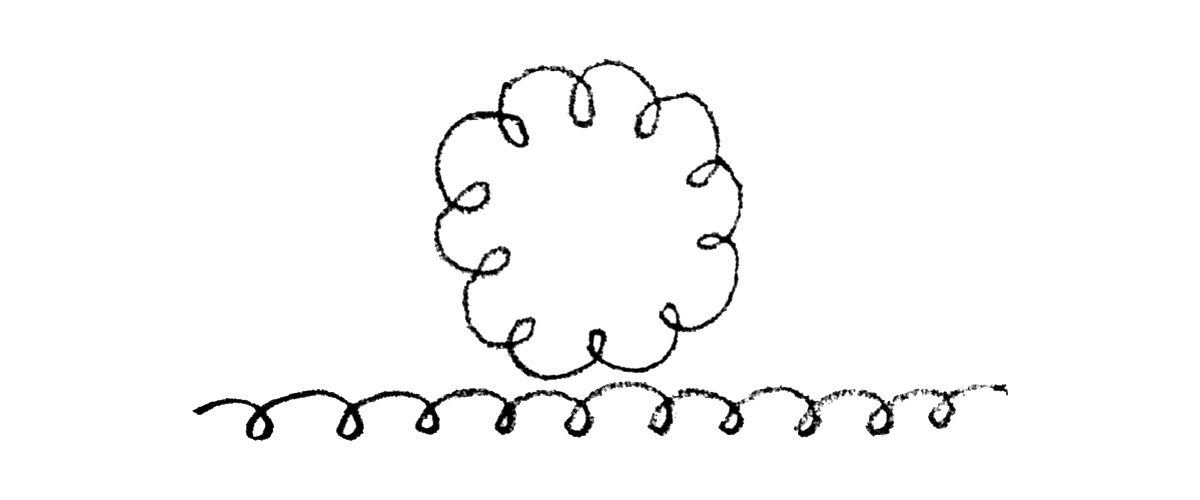
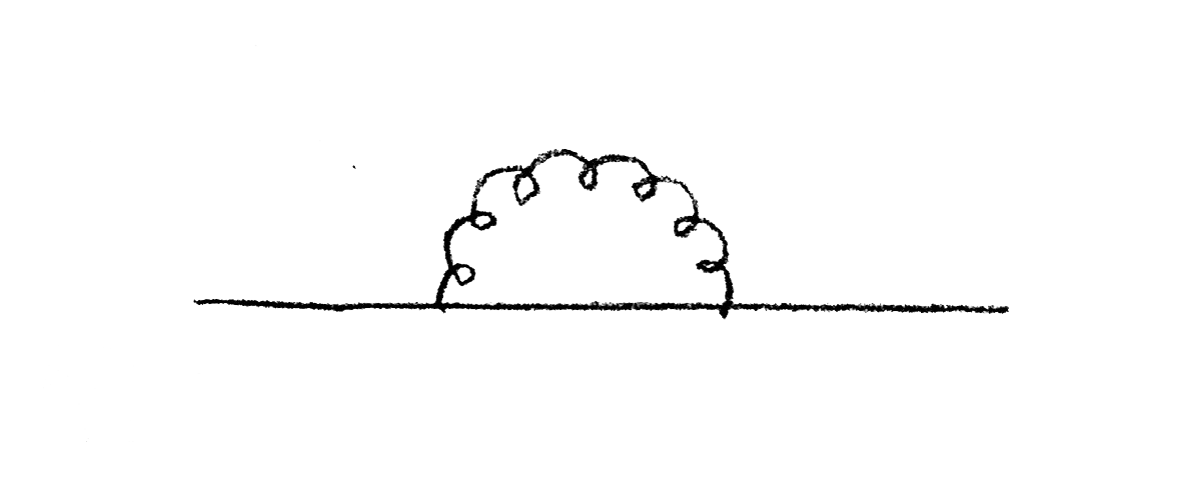
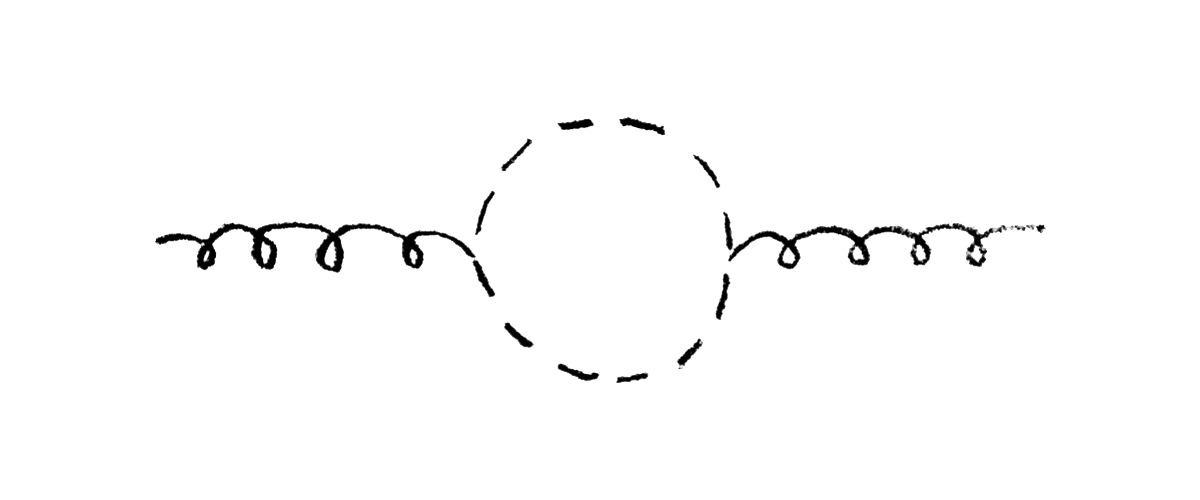
At this same conference, Feynman introduced “ghosts” into his famous diagrams—the system of simple graphic symbols he developed, which has proven essential for visualizing complicated concepts in theoretical physics. Feynman was attempting then to formulate a quantum theory of gravity, which remains yet to be explained, but his ghosts have since become critical to the formulation of Quantum Chromodynamics. Ghosts are technically nonexistent, but nonetheless necessary to maintain the consistency of some aspects of gauge quantum field theory—the basis of the Standard Model of particle physics.
The Standard Model, developed over a ten-year period from 1965 to 1974, encompasses all the known elementary particles and three of the four known forces, excluding only gravity. Gauge theory is more difficult to define. In differential geometry, a gauge is a coordinate system that is carried along by the local surface it describes. Roughly speaking, gauge theory in quantum physics is a mathematical description of the transformation of a field of particles in which the particles change phase in space and time without, in turn, creating a quantifiable physical change in the overall field. So, despite the gluon-mediated (quite possibly ghost-assisted) force exchanges constantly occurring among the quarks in the hadrons of the nuclei of every atom of every molecule of, say, this page, it holds together, and remains solid, extenuating circumstances notwithstanding. The ghost, a fictitious, unphysical particle, is a convenient computational device, which makes a fleeting appearance in certain equations that demonstrate this fact. Feynman represented his non-observables in the graphic form of looping and spiraling lines.