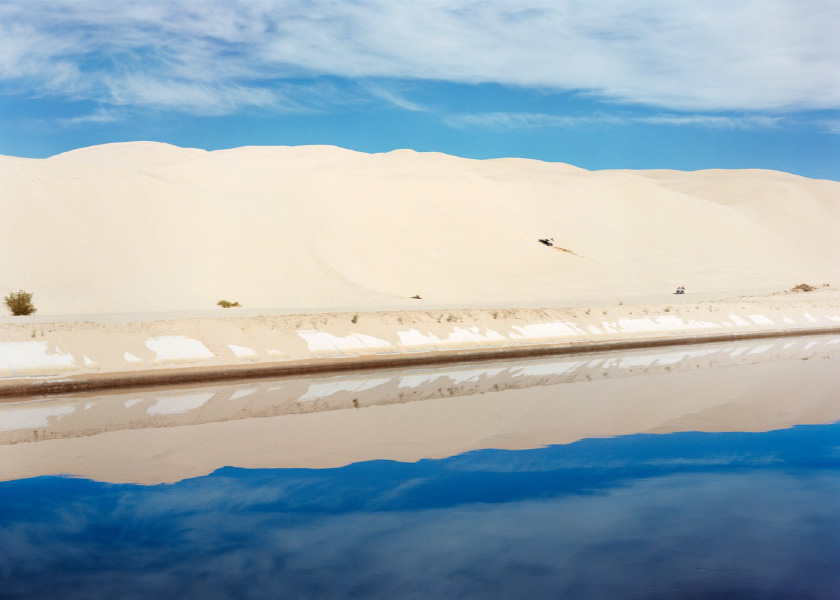
Pack It In Pack It Out
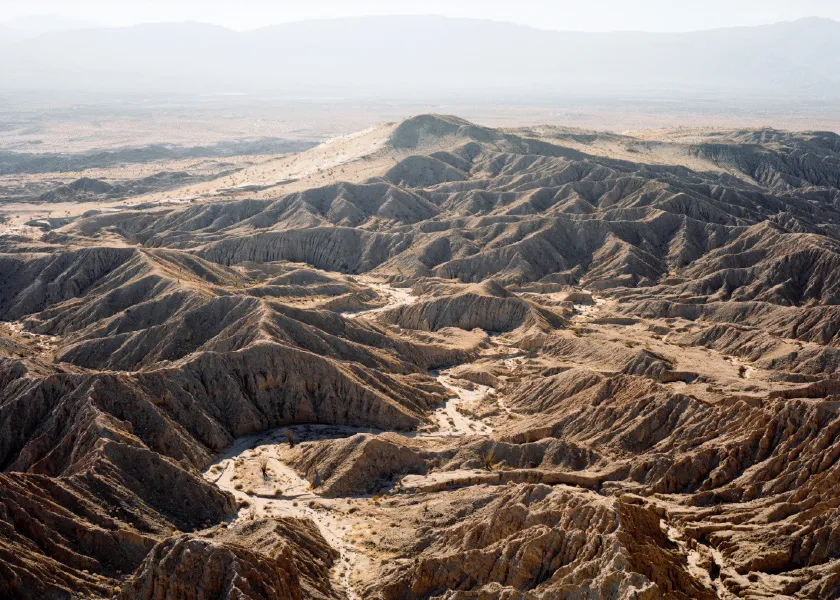
We stand above the driest desert mountain range swelling underfoot like an angry brown sea. Along the horizon through a sheer mist of pale dust an immense tidal wave rolls towards us, tens of cities high and as wide as our eyes can fathom. We are nothing against this terrible ocean. Not a cell. Not a microbe. Not a millisecond. Yet, being so minute, we live and die a thousand times before the fearsome storm advances even an inch. A breath. We traverse its crests as if time has stopped. Lay our tracks and highways over its halted troughs and peaks. Pitch our delicate nylon tents. Take selfies. Center our fleeting souls. To us, the mountains are immovable, no more threatening than the thin cake of umber dirt we'll scrape from beneath our fingernails later, back at the hotel, when we open the taps to wash off the day, our earthly irrelevance pooling under another night of sound and soon forgotten sleep. But the image awakens us, arrests us, reveals to us our predicament. It registers the strange pleasure we take in teasing our own devastation. Before the image, we are caught between dissolving and striving. We see our time, and we are displaced.
For Victoria Sambunaris
When everything else has gone from my brain—the President's name, the state capitals, the neighborhoods where I lived, and then my own name and what it was on earth I sought, and then at length the faces of my friends, and finally the faces of my family—when all this has dissolved, what will be left, I believe, is topology: the dreaming memory of land as it lay this way and that.
The way we incorporate ourselves into the landscape reflects who we are.
Pack it in, pack it out. I come across the line in the last pages of the most recent volume of Victoria Sambunaris' road journal, a hand-written diary she has been keeping of her drives through the North American West these many years spent photographing the landscape on months-long journeys while camping in a tent on the roof of her vehicle. Not being a camper myself, I make a mental note in the event I someday become one: pack it in, pack it out. Sambunaris is recounting a 1946 essay by Wallace Stegner, written as he traveled through the national parks, appalled by the many regulations restricting visitors' mobility and behavior, as well as by the visitors' apparent unwillingness to clean up after themselves, leaving campsites and parklands a mess of garbage.
Waste management has been a preoccupation of Sambunaris' work for over two decades. In an obvious sense, she frequently captures the human incursion of energy and transportation infrastructure, of heavy industry, housing developments, and waterworks across the land. In a less obvious sense, she shoots with a wooden box camera, photographing on 5x7 color negative film. This is not a matter of point and click, snap and repeat. There is no digital preview or delete function. A shot is something to prepare carefully with one's hands and body in concert with one's eyes, the weather, the light, patience, and intention. Each printed photograph represents a considerable effort of time and material potentially squandered. Meanwhile, Sambunaris consistently confronts us with lavish excesses. Here is too much detail, too much color, too much sublime beauty to contain within a frame. Here, also, is too much ever to leave well enough alone, and too much to imagine ever depleting. As we can plainly see for ourselves—because she has shown us—the largest refinery or container ship is but one tiny thimble on the surface of Earth, one tiny matchbox bobbing in the ocean. And with so very much already to behold, surely there must always be more. Surely alfalfa farming in the desert is an undisputed marvel of human ingenuity and acumen. Surely you have never seen such a stunning carpet of emerald vegetation.
What do we expect from a landscape? And from a picture of one? The problem and the advantage of genre is all that it enables us not to notice about a given specimen once we've situated it within its proper category.
For Sambunaris, landscape photography is a license to inhabit the roads of the West and to experience the particular solitude and the particular social life one finds only there, perhaps only as a certain kind of woman traveling alone through that place with a camera. In and out of campsites and one-store towns, diverted from her route now and again by compelling strangers she meets passing through, her wending path resembles more a troubadour's than a surveyor's. In pursuing her work, Sambunaris lives as a roving storyteller, one who gathers the stories of others into her own as she rolls onward. The road journals make this fact clear, even if the photographs rarely correspond directly to scenes recorded in the notebooks.
Sambunaris herself observed during a public talk some years ago that "road trips are stories of failures and vulnerabilities, sometimes your own and sometimes other people's," and that "American road stories tend to end in disappointment." Throughout her journals she attends to the mundane vulnerabilities marked by the water supply, the gas tank, the phone batteries, the occasional flat tire. She mentions the ease with which one might become lost on foot in a region without cell service, how one might disappear into the landscape without a trace, end up a "goner." She remarks on the rigs of the rich campers, built for playing out luxurious survivalist fantasies, minimizing discomfort and risk with the aid of expensive solar panels, auxiliary tanks, and wi-fi boosters. She admires the mettle of the rare person she meets who is at home in "the dirt," able to live off hard land.
"'Hardness' has not been in our century a quality much admired in women," Joan Didion noted in her 1976 essay on Georgia O'Keeffe, another artist who migrated westward with her work after biding early years of her career in New York. By Didion's gauge, O'Keeffe was "simply hard, a straight shooter, a woman clean of received wisdom and open to what she sees." Like Didion's O'Keeffe, Sambunaris casts an unsentimental gaze over her subjects, while the range and precision of her eye assure us that she, too, remains "open to what she sees." Less like O'Keeffe, whom Didion depicts as severe in word and deed, Sambunaris manages the harder elements she encounters among the population and in the landscape with gracious equanimity and robust good humor. The daughter of first-generation Greek immigrant factory workers, Sambunaris attributes her lack of pretension to a working-class background, though this explanation belies the equal agility with which she circulates among curatorial and collector classes when not on the road. People approach her from all walks. Her open manner disarms them. She gathers their trust and their opinions. They relish her attention and her tales. Hardness needn't figure. Never mind the confronting testimony of her work. Never mind the knife in her boot.
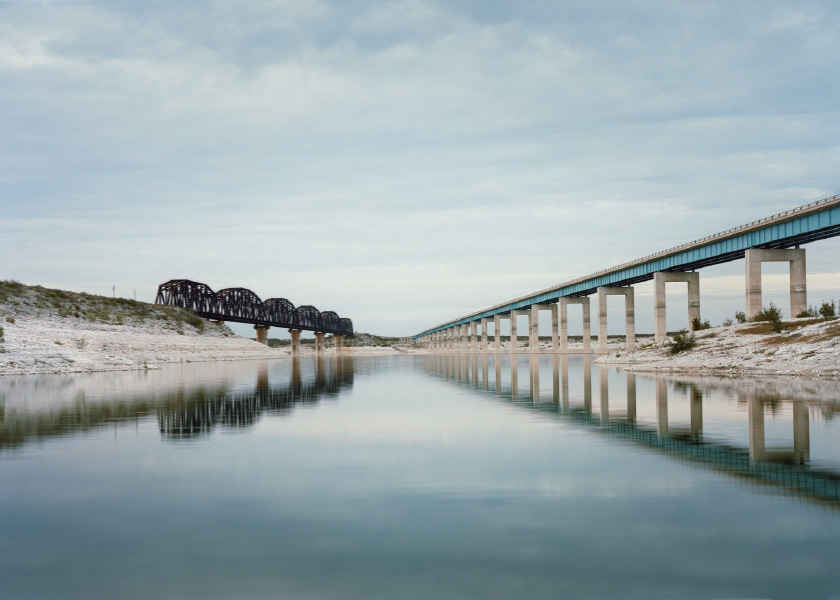
Sambunaris has been traveling to towns along the border between Mexico and the US since 2009, developing a particular affinity for Del Rio, Texas, where she has lived from time to time as she works, occasionally crossing the Rio Grande to Ciudad Acuña. There, she first encountered the photographs of Robert L. Warren and learned of his studio in Del Rio, which Warren and his wife Lucille purchased in the early 1940s from the original owner, who established the operation in 1921 to manufacture scenic postcards. The studio thrived for decades under the Warrens, whose repertoire soon expanded from processing and printing services, hand-tinting, and camera and film sales to include aerial photography. In 1996, Rosantina Calvetti, a native of Acuña who had been the Warrens' longtime assistant, inherited the shop following Robert's death. Sambunaris befriended Rosie, who opened the Warrens' archive to her, revealing among other gems an extensive collection of images of female bullfighters, or matadoras, taken over several years of activity at La Macarena, the former bull ring of Acuña. Among these matadoras, Patricia McCormick would assume special significance for Sambunaris, who eventually made McCormick the subject of Del Rio, one volume in an ongoing series of expediently printed artists' books she publishes in collaboration with three partners. In one spread of the book, which resembles a playbill with its single-color printing and stapled binding, a gleeful McCormick stands center ring following a fight, triumphantly raising both arms to display to the crowd her new trophies, the ears and tail of the bull she has just killed with her sword. She wears a fitted white bolero over wide Andalusian pants, the right sleeve of her short coat smudged at the elbow with the animal's blood. She smiles broadly, like the honored child at a birthday party. On the opposite page, we see an oblique aerial view of the Governors Landing Bridge spanning the Amistad Reservoir, a stylized WARREN'S DEL RIO TEXAS corner stamp marking its provenance.
The bridge comprises two separate structures, one built for trains to pass between a series of arched trusses, the other an open-air highway for vehicle traffic, both supported by concrete pylons where they cross the large reservoir just off the Rio Grande. On the south side of the bridge, the two routes stand farther apart than on the north, where they converge into parallel lines and curve westward together. When viewed from the south, the visual meeting of the two structures on the northern horizon, accelerated by their convergent angles, creates an exaggerated sense of depth, an optical illusion triggered by the brain's assumption that the structures run parallel, directly into the distance. Sambunaris photographed the bridge from the ground in 2013, standing in the picnic area at the south edge of the reservoir, facing north, just as the Warrens were oriented from the air decades earlier, although by the time of Sambunaris' arrival, the reservoir had filled, revealing only the top quarter portion of the tall pylons that were fully visible in the Warrens' shot. Sambunaris' photo appears as the second spread of Del Rio, while the older, archival image sits near the end, contributing to a vague sense that, as one proceeds forward through the pages, one is being lured backwards in time, away from the technologies and mores, as well as the landmarks and landforms, by which we of the present tense identify and anchor our now.
Sambunaris often revisits the sites and narrative footpaths of her previous work, claiming that a project is never finished. Moreover, as the old sites and stories evolve, they offer her "new perspectives," and, inasmuch as they remain the same, they provide comfort. In 2018, she traveled to McCormick's hometown of Big Springs, Texas, where she was introduced to a local gun shop owner named Gary Humphreys, who had met McCormick as a starstruck nine-year old boy, and, faithful to the iron law of first loves, "never forgot her." Humphreys went in search of McCormick fifty years later after glimpsing a sun-faded publicity image of her hung on the wall of a bar in Acuña. He finally located her "down on her luck" in Midland, Texas and helped her to return from there to Del Rio, where she died, impoverished, some years later after a too brief revival of public interest in her story.
Sambunaris lent me a copy of Lady Bullfighter, the autobiography McCormick drafted while confined to bedrest when she was twenty-four, recovering from a goring, one of six she would survive during her ten-year career in the ring. She had studied painting and music in college and saw her work as a matadora in terms of art. On the last page of the book's final chapter, she spells out her life's aims of "perfecting myself and my art and skill ... growing in the present toward the ideal I carry like a flame inside me, trying to make each moment an hour of truth." She continues, "This is the phrase bullfighters use for the moment of a fight when the matador goes in with the sword, honestly, offering the bull the best chance to kill the man." The young McCormick relished the prospect of mortal entanglement with a wild animal in a zero-sum competition for survival. But her description begs the question those opposed to bullfighting might also ask—what is an art that transcends its metaphor?
I return to the spread in Sambunaris' Del Rio book, with McCormick celebrating her triumph on the left, facing the Warrens' aerial view of the newly constructed bridge over the dry reservoir on the right, wondering how to read this reframing of one artist's story by another. McCormick's stated intent was to do always and only as she wished and as she felt she must—an agenda perhaps rarely afforded to some select few, less often, if ever, to others. In the image, she flaunts her spoils, but also her clarity of purpose. She had entered the ring to realize a dream held before and beyond taboos. For a moment, she managed to live as her own hero. Then her youthful career faltered, and her achievements receded into cruel obscurity.
Gary Humphreys invited Sambunaris to try one of McCormick's glittering sateen costumes when she visited him in Big Springs. Elated, she obliged, and he took several snapshots of her in it before she quickly returned the outfit to him. "Too hot, too tight," she explained, but one wouldn't guess as much from the photos. She grins like a champion matadora.
Sambunaris writes, "Essentially, I am recording anonymous modern-day monuments that have settled onto the contemporary landscape, telling a conflicted story in geographical, environmental, political, and cultural terms. The photographs I produce question traditional and clichéd notions of landscape, our place within it, and collective roles and responsibilities in how and why we shape it the way we do." As a diarist, she describes the landscape through the multiple perspectives of those on the ground, not in their collective aspect, but as a thousand disunited eccentrics. Many have self-selected to be in the places where Sambunaris finds them, often in explicit defiance or rejection of any collective sentiment at all. Others, lacking agency to choose a path, have simply ended up there instead, clinging to the frayed end of a withered line, permanently "camping" in "economically depressed communities surrounded by toxic pools, toxic air, and no way out," as she describes the increasingly impoverished conditions she has observed on the road over the past few years.
She peppers her journals with a changing read on her own solitude, like a weather report. Feeling lonely... Feeling alone, not lonely... Getting comfortable with aloneness... Finding aloneness fulfilling... Most of her encounters are unplanned. She meets people at campsites, or people notice her working and stop to inquire about her camera, typically a pretext for inquiring about her. In 2021, she produced a series of photographs over a period of days spent camping alongside a group of OHV or "off-highway vehicle" enthusiasts she met while scouting east of San Diego in Ocotillo Wells, California. The ostensive leader of the group, a charismatic, record-setting cyclist who had once been sponsored and appeared in bike ads, introduced her to the community, including multiple extended families and assorted networks of friends who regularly descend on the desert in their trucks and RVs with dirt bikes, all-terrain vehicles, and dune buggies in tow. They play in the badlands by day and gather to cook and party around communal campfires at night. When Sambunaris departed the group one afternoon in search of an artesian well rumored to be found in the surrounding area, she ran into a man from a local mineral club who complained that "between the OHV people and the high winds, these hills will erode, and there will be nothing," echoing the sense of foreboding and resentment she hears frequently on her journeys. The promised well was merely a trickle from a pipe. She returned to camp disappointed, recalling that the only hopeful person she had met on this trip was a geothermal energy executive talking up his company to a film crew at the edge of the Salton Sea. The OHV crowd may have been devoting their weekends to communal revelry, but their politics were bleak. Some spoke almost wistfully about the prospect of joining militias in Oklahoma. They professed no clear loyalty to a political party, rather a sense of alienation from politics in general. "That sentiment is everywhere," the journal notes.
Sambunaris treads gently along the contemporary political divide, resisting the urge towards clarity of position that markets, first and foremost, require, and which has become de rigueur within cultural spheres otherwise regarded as aloof from market logics. She seems to reject, implicitly, that more propaganda could be an appropriate artistic response to already polarized political conditions. An avowed observer of the way "we" incorporate ourselves into the landscape, she is evidently committed to witnessing us, wherever and however she finds us, and presenting us to ourselves as such. But only gradually, over the past three years, have actual human figures begun to appear in her photographs. To date, we remain quite small.