Other Futures
In a YouTube clip called “Australian Man Walks Around Dissing the Empire State Plaza,” the late art historian Robert Hughes can be seen and heard giving his review of a modernist building suite commissioned for the government of New York State in 1959 (completed 1976) by then-governor Nelson Rockefeller.
With Kianja Strobert
Hughes wears a collared shirt and tie under a navy double-breasted sports coat as he walks alongside an immense central fountain that resembles an Olympic pool, gesticulating to emphasize his points in the manner of a seasoned orator. His every sentence conveys a portent well beyond what most would anticipate from an entire conversation with an art historian conducted during a midday summer promenade next to a bubbling water feature. The scene conjures Michelangelo Antonioni’s film L’Eclisse, with its stark, futuristic architectural backdrop, crossed with Peter Sellers’ The Party, in its unfulfilled promise of a good time—if you can imagine the mesh of those two films infiltrated by an orotund narrator from the BBC or the American public television network, PBS. Both networks in fact produced (BBC) and aired (BBC 1980, PBS 1981) the series from which the clip is lifted, called The Shock of the New, after Hughes’ book by the same name.
Here, he opines:
This is the scariest new monument that I know—Albany mall, the seat of government of New York State. It was designed for one purpose, and it does it very well: It expresses the centralization of power. And I don’t imagine there’s a single citizen who’s ever wandered on this plaza and felt the slightest connection with the bureaucrats who live in their towers up there. The place would make Albert Speer seem delicate. Utter simplicity of meaning. No ambiguities. And what comes out is not the difference between America and Russia, but the similarities between the corporate and the bureaucratic states of mind. Any one of those buildings there, you could imagine with an eagle on top, or a swastika, or a hammer and sickle. It makes very little difference to the buildings. If you forget about the projects and the manifestos, and think about what it actually built, there’s no doubt that our culture has its language of political power. It’s not linked to any particular ideology. It’s value-free. It can mean anything. In the area of public building, our century has not yet managed to come up with an architecture of free will.
I’ve begun my last couple of public talks by looping this clip while an audience assembles and finds its way to drinks and seats. The eerie synth background music and stunning images of the mall combined with Hughes’ bombast set expectations for what will come the same way a trailer for a psychologically intense espionage thriller sets expectations for a poetry reading, which is to say that I don’t represent ideas in much the style of Hughes, who, despite his criticism of the Empire State Plaza on grounds that the architecture conveys “utter simplicity of meaning” with “no ambiguities,” was himself prone to oversimplify for rhetorical impact, exhibiting an outsized confidence that obscured the highly personal and fallible quality of his commentary. Of course, the “language of power” spoken by Hughes has its appeal. There’s a reason why his books and television series were so popular. It’s the same reason Hughes gets away with saying the buildings embody “no ambiguities,” while in a next breath claiming the architecture “can mean anything”—that is, that the architecture is essentially ambiguous. He performed his spectacular brand of cultural analysis with all the certitude and disregard of a demagogue.
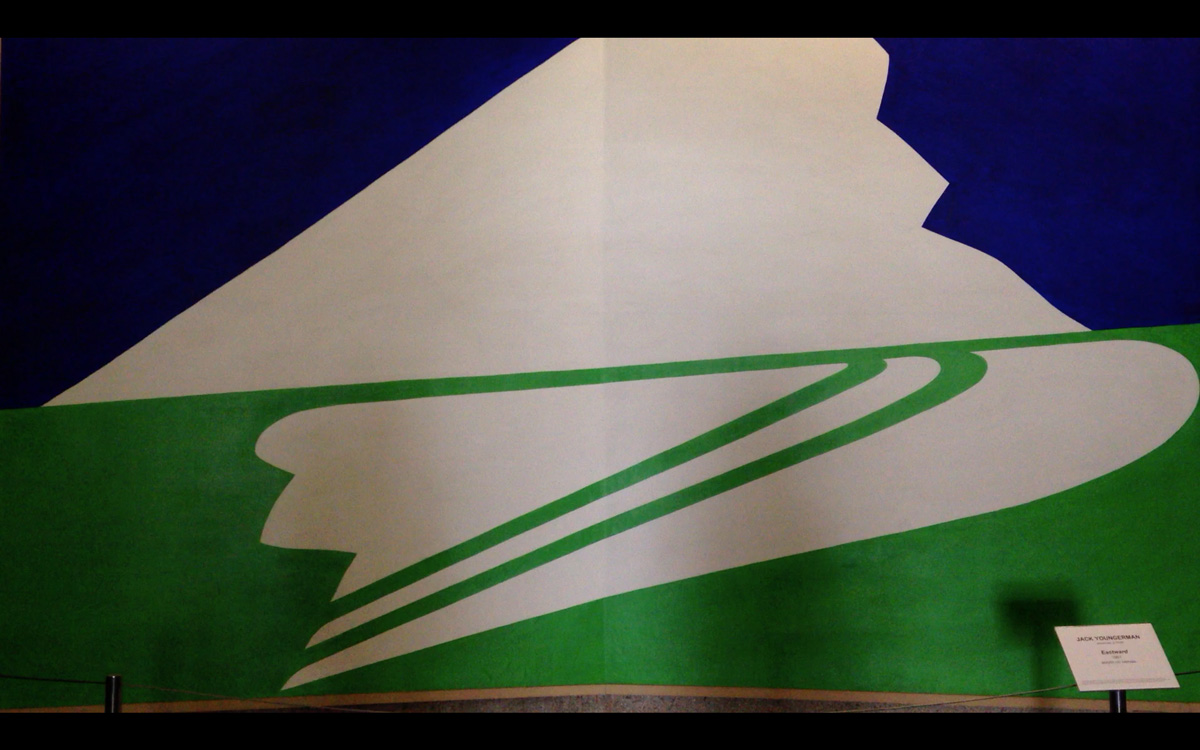
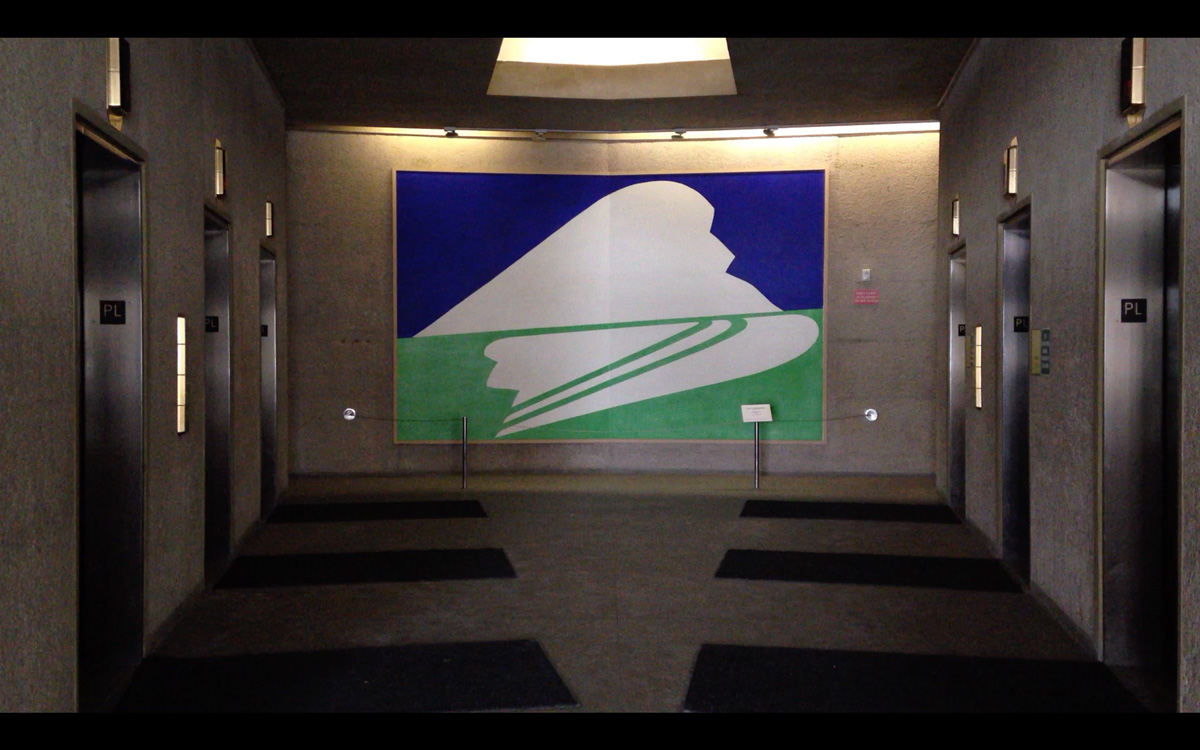
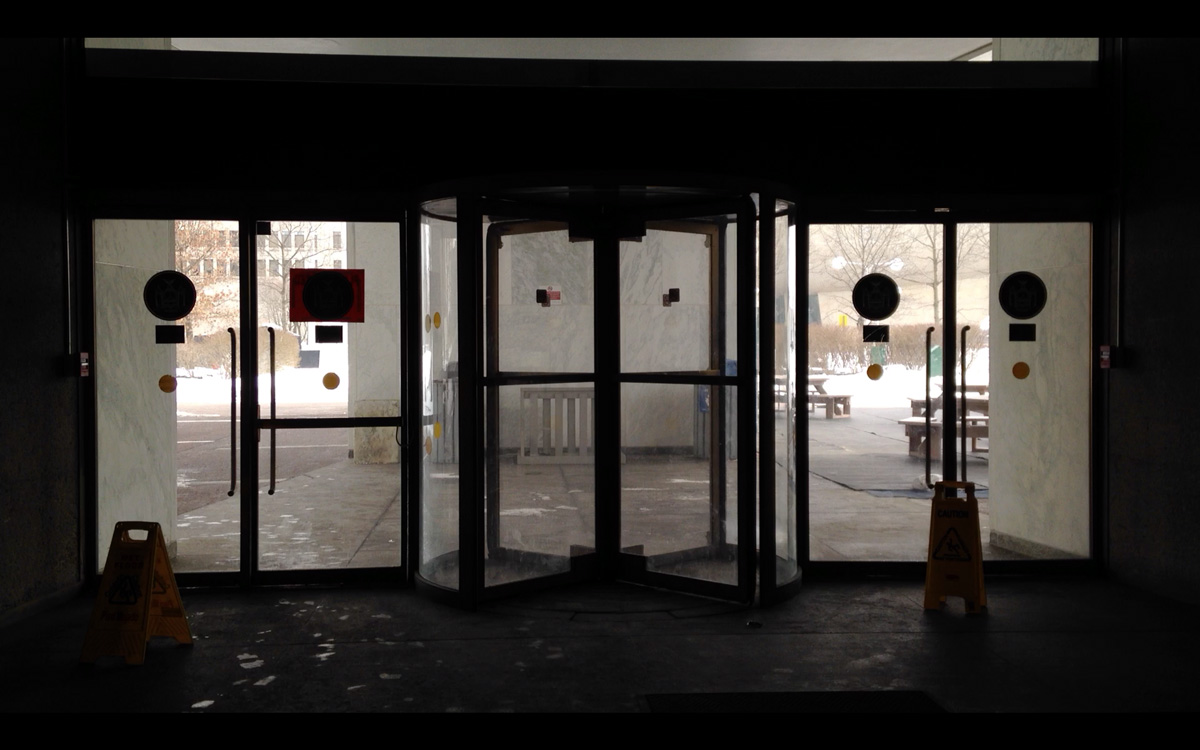
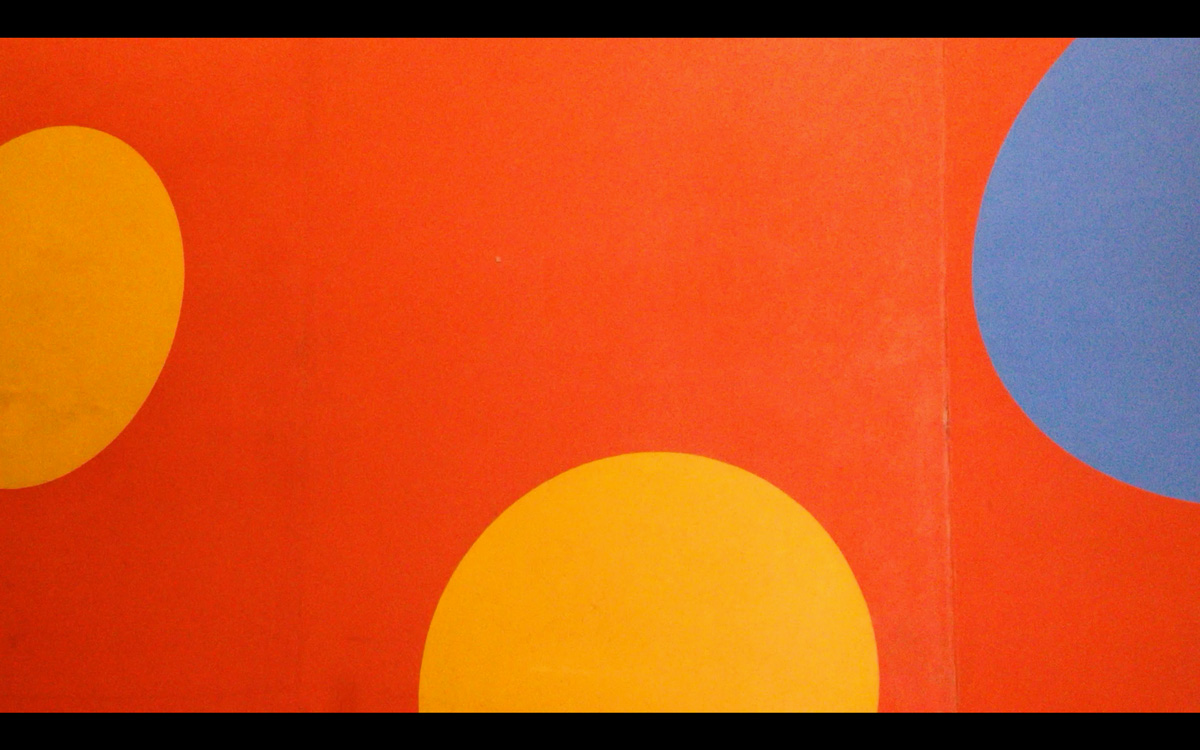
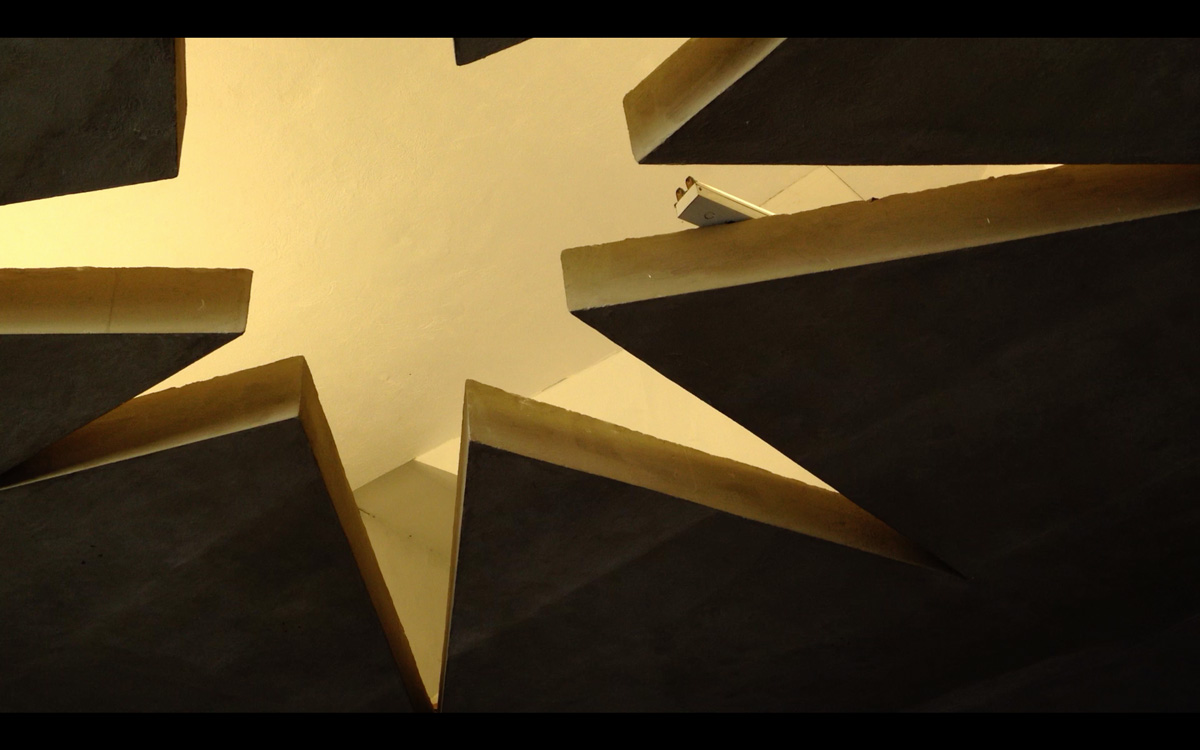
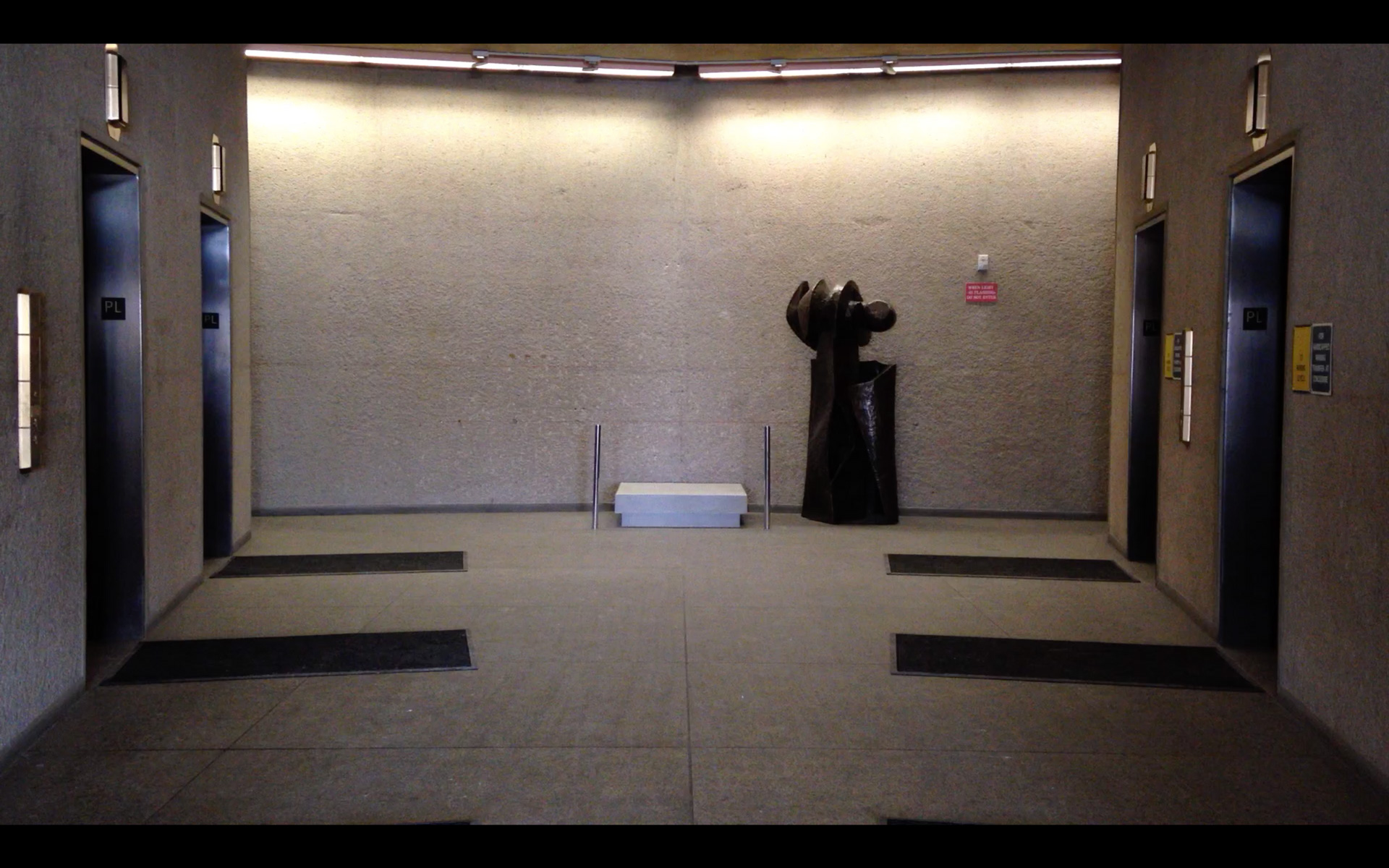
I’ve had occasion to visit Albany for two reasons in recent months, one concerning art, the other concerning money, both concerning local real estate. The first was to collaborate with artist Kianja Strobert in producing a video at Empire State Plaza, the site of Hughes’ scene. We made three trips there this winter, each time during the new “coldest day on record,” when barely a soul dared to cross the frozen mall. Initially, we shot in the unheated lobbies of the identical tower structures Hughes regards, riding the heated elevators up and down in-between takes to thaw our fingers and equipment. Each of these lobbies contains a single commissioned artwork specifically made to fit the building’s obtusely-angled concrete walls. As we filmed in the lobby of the third tower, a slender man in a workman’s jacket and boots emerged from one of the elevator bays, politely apologizing to us for crossing in front of our camera. He added, “I’ve been looking at that painting for thirty-three years!” The multi-panel work by Oli Sihvonen consists of a series of elliptic blue, mustard, and dark red dots, vibrating against a bright red background. “Do you like it?” we asked. He answered with a laugh. The Plaza is full of monumental works by modernist headliners Rockefeller commissioned between 1968 and 1972, including Guston, Pollock, Nevelson, Frankenthaler, Stella, Kelly, Kline, and others well-known by their surnames, though Kianja and I weren’t yet exposed to this trove when we met our passerby, having by that point encountered only the lone piece in the vestibule of each building. We boarded the elevator with the man as he returned from his cigarette a few minutes later. When we explained to him our method of keeping warm, he asked why we weren’t commuting through the heated underground concourse linking the entire suite of buildings. We hadn’t realized until then that such a place existed.
At this point in the talks I’ve been giving, I play a clip of people walking by a thirty-foot-long painting by Kenneth Noland called Via Ochre (1968), located in the concourse directly below Hughes’ outdoor walking path. As the video reveals, the concourse is in fact an active public space full of working people and capitol visitors. The footage doesn’t capture any of the exalted “bureaucrats” Hughes alleged, but maybe that’s because they were indeed in “their towers up there” instead of downstairs, buying take-out coffee and dropping off dry-cleaning underground like everyone else. While Via Ochre loops inaudibly, I read to the audience relevant excerpts from an essay about perception and cognizance, which I published about a year before Kianja introduced me to Hughes or his Albany, though the excerpts conveniently serve as a response to Hughes’ critique. The essay begins as an imagined encounter between ancient philosophers Aristotle and Zhuangzi on the same road that links my home in rural New York state to Albany mall, and progresses from there to a discussion among research scientists and philosophers about the physiology of “free will,” which casts doubt on our conventional understanding of the concept. The rhetorical structure of the essay, like the talk, resembles a Venn diagram, formulating concerns through the overlapping of associated subjects, rather than by way of a unified logical argument in support of a pointed thesis. The talk includes a description of this rhetorical structure, or strategy, within its demonstration, inviting audiences to weigh the possibilities of critical engagement against those of critical messaging.
My second reason for visiting Albany this winter was to attend a free, introductory “seminar” offered by an organization called Fortune Builders, the self-dubbed “Premiere Real Estate Investing and Coaching” service. I accompanied a contractor friend who hoped the event might help him navigate the area’s residential house-flipping industry, but I went along to behold the pitch itself. The Fortune Builders’ talk took place in the “Empire Room” at the local Marriott, and, like my own talk, began with a video montage shown on a large projection screen at the front of the room. Unlike my talk, seating was ushered, no refreshments were served, and guests were obliged to wear name tags.
The Fortune Builders reel consisted of clips from Flip This House, a so-called reality show in which one of the speakers? or perhaps a founder of Fortune Builders? may have appeared. The exact tie-in eluded me, but the message of the video seemed clear: if “finding a cool, new passion” by “getting into real estate” piqued my interest, then I had come to the right place. The seats soon filled with an assortment of people whose collective demeanor broadcast that they weren’t seeking a cool, new passion, so much as a remedy. Sometime after the time-lapse clips of home remodeling magic on screen began repeating themselves and the mild anticipation of the room tipped into boredom, our host finally made his entrance through the double doors in back, well behind schedule. He skipped and trotted across the room unconvincingly like an out-of-shape boxing contestant bound for defeat in the ring. Upon ascending the four-inch-high platform stage in front of us, he shouted, “How’re you folks doing tonight?” with excessive enthusiasm. Disappointed by our reply to his disappointing opener, he chided the audience that we would get out of life only what we put into it, and threw out the first aphorism (there would be many over the course of the evening), regarding the power of a positive attitude. He then relented slightly by commending us for taking the “courageous first step of assuming control of our financial futures.”
As it turned out, the seminar wouldn’t be led by the cast of Flip This House, nor by any founder of Fortune Builders, but by one Tony Natoli, motivational speaker. Natoli cracked a few jokes before explaining that he wants us to “have fun tonight” because “we learn better when we’re having a good time,” plus we all know “wealthy people have more fun.” The rest of his presentation wavered between a typical long-form soft sell and a cult indoctrination. He broke us down, he built us up, he told us a pitiable life story—about a father who spent a career in government service then had to take a job at McDonald’s in his late sixties after he was unceremoniously laid off by “Uncle Sam.” He derided Corporate America and higher education, both, before boasting of Fortune Builders Inc.’s great success as a “thriving enterprise” helmed by its “Ivy League-educated” founder, Than Merrill. He asked us, “How many of you think I’m here to sell you something?” then immediately answered his own question, “Well guess what, I am. I don’t apologize for one second for offering you something that can help you meet your goals,” before offering us an incredible two-for-one deal on the upcoming three-day workshop, which retails for $1,197 per person, but could be ours to share with a partner for the bargain price of $197, total—a whopping 92 percent discount off two full-price tickets—if we would only sign up now. Finally, he assured us that we would train with Fortune Builders to become “solutions providers,” not salespersons.
From what I could gather, the Fortune Builders’ core proposition is that you don’t need to be “smart” to make money. What you need is “other people’s money,” referred to by Natoli as OPM, as in, “Surround yourself with successful investors, and use OPM to tap into hidden markets.” I have my doubts that a positive attitude and some simple rules of thumb are sufficient to overcome a lack of skills, connections, and capital to thrive as an investor in a competitive market. That said, at a squint, Natoli wasn’t far off in his bastardized breakdown of market dynamics. John Maynard Keynes’ “beauty contest” has for decades occupied economists and game theorists seeking to model the reasoning and learning processes that would accurately simulate investors’ behavior. In The General Theory of Employment, Interest and Money (1936), Keynes writes:
Professional investment may be likened to those newspaper competitions in which the competitors have to pick out the six prettiest faces from a hundred photographs, the prize being awarded to the competitor whose choice most nearly corresponds to the average preferences of the competitors as a whole; so that each competitor has to pick, not those faces which he himself finds prettiest, but those which he thinks likeliest to catch the fancy of the other competitors, all of whom are looking at the problem from the same point of view. It is not a case of choosing those which, to the best of one’s judgment, are really the prettiest, nor even those which average opinion genuinely thinks the prettiest. We have reached the third degree where we devote our intelligences to anticipating what average opinion expects the average opinion to be. And there are some, I believe, who practice the fourth, fifth, and higher degrees.
The Fortune Builders’ proposed method of house flipping one’s way to wealth by tapping into overlooked opportunities where others have already successfully invested rests on this same principle that insight about where things are heading in a market derives from average opinion about average opinion about where things currently are. When one’s medium is information, as Hughes’ was, a prominent developer’s or investor’s role is less a matter of guessing average opinion and capitalizing on that knowledge, than of influencing others’ perception of average opinion by successfully promoting one’s own.
A wave of researchers following Keynes tested the effects of many versus few subjects and the influence of outliers on the beauty contest game. Efforts soon expanded to include wider ranges of participants, teams versus individuals, players with varying degrees of experience, and other parameters. What subjects learn is to anticipate what other subjects learn (and whether and how they will behave accordingly) in given circumstances. According to a recent paper published by economist Rosemarie Nagel, the most significant finding of all the experiments has been that Keynes was right. “Subjects apply only 0 to 3 levels of reasoning,” she writes, and it is primarily economists who operate on the third, deepest level. Economists aside, most of us formulate opinions by unwittingly aggregating others’ opinions and taking perceived averages for the facts of our shared reality. Thus, behavioral and intellectual trends move and spread through populations like fashions.
After seeing the clip of Hughes at Albany mall, I watched all eight hours of The Shock of the New from beginning to end in a single sitting. I found Hughes’ recapitulation of the canon of recent Western art history riveting, despite disagreeing with how he edited that canon and much of what he said about its edited contents. An unwieldy breadth of material becomes tantalizingly coherent in the hands of an able spokesperson, never mind that so many of his assertions collapse under slightest scrutiny.
The ambiguity Hughes first disclaims then assigns to Albany mall is not an on-off quality intrinsic to a building as he would have us believe, rather a property of interpretation. Individual assessments as to whether or not anything other than a paradoxical argument is ambiguous are opinions, not facts. Yet, in the aggregate, opinions, including opinions about aggregate opinions, do add up to much more—politically, economically, and materially. If this weren’t the case, there would be little value in persuasion, and our human-ish ancestors might never have left their caves. As this is the case, how we go about negotiating the differences among widely ratified but opposing opinions matters. These should be elementary observations, but in periods of extreme political polarization, the provisional quality of our beliefs becomes less obvious. Or perhaps it is precisely when we lose sight of the provisional quality of our beliefs that we invite political extremism to flourish.
In a summer 1995 cover story for TIME magazine, the long-standing, nationally distributed news weekly where Hughes worked for decades as resident art critic, he wrote an essay called “Pulling the Fuse on Culture: THE CONSERVATIVES’ ALL-OUT ASSAULT ON FEDERAL FUNDING IS UNENLIGHTENED, UNECONOMIC AND UNDEMOCRATIC,” in which he railed with typical fervor against Republican political leadership intent on ending public funding for the arts. In response, Newt Gingrich, who was then Speaker of the House—which means he was leader of the majority party in the House of Representatives, itself one half of the U.S. Congress—signed a rebuttal, which TIME published two weeks later under the title “Cutting Cultural Funding.”
Gingrich would be forced to resign from Congress in 1999, but not before he made a name for himself there by pushing partisan extremism and backing a controversial and highly contested investigation of the President, which climaxed with a vote for impeachment in the House under Gingrich’s leadership. (The Senate voted the measure down, and Bill Clinton remained in office.) An ethics scandal of his own, which involved lying about possible tax violations, precipitated Gingrich’s resignation process, but he was pushed from public office as much by his colleagues’ reaction to his political miscalculation regarding the likely impact of the impeachment affair, which in fact hurt Republican standing in public opinion and resulted in a loss of seats for his party in the 1998 midterm elections. Upon exiting the House, Gingrich founded a private consultancy and has worked since then through that company and other businesses he owns, as well as with assorted think tanks, to publicly promote various political causes, meanwhile amassing a small fortune from his activities. Today, he remains a powerful right-wing political operative. (Notably, he and his wife have produced several propaganda films in collaboration with Citizens United, the media entity that became known for its role in the infamous 2010 Supreme Court decision, Citizens United v. FEC, which opened the floodgates for corporate donations and other, untraceable funding sources to enter federal election campaigns, accelerating the privatization of U.S. politics.) In short, Gingrich knows the dark arts of popular influence from the inside out and back again, and he’s an incorrigible practitioner.
However, Gingrich was still on his initial ascent to national fame in 1995, not yet at the peak of his visibility and influence, and he responded in print to Hughes’ diatribe with what reads in retrospect as an uncharacteristic show of restraint, emphasizing from the first paragraph a stark contrast of style between the two disputants, before quickly insinuating his sincerity and moral superiority. The letter begins:
Two weeks ago, TIME devoted nine pages to a Robert Hughes essay on Congress, America’s priorities and the arts. This is an important topic worthy of serious debate. Yet, instead of debating the message, Hughes decided to attack the messengers. It is unfortunate Hughes chose to resort to name-calling: “Neanderthals,” “Jurassic … [with] limbic forebrains,” “insatiable Fundamentalist Christian right wing” and “Jacks-in-office” are not helpful contributions to an important discussion of our nation’s priorities.
Gingrich explicitly validates the topic at hand, implies his desire for “serious debate,” then posits Hughes as a playground bully, standing in the way of the nation’s progress. Indeed, the evidence against Hughes is damning. In Gingrich’s selective recap, he comes off as laughable, possibly unhinged, certainly unserious.
Next, Gingrich defends the readers, making them his constituents:
TIME’s readers deserve better. It is important to present the whole picture, not the distorted outline Hughes sketches. The American people need an actual debate to understand where federal funding of the arts fits in with larger issues confronting our nation. Balancing the budget, restoring a civil society and seeking alternatives to the pervasive intrusion of the Federal Government are part of this debate. Federal funding of the arts should not and cannot be discussed separately from the larger questions.
Gingrich slyly sidles the issue of “funding of the arts” up to “seeking alternatives to the pervasive intrusion” of government, so that assenting to “actual debate” over arts funding implies an endorsement of his depiction of government as a usurping adversary, rather than the collective means of democratic self-governance. He repeats this strategy in later paragraphs:
There are many well-intentioned programs the Federal Government funds that have not produced results we are satisfied with, including our education and welfare systems. Many of us believe that federal bureaucratic funding of the arts and humanities falls into this category. Has the overall culture flourished in the 30 years of public funding of the arts and humanities? Or has it decayed? Many Americans would argue the latter case.
So, “federal bureaucratic funding of the arts” belongs in the same category with unsatisfactory education and welfare systems. This adjacency is misleading, considering the ant-scale arts funding that then existed as compared with the elephant-scale education and welfare expenditures, but, worse, it implicates readers in agreement that “education and welfare systems” should perhaps be abolished, as Gingrich ultimately suggests art funding should be. (In fact, under the leadership of Gingrich and Clinton, welfare was severely cut, and the movement against both public education and social welfare funding continues today.) He also invokes the same “bureaucrat” bugaboo that Hughes did in his Shock of the New video made fifteen years earlier, proving he and Hughes had something in common, after all.
Finally, Gingrich slays Hughes with his own sword:
Those believing America to be one multiethnic civilization would rather celebrate what unites us instead of what divides us. That sentiment is clearly at odds with trends in the elite cultural world. As Hughes himself put it in his 1993 book, Culture of Complaint: The Fraying of America, “The catalogue convention of the ‘90s is to dwell on activist artists ‘addressing issues’ of racism, sexism, AIDs, and so forth. But an artist’s merits are not a function of his or her gender, ideology, sexual preference, skin color or medical condition, and to address an issue is not to address a public. The political art we have in postmodernist America is one long exercise in preaching to the converted.” Republicans couldn’t agree more. We further ask: Why is it in the best interests of a country to continue funding that which contributes to its cultural fraying? Should we fund that which is intended to be separatist, divisive and dismissive of our civilization’s standards?
He goes on to suggest that artists who prosper from their publicly funded work should pay a percentage back to taxpayers (presuming artists aren’t also taxpayers? and that “taxpayers” aren’t duly compensated for funding the arts by the proliferation of diverse public art and the other public work artists do?); that wholly philanthropic funding would be better for the field (didn’t aristocratic court culture produce fine things?); and that a few benefit concerts held by prominent performers could finance a private endowment that the artists themselves could manage, far away from public dispute (let artists devise their own welfare system and leave the public out of it—why should taxpayers compensate “unsuccessful” artists who don’t draw stadium crowds?). But Gingrich’s proposals quickly proved moot, because this “important topic worthy of serious debate” was effectively eradicated from the public radar under his guidance, along with most public funding for the arts, humanities, and even public broadcasting. Considering that the majority of funding went to civic organizations like local orchestras, theaters, festivals, and museums, as opposed to individual artists producing controversial work, and that public broadcasting had long played an important role in providing primary educational programming, as well as quality journalism, the taxpayers lost much more than Gingrich intended for them to realize when he characterized the arts as “separatist, divisive, and dismissive.” (Missing from Gingrich’s letter is any engagement with Hughes’ proposals for practical reforms to the management and disbursement processes of the National Endowment for the Arts [NEA], and the National Endowment for the Humanities, the latter of which had been extolled as an exemplary institution by marquee Republicans only a few years earlier but was roped in with the NEA and similarly sunk when conservatives targeted the arts for divestment.)
Irate and outwitted, Hughes lost the debate in TIME, but he didn’t surrender … or evolve. In a 2001 screed called “The Fraying of America,” after the same book Gingrich had quoted in his rebuttal letter, Hughes assailed “political correctness,” the “prevalence of demagogues,” “single-issue politics,” and “right-wing extremism,” alike, writing again in the pages of TIME:
In cultural matters we can hardly claim to have a left and a right anymore. Instead we have something more akin to two puritan sects, one masquerading as conservative, the other posing as revolutionary but using academic complaint as a way of evading engagement in the real world. Sect A borrows the techniques of Republican attack politics to show that if Sect B has its way, the study of Milton and Titian will be replaced by indoctrination programs in the works of obscure Third World authors and West Coast Chicano subway muralists, and the pillars of learning will forthwith collapse. Meanwhile, Sect B is so stuck in the complaint mode that it can’t mount a satisfactory defense, since it has burned most of its bridges to the culture at large.
Hughes, who died in 2012, clearly ascertained the ascent of cultural extremism in the US. He speculated about the terms of the interested parties’ entrenchments publicly and at length over many years. But he didn’t seem to recognize his own hyperbolic vitriol as a compounding symptom of the problem. His positions were underwritten by attitudes he claimed to disdain. In this, he was like Tony Natoli, whose business wasn’t so much real estate investing as it was convincing a roomful of people to pay $197 for a seminar by deploying psychological devices known to short-circuit skepticism and inspire irrational confidence. But Hughes was an idealist, likely innocent of any deliberate con, and therefore a relatively tragic figure, however brash, misguided, and unsympathetic. Neither Hughes nor Natoli grasped sales craft like Gingrich, whose showmanship set into motion cultural trends that continue to dominate political life two decades after his departure from office. Though, to be fair, Natoli’s career isn’t over yet. His web page currently features an unfocused snapshot of himself (gray suit, no tie) smirking at the viewer while seated cross-legged in a gilded throne before a marble-tiled staircase next to a gilded, red velvet-topped side table.
Governor Rockefeller reportedly decided to build the Empire State Plaza after experiencing embarrassment at the evident poverty of the neighborhood surrounding the existing capitol building as he played host to visiting European royals. He was one of the richest people in the world at the time. He and his administration displaced thousands of Albany residents, mostly poor and working class, through eminent domain to clear the roughly 100-acre site for the Plaza’s construction in the middle of downtown Albany—a move believed by many to have hastened the economic and cultural decline of the city in the 1960s and 1970s, which has left behind a significant stock of empty buildings ripe for prospective Fortune Builders’ investment and renovation, supposing the local economy can ever again attract end buyers. According to current online listings, one can pay as little as $10,000 or as much as $866,000 to purchase a residential building within the circle of city blocks adjacent to the mall. The large collection of monumental modernist artworks on permanent public display a few paces away doesn’t seem to have had a stabilizing effect on the housing market, but the ninety-two pieces acquired for $2.6 million in the late 1960s were worth five times as much just fifteen years later, in 1984, the last date of a published valuation. Supposing a steady rate of appreciation, the collection would fetch perhaps $300 million today, though many of the collected artists’ works have seen even steeper gains. Last year the New York State Council on the Arts awarded $36.2 million in grants to arts organizations and individual artists, whose work generated associated revenues estimated at $114 billion.