Ch 1
Six months ago, an empty house inspired me to write a book.
I walked in, assessed rooms, closets, cabinets, windows, and an old fuse box, walked out, circled the grounds twice, and left, certain that I had discovered a story.
Some weeks later, I uprooted myself, moved an hour away from the town where I had been living for most of my early- to mid- (soon-to-be-late) thirties, settled into a 5000-square-foot industrial building with twenty-six-foot-high ceilings, and set to work on other things. The building I live in now is not the building that inspired the book. It was just the first building that came along after I gave notice on the old place—a cozy, cottage-like rental in a small town directly off the train line two hours north of New York City. I was still fond of that house, but I no longer felt at home there after the record collection vanished, along with most of the poetry books, half the pots and pans, the good Japanese knife, and whatever furniture hadn’t belonged to me. Another relationship had ended, and it wasn’t possible to patch the holes left behind by simply redistributing and rearranging all that I owned before we were together, when I lived contentedly in the same place for two-and-a-half years by myself. A midlife comb-over doesn’t fool anyone, least of all the receding person standing in front of the mirror holding the comb. So I turned off the baseboard heat in the emptiest room, shut that door, and began collecting cardboard boxes, bubble wrap, and shipping tape. A friend caught wind of my non-plans and offered an unoccupied building of hers as a temporary respite, which at the time, and given the timing, corroborated an abiding sense I half hold that my life is a fine ride as long as I don’t attempt to navigate. The least critical way to describe this outlook is “bemused fatalism,” and as coping mechanisms go, there’s much to be said for keeping that faith, but so far it hasn’t proved compatible with ambitious ideas like writing a book, though this may turn out to be the first page of a first chapter, in which case I’ve changed my life and overruled fate with you as my witness.
I moved in mid-March. Now it’s mid-August, and I’m sitting alone at an antique zinc-topped dining table designed for a family of twelve, in the center of a large, square room, under a ceiling four-and-a-half times my height. The structure dates to about 1900, give or take a few years. It was once a creamery, where milk and butter were stored for distribution. The walls are made of thick concrete, so the building remains cool and slightly damp even in the hottest, driest stretches of summer, and the room, which has become a kitchen, feels more like an enormous refrigerator compartment than part of a house. The floor is covered by oblong, dark red ceramic tiles set in a brick pattern that curves and dips toward two sunken drain grates spaced a few feet apart, which would make cleaning the place with a garden hose convenient if not for the fact the drains were blocked a few years ago to prevent radon gas underneath the building from infiltrating the living space. Four square windows puncture the top half of one wall. Underneath these, recent owners have inserted a double-pane picture window the size of a small car, and on the adjacent wall, three more rectangular windows and a pair of wide French doors leading out to an elevated, wooden deck. Exposed metal trusses and a slatted wood ceiling are whitewashed overhead to maximize the luminous effect of the numerous windows and a single, distant skylight. The kitchen alone is larger than my entire former apartment, and the next room is more than twice the size of the kitchen. There, a canoe belonging to the building’s absent owner appears to float on another lake of undulating red brick tiles. I can play tennis and basketball and ride a bicycle in that room, but so far I’ve only spent a few minutes dribbling and a few more minutes testing surfaces for wall ball. Another friend and I did set up a game of darts (or dart, since I found just one dart lying around) on the other side of the building, in a loft above the old garage, but our pencil-drawn board is too far from where I spend most of my time to make it convenient to play with any frequency. I couldn’t have chosen a next-place-to-live that would feel less like my old house, with its seven-and-a-half-foot-high ceilings and its modest, nineteenth-century clapboard charm. Then again, I didn’t choose this place. I accepted it. And now my old place feels far away. I don’t live there anymore, but I don’t live here yet, either.
The house that attracted me in January, at least as a subject or a foil for a story, sits atop a hill on five rural acres about an hour’s drive from here and an hour’s drive from my old place, which is also about an hour’s drive from here, which means the three points form an equilateral triangle in commuting minutes. I discovered it through a sales listing. I had been looking for a place to buy on behalf of my brother and his wife, who were interested in investing in a property that I would renovate and we would sell for a modest profit in a few years. The search had been underway since the previous August when they left the country for a two-year assignment overseas, and I took up the cause on my own. We made one bid in November, but that house turned out to be illegally marketed; apparently a tenant was posing as the owner and attempting to sell it without holding the title, which in fact belonged to the city due to unpaid tax liens on the property. It was at this point that it first dawned on me exactly how real estate is like romance: potential matches abound, and people will say all kinds of nice things to get you into bed; you can do your research and learn a little up front, but you won’t really know what you’re getting into until a few months after you start sleeping together; while fixer-uppers may come cheap, they’ll almost certainly require a bigger investment to turn around than you anticipate, if they’re even redeemable, which they probably aren’t; timing is everything; etc. Except, I don’t actually believe these clichés about people or romance, and perhaps not about real estate, either. That may mean I’m afflicted with romantic delusions, or I’m stubborn, or both, since the two go hand in hand.
At that point it dawned on me exactly how real estate is like romance: potential matches abound, and people will say all kinds of nice things to get you into bed; you can do your research and learn a little up front, but you won’t really know what you’re getting into until a few months after you start sleeping together; while fixer-uppers may come cheap, they’ll almost certainly require a bigger investment to turn around than you anticipate, if they’re even redeemable ...
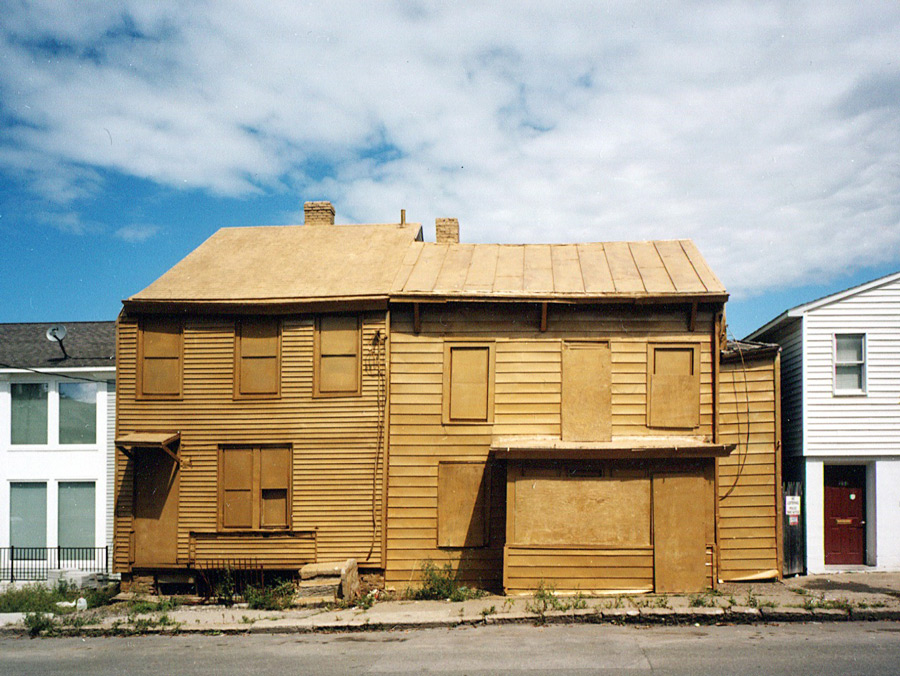
Judging by the photos accompanying the listing, the house was priced far below market value, yet it had been for sale a long time, more than two years, which didn’t bode well. Unlike most of the properties I had already visited, it was not a dilapidated farmhouse built over a hundred years ago and subsequently smothered by arbitrary trends in home décor or makeshift repairs intended to impede structural decay. It was a modernist family home from 1949. The wood siding above the lower stone walls had recently been painted banana yellow, and the concrete floor was partially covered with red wall-to-wall carpet, but the structure stood upright and square on a solid slab foundation that belied no signs of amateur interventions.
I drove to visit the house with Peggy, a buyer’s agent I met through a referral at the onset of our search. We took my car since hers was in the shop that day, and when my fuel light came on thirty minutes into the trip, we made a detour to find a gas station. I had been away for several weeks, staying with my brother and sister-in-law during and after the Christmas holidays, nursing the grief of the recent breakup, and my right mind hadn’t yet returned to me. Not only had I forgotten to think about gas, I had forgotten how to use a debit card. The air was so cold that I could barely manage the keypad at the fuel pump. I repeatedly inserted several cards in succession, fearing each time I was rejected that I had miscalculated my balances or my accounts had been suspended (Is this happening because I was out of the country for so long and didn’t pay my electric bill? How did the electric company get to the bank people and the credit card company? Was there a meeting? Is that legal?), until it dawned on me to consult the instructions in the tiny diagram printed next to the card reader. I had oriented the magnetic strip on my cards in the wrong direction each time. After demonstrating all the lucidity and presence of a sleepwalker, yet somehow managing to purchase several gallons of highly combustible liquid without so much as a nod of approval from another human being, I placed myself behind the wheel of the small, red car once again, and we continued, through snow, toward Westerlo.
Peggy was recommended by my friend Max, an artist living in my ex-town, who had been working for a few years on a multifaceted project inspired by Washington Irving’s 1819 story “Rip Van Winkle,” which was set nearby, in a town across the river. I remembered the “legend” of Rip Van Winkle as the tale of a guy who gets lost on a hike one day, falls asleep under a tree, and wakes up decades later to find his beard is long, his hair is white, and no one remembers him. That’s not inaccurate, but it’s not the whole story. I re-read Irving’s version after Max described it as “a political allegory about a henpecked man who disappears during the American Revolution then re-emerges years later to find the world significantly changed.” Max was drawn to the story in part because he observed—in himself and friends who moved upstate from the city during the aughts—a similar desire to escape to the hills and the ensuing dissociation from the culture they’d left behind as months rolled into years and then into a decade or more. The difference is that Rip Van Winkle eventually returns to town, whereas today the town, New York City, spreads to the hills, with increasing numbers of expatriated urbanites buying second homes in rural New York state and bringing the city’s culture of affluent consumption with them. With us. My ex-town, where Max still lives, is a poster child for the movement, with the proof writ in skyrocketing real estate values that defy the deflated mortgage bubble and the overall economic downturn of the past several years, just like the housing stock two hours south.
Max owns a gold mine he bought for a song on the main street, which he and his family will eventually sell at a profit that will allow them to move back to the city in comfort, if they so desire, though I doubt they do. When I asked him to refer a buyer’s agent, he said, “In my experience, they’re all pretty awful in a similar way, but this one at least knows what she’s talking about.” The day we drove to Westerlo, Peggy wore a mink head muff over a printed silk scarf she had wrapped around her skull like a turban, reminding me of a character actor from a Technicolor melodrama, whose theatrical diction and gestures she also conveyed despite riding shotgun, crammed into my tiny, unglamorous Volkswagen. We had been making these outings together for several months at that point, and she had long since taken to calling me “Anj,” as in, “Well, I’ll tell you what I would do, Anj …” or, “You know what you ought to do, Anj …” or, “Listen, Anj, I’m going to put you in touch with the guy I use. Here’s his number.” I liked her. She did know plenty about historic regional architecture, and I appreciated that she would guffaw when we occasionally pulled up to another house I had selected that turned out to be lacking a floor or a roof or some other fundamental part.
The house in Westerlo had been uninhabited for some time. The water and the heat were turned off, though the electricity had been left on for the benefit of prospective buyers like me, who might want to take a look at the partial basement (just over half the foundation was slab). I later learned that the last owner, who was only the second since the place was built sixty-five years earlier, had died in the house two years prior to my visit. It was his baby grand piano, plaid robe, and faded miniature Buddhist prayer flags I studied on my first tour. But I’m getting ahead of myself. We’ve only just parked the car and approached the house. Peggy has opened the lock box with her secret brokers’ combination and is twisting the key back and forth in the front door without success. After offering my assistance and rotating the key clockwise one complete turn, I reach for the knob, which comes off in my gloved hand as I attempt to pull the door. Fortunately, the knob reattaches easily, and after another slight twist followed by a shoulder shove, the house opens to us.