Being the Measure
The man born René Maria Rilke became the poet Rainer Maria Rilke in July 1897, while sharing a hillside cottage in the small German town of Wolfratshausen with his lover, a captivating married woman named Lou Andreas-Salomé who had already captivated Friedrich Nietzsche and would eventually enchant Sigmund Freud, among others.
Young René first met Lou that May in Munich when he was twenty-one and she thirty-five. The pair spent much of the next three-and-a-half years living and traveling together and remained close correspondents thereafter, until Rilke's death in 1926. Biographers credit Salomé with cultivating Rilke's gifts at a crucial period in his development both as an artist and an adult. She was his most trusted critic and confidante. The record of their correspondence indicates that she effectively curbed some of his worst instincts ("...you were ... at risk of ... squandering yourself ... on trivial enthusiasms..."; "...you overburdened [your work] with metaphysical raptures...") while urging him to devote himself completely to his craft ("...full human honesty in artistic matters is even more important than in relation with other human beings..."; "... I ... feel that the whole of lyric poetry with its capacity for meaning and expression is but a small sector of that realm in which it is your task to make things come to life..."). It was on Salomé's recommendation during those first few months of their acquaintance that Rilke changed his name from the feminine René, given by his mother who had wished for him to be a girl, to the masculine Rainer, preferred by Salomé.
Rilke undoubtedly ranks high among the world's most lauded writers, and the sizable output of scholars and popular biographers sponsored by his art does not want for input from this reader; I've not studied his work formally, nor even read the lot of it. Despite his prominence, Rilke wasn't a key figure in the U.S. public high school literature curriculum, and I never once encountered him in college. I knew Rilke's name when I was a girl mainly because his Letters to a Young Poet sold in ornamented gift editions next to the cash register at every bookstore franchise in town. We probably spent a few classroom minutes on his poem "The Panther," but I can't be certain even of that, because I don't remember reading it so much as always being vaguely aware of it as a poem everyone knew or at least knew of. Later on, when I was in my twenties, a friend took me to the Jardin des Plantes in Paris to see the panther exhibited in the same place where the subject of Rilke's famous poem lived some generations ago, "His gaze [...] become so tired that it holds nothing anymore." The crowd was dense that day with apparent poetry fans of every age and stripe, squeezed in like their counterparts at the Louvre, who were simultaneously straining to lay eyes on the Mona Lisa. We waited a few minutes for an opening but soon gave up, failing to witness Rilke's description of a defeated will, meanwhile enacting it.
At some forgotten point during those same years, I acquired a copy of The Book of Images, first published in 1902, consisting of material written from 1899 onward, partially overlapping with, then following, Rilke's initial relationship with Salomé. I once mined its contents with the profane intent of adding a meaningful phrase to a homemade birthday card for my brother but found most of the prospects far too forlorn and archaic to sub for contemporary greeting card fodder between siblings still in the spring of our lives. Never mind that we were approximately the same age Rilke had been when he wrote them. ("O solitude, O heavy spending on and on of time..."; "O how far away and long gone / everything is."; "The leaves are falling, falling as from far away"; etc.) I settled on the first few lines from the only poem in the book that seemed to anticipate the future as something other than a prelude to death:
Whoever you are, in the evening stepout of your room, of which you know each part;yours is the last before the infinite,whoever you are.
It's called "Entrance" or "Eingang" in the original German. I don't speak German, and I don't know where I got my translation, which happens to be wrong. Possibly, I made it up, at least in part, by misremembering a correct translation. The credible version by Edward Snow, reputedly "Rilke's best contemporary translator," and the person responsible for the edition I own, in fact reads:
Whoever you are, in the evening stepout of your room, where you know everything;yours is the last house before the distant:whoever you are.
My unsubstantiated insight regarding the poet's intent replaced "everything" with "each part"; nixed the "house" in the third line, rendering a new meaning for "yours" as a more general state of possession; and swapped "the infinite" for "the distant," but the room, the evening, and whoever you are survived, along with the overarching metaphor of transcendence.
"Entrance" is not addressed directly to René Descartes, as far as I know, or to Pascal, or to any other thinker famous for praising the virtues of sitting quietly in a room and observing one's thoughts, but a deep ambivalence toward the Cartesian concept of mind-body duality does trouble Rilke's oeuvre, which hinges on the problem presented to a living human mind by its awareness of looming bodily death—a problem Descartes implicitly dismisses by conceiving of mind as wholly disembodied and enduring. From Part IV of his Discourse on the Method of Rightly Conducting the Reason, and Seeking Truth in the Sciences:
...I attentively examined what I was and as I observed that I could suppose that I had no body, and that there was no world nor any place in which I might be; but that I could not therefore suppose that I was not; and that, on the contrary, from the very circumstance that I thought to doubt of the truth of other things, it most clearly and certainly followed that I was; while, on the other hand, if I had only ceased to think, although all the other objects which I had ever imagined had been in reality existent, I would have had no reason to believe that I existed; I thence concluded that I was a substance whose whole essence or nature consists only in thinking, and which, that it may exist, has need of no place, nor is dependent on any material thing; so that "I," that is to say, the mind by which I am what I am, is wholly distinct from the body, and is even more easily known than the latter, and is such, that although the latter were not, it would still continue to be all that it is.
According to Descartes' narrative, the method of reasoning he describes in the Discourse—site of his famous inference, Cogito, ergo sum (I think, therefore I am)—came to him while taking shelter from an oncoming winter storm in a secluded, stove-heated room in Germany, somewhere between a coronation and an army. The first biography of the philosopher, published in 1691, cites some notes he made, which have since been lost, that describe a series of three dreams that occurred in such a place between Frankfurt and Bavaria in November 1619, when Descartes was twenty-three. First published in 1637, the Discourse was begun three years earlier according to the text itself, which puts its initial writing at fifteen years after the reported dream. But the Discourse contains few details about this lost moment of conception in the small room on the way to Bavaria, other than its approximate location and the circumstances that brought Descartes there. It appears Descartes had chosen by 1637 to suppress the notion that his ideas about reasoning were inspired by the irrational dream visions he had noted years earlier. For the benefit of posterity, he left behind only the room, the winter weather, and some well-ordered reflections.
What might the physical setting of this possibly apocryphal room have to do with the philosopher's musings, and, moreover, with the secularized concept of ethereal mind as separable from corporeal matter, which underwrites Western thought to this day? The question isn't serious, but its answers may be.
A consumer-marketing research study published in 2007, titled "The Influence of Ceiling Height: The Effect of Priming on the Type of Processing That People Use," determined that test subjects' awareness of a room's ceiling height, whether high or low, had a significant effect on the type of mental processing they used to perform some simple linguistic and memory-related tasks. Participants tested in a room with a relatively high ceiling exhibited greater "relational processing," whereas those tested in a room with a lower ceiling tended toward "item-specific processing." In other words, in a room with a high ceiling, test subjects thought more about the relationships among a number of objects or concepts in terms of "higher-order abstraction" than did subjects in a room with a low ceiling, who focused instead on isolated items and their specific qualities. The study also found that when solving anagrams, people in low-ceilinged rooms more readily identified words pertaining to confinement than to freedom, and vice versa; in high-ceilinged rooms, people more quickly formed words pertaining to freedom. According to the researchers, the relational processors (high-ceiling people) emphasized "data integration and abstraction," while the item-specific processors (low-ceiling people) emphasized "discrete and concrete data" itself. Thus, a study conceived to help retailers market wine racks and coffee tables more effectively also helps erode Descartes' concept of "thinking ... dependent on [no] material thing ... wholly distinct from the body." Without necessarily intending to, the researchers brought the method of systematic observation and reasoning the philosopher pioneered full circle, toward the conclusion that thinking is indeed quite bodily and material.
One takeaway the study offers marketers is that people in high-ceilinged environments are more likely to understand semantically playful or ironic advertising messages, while people in low-ceilinged environments are more likely to read fine print. Maybe this explains why so many television advertisements made by pharmaceutical companies, who are legally obliged to include extensive fine print with every product promotion, take place outdoors under expansive skies. The companies would surely wish to distract customers from "discrete and concrete" concerns like possibly fatal side-effects. As the researchers explain:
... retailers may benefit from reflecting on the nature of the goods they sell before deciding how high they wish their showroom ceilings to be. For example, art galleries that feature often hard-to-interpret abstract art may wish to install a high ceiling, which should prompt relational processing. Yet, those that feature more concrete, detail-filled representational art might benefit from low ceilings that prompt item-specific processing.
Like poets and gallerists, builders of cathedrals and prisons have long understood that different sorts of spaces prompt different sorts of associations, but methods for quantifying the impact evolved only recently. The study in question cites antecedents dating as far back as 1966, but it claims to be first to have assessed not only subjects' behaviors and reported psychological states, but their modes of cognitive processing. The researchers speculate that the perceived volume of a space and one's bodily relation within it, not necessarily or only the height of the ceiling in a given room, may be relevant factors affecting cognition. They conclude by supposing "... extreme expanses like the Grand Canyon might also prime distally and more abstractly related associations about one's origins, possible other life forms, or spiritual forces..."
Perhaps if Descartes had fallen asleep in another setting a different sort of analysis would have occurred to him years later when he sat down to write. I feel, therefore I think ...? Or perhaps he would have become a poet instead. Of course, it's impossible to verify the spatial conditions of the room where Descartes' revelation occurred, because no one knows exactly where it is or was. However, we're quite certain of where Rilke lived and wrote. Though he followed a peripatetic path over the course of his life, never resting in one place for very long, two sites were of particular importance. This spring I traveled to both, intending to measure the ceilings at the places where the poet composed his early and late, great works.
Wolfratshausen is a quiet Bavarian city of fewer than 20,000 inhabitants nestled in the triangle formed by the confluence of the Isar and Loisach rivers, approximately halfway between Munich and the Austrian border. Historically, one reached the town from Munich via boat. Today, a forty-minute ride on a commuter train from Munich's main station offers a faster alternative, which is how I arrived in March, bringing with me the last exhale of winter weather and a friend I had coaxed into joining. According to the map on my phone, number 10 Eichheimweg, the address of the cottage where René and Lou lived in the summer of 1897, would be a short walk from the station. Indeed, as the crow flies, it was, though icy conditions made climbing the zillion or so steps from street level straight up the face of the mountain where the cottage sits relatively treacherous. We made our way by hewing to the side of the stone staircase, where a fresh film of powdery snow supplied meager traction to frozen treads.
From the street, the cottage appeared as a giant cuckoo clock, and for the first time I understood that cuckoo clock architecture is in fact miniaturized Bavarian cottage architecture, but as we climbed higher and nearer to the building, its proportions changed from squat to tall with our changing vantage, so that by the end of our ascent, it looked more like a slender chimney wearing a big, lacy hat. The steeply sloped roof eaves extended far from the core of the building in all directions to prevent snow from collecting on the side entrance and the narrow porch wrapping the house. Simple, repetitive, cut-out ornamentation decorated the wood trims and porch railings, completing the folksy cuckoo clock effect. I wasn't entirely certain I had the right place until we drew close enough to identify a single star excised from each shutter on either side of the front windows. I had read that Rilke once sent Salomé a love letter consisting of an inked page entirely blackened except for one small star of exposed paper—a drawing of their room at Wolfratshausen as it looked from the inside, in the dark, with the rest of the world shut out.
At the top of the stairs, a small brass plaque mounted to the side of the house confirmed what the stars had signaled:
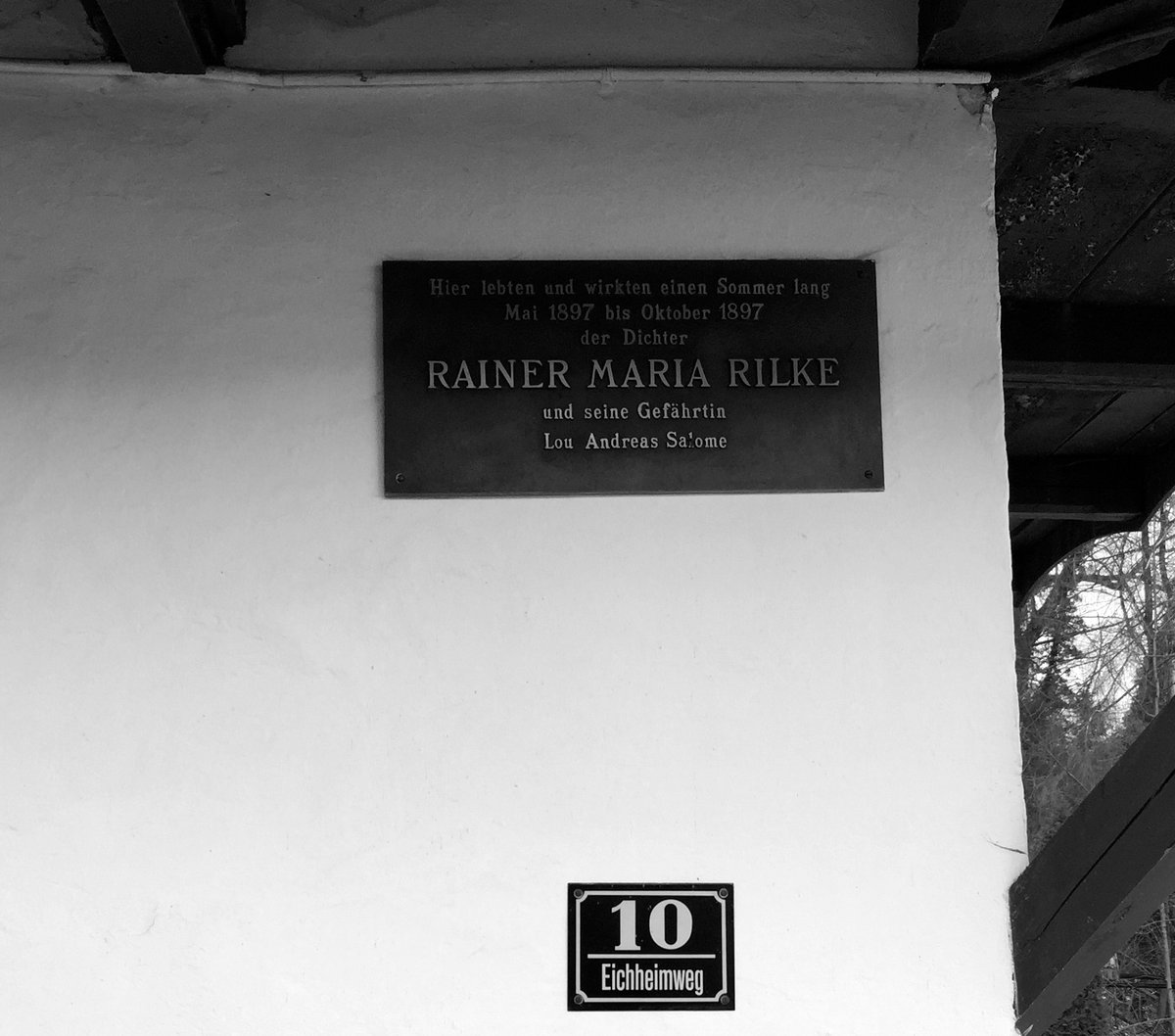
Here lived for a little while one summer A MAJOR POET with his gal pal, Lou. The variation in letter size and capitalization, rendering Rilke's name thrice as grand as the rest of the information, transmitted the message clearly, even to one who doesn't read German.
The house was evidently inhabited, but the owners didn't seem to be at home. Timid evergreen plants grew from plastic window boxes between the shutters, and a handful of terra cotta pots sat against the nearest wall along a curved concrete stair leading from the main door on the side of the middle floor down to another door on the lower floor. There were three stories altogether, with the lower two graded into the slope at the back of the house, so that the main, side door seemed to lead directly into the mountain. Although the smaller door at the lower level was located on the front façade of the house, where one would expect a cuckoo bird to emerge on the hour, it stood several inconvenient paces farther from the stairs leading down to the street than did the side door, and—given its smaller stature—looked too inconsequential to serve as a main entrance. Parked beside this secondary door was a gnome-scaled wheelbarrow holding a small load of dirt, a dead plant of some kind, and what appeared to be a note on a stick. I stepped down a few feet, hoping to use the zoom on my phone's camera to get a closer look at the note without breaching the iron gate surrounding the property. There I caught sight of the wheelbarrow's likely owners, a pair of faded ceramic gnomes lurking behind the far corner of the house. Their "note" to us was only a seed packet, probably identifying the deceased contents of the planter.
Based on the single image I've seen of the cottage when Rilke and Salomé were in residence, the place looks much the same as it did a hundred-plus years ago, with the exception of the gnomes and other lawn tchotchkes. It's a simple, white stucco box with dark wood trim and traditional rustic detailing. But neither the archival photo of that quaint summer cottage, nor the romantic evocation of the shutter, nor the satellite images from the internet hinted at what is most remarkable about Eichheimweg 10, which is the view. Standing still beside the house, looking out across the town of Wolfratshausen toward the mountains on the far horizon feels like flying. The contrast between the Lilliputian cottage interiors and the wide expanse of valley and sky beyond the windows couldn't be more pronounced. Using the span of my hand as a gauge, I estimated the ceiling height of the main floor at under seven feet, or about two meters—a lower ceiling than even those tested by the researchers conducting the "Influence of Ceiling Height" study. If Rilke wrote "Eingang" in Wolfratshausen by candlelight with the shutters closed, he did so from a low-ceilinged state of mind, but that's hardly likely. No pair of scandalously free-spirited bohemian lovers pursuing "full human honesty in artistic matters" would have kept the shutters of their idyllic mountain retreat sealed all day in the middle of summer. And the innuendo of the closed shutter Rilke drew in his letter to Salomé wouldn't mean much if the shutters had been closed all the time.
In front of the cottage and off to one side, the steeple of a pale-yellow stucco church rose from street level, culminating in a gray onion dome topped by a delicate cross resembling an antenna. Including this steeple, the whole church structure reached slightly higher than the cottage, though the cottage was perched far above the roof of the church. A historic account posted in several languages behind a layer of weatherproof plastic sheeting attached to the church exterior asserted that the Katholische Stadtpfarrkirche St. Andreas had existed there since 1484, which means it was present in Rilke's day. From this same poster, we also learned that there were no other cottages visible on the hillside behind St. Andreas in 1910, the date given in the caption of a black-and-white photograph of the church accompanying the narrative. So, Rilke and Salomé enjoyed relative seclusion when they shared the cottage, which is surrounded today by neighboring cuckoo clocks.
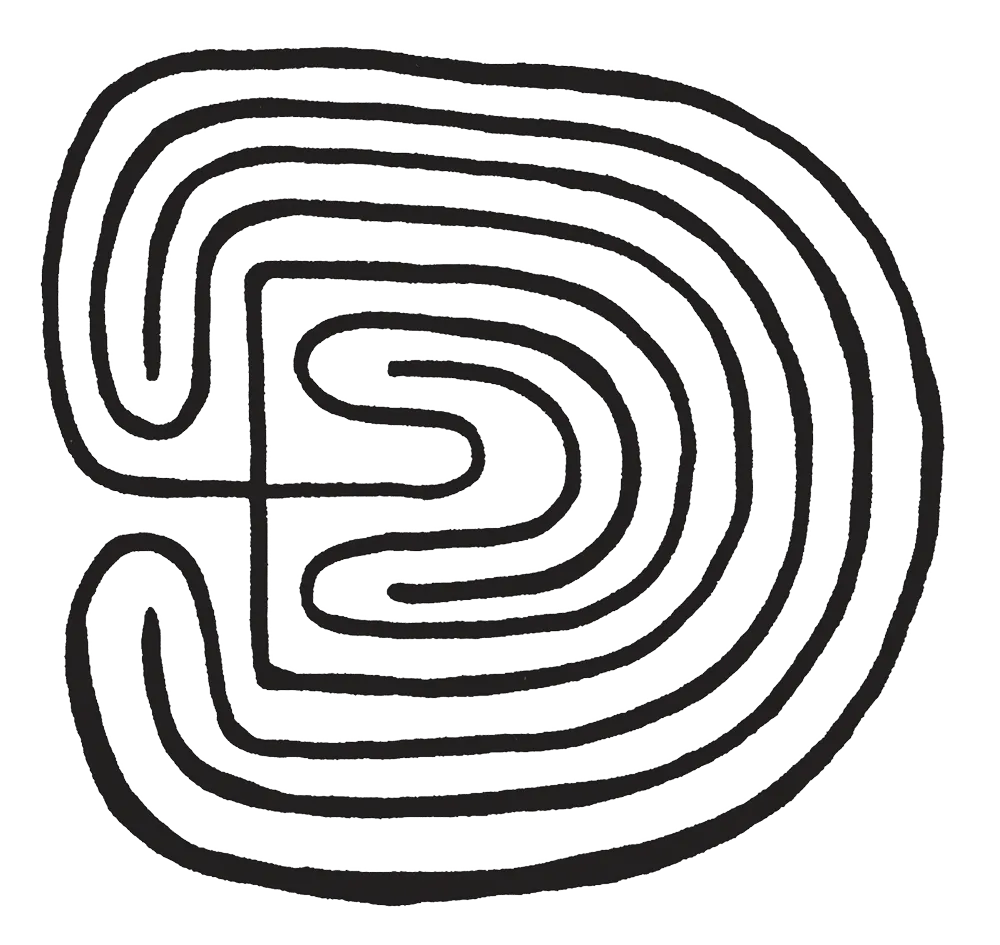
Inside the church a locked iron gate prevented our access to the nave. Seems we weren't the first faithless tourists to wander in from the cold. A narrow shelving unit on our side of the gate displayed some postcards for sale and a collection of brochures and pamphlets in German, which I attempted to decode. I immediately sussed the mother-child support group and the suicide-prevention hotline, but one especially attractive brochure proved perplexing. Unlike the others, with their full-color cover photos, this one could have been produced on site with a laser printer. Its cover featured a circular, maze-like icon in flat black ink, the labyrinth image formed by two entwined coils left blank, like the star in Rilke's shutter drawing. Strangely, one maze tube led from the center to the outside, defying maze rules to create a four-way intersection as it crossed over itself.
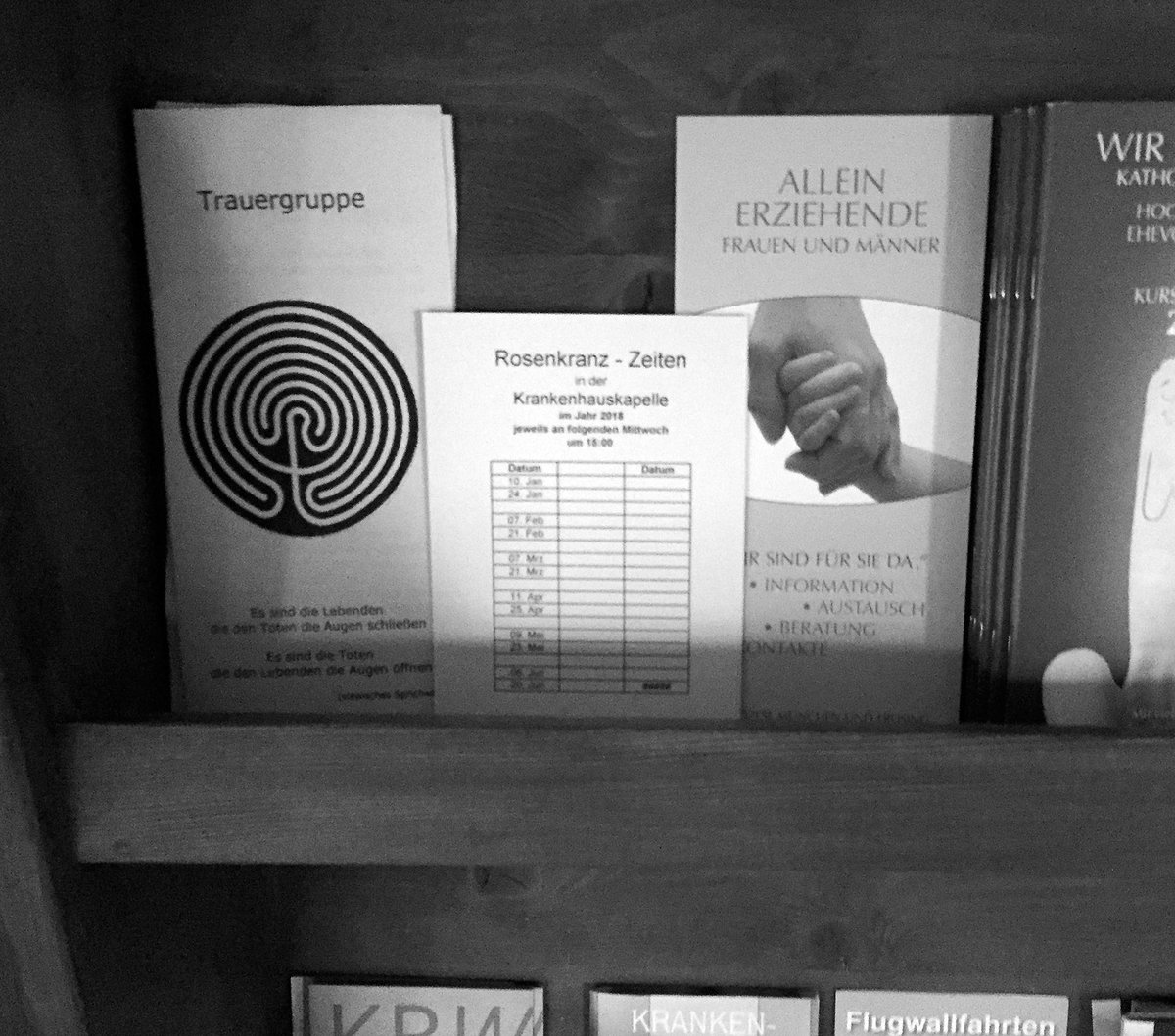
Printed above the icon was a single word I didn't understand, Trauergruppe. I put this into my phone for translation and received "Bereavement group" in response. St. Andreas couldn't have organized an array of literature closer to Rilke's themes if the poet had curated the church pamphlets himself. We selected two postcards to purchase, one of the church exterior and one of the interior, dropped a euro into the slotted donation box, and left for the train. On our way, we passed a bookstore displaying a new biography called Rilke und die Frauen, its cover decorated with portraits of Sophie Entz, who was Rilke's mother, Lou Andreas-Salomé, and Clara Westhoff, the sculptor Rilke met in 1900 and married the following year, much to Lou's dismay. On February 26, 1901, in what she called a "Last Appeal," Salomé wrote, "... in Wolfratshausen I entered your life like a mother. Let me then discharge as a mother the responsibility I incurred ..." but she succeeded neither in thwarting the marriage to Westhoff, nor in cutting off her own relationship with the poet she had nurtured.
I left Munich by plane the next morning, heading for Trieste, a mid-size city on the finger of Italian territory buffering Slovenia from the Adriatic Sea. From the airport, I took a bus northwest along the coast to Duino, arriving around mid-afternoon, in time to visit Duino Castle, where Rilke sometimes lived as a guest of his patron, Princess Marie von Thurn und Taxis. There, he began writing the Duino Elegies in 1912. He dedicated the suite of ten poems to the princess when he finally published it in 1923, following a decade-long writing process marked by brief bursts of energy punctuated by World War I and other multi-year setbacks. Today, the Elegies are considered Rilke's greatest work.
By the time I had dropped my bags at the hotel and figured out how to reach the castle (by walking straight ahead for approximately three blocks), only an hour or so remained to explore the place before closing. The woman in the guardhouse-turned-gift-shop tried to dissuade me from entering at all, but when I pleaded, explaining I would be in town less than a day, she allowed me to proceed on the condition that I should return in the morning for more time, using the same ticket. We conducted the entire negotiation in an ad hoc language of hand gestures, nods, and broken French, since she didn't speak English, and I don't speak Italian.
The air in Duino felt much warmer than in Wolfratshausen, but wasn't yet warm enough to go without a winter coat and gloves. A heavy mist turned to light rain as I proceeded from the gatehouse toward the castle itself, which was situated a distance of perhaps one or two blocks from the perimeter wall, on the very edge of a cliff. Off to one side of the stone archway marking the final stretch to the main building, a tiny sculpture of two frolicking putti presided over a large rectangular pool, which was partially covered by a skein of melting ice. Overhead, leafless vines clung to the old castle walls like desiccated veins. Beneath the seasonal gray mood cloaking trees and sky alike, the scene practically waxed elegiac on its own. Weather aside, the castle seemed to have fallen on hard times. Bits of stucco from the more modern section of the sea-facing façade were flaking off here and there, collecting in splatter piles on the ramparts below. The stucco's soft yellow hue brought to mind the walls of St. Andreas. I pocketed a flake as a keepsake, justifying my crime in the name of quasi-scientific pseudo-research. There were no security personnel or other staff minding the place, and I seemed to be the only visitor at the castle that day, just as my friend and I had been the only ones peeping around the cottage the day before.
I had found pictures of the building's exterior online, but nothing of the interiors, and I didn't know what to expect as far as a museum collection. In fact, I hadn't even wondered about that. I simply planned to show up, have a quick look around, and measure the ceilings. As it turned out, the castle was brimming with artifacts, in addition to what appeared to be the complete furnishings of the last inhabitants. The former can be divided into three main categories, listed here in order from least to greatest according to mass: musical instruments; family pedigree stuff; and Rilke paraphernalia. The musical instruments—especially an impressive collection of violins and violas showcased in an upper hall—were largely segregated from the rest, but the Rilke paraphernalia and family pedigree stuff peppered the entire house. There were also other assorted collections, like legions of toy soldiers representing every era of military history, and a curio of marble eggs, and lots of paintings and china and Greek vases and ladies' fans and taxidermy—even a model of the castle itself—and yet more still. The furniture was cordoned off halfheartedly—it would have been easy to test beds and chairs for firmness without crossing a barricade—but the subtle disarray conveyed by the visible fraying of silk upholstery and the faint smell of decaying finery quelled the impulse to make contact with these items, for fear their decrepitude might be catching. The windows all framed identical views of endless sea, which one expected to find inspiring, but on the day I visited, so many blank vistas only reinforced a creeping sense of isolation and desuetude.
As one would guess, the castle chambers afforded ample headspace. Several ceilings even boasted central murals of heavenly skyscapes—replete with fluffy clouds, angels, and musical cherubs—bound by ornate mouldings. In the princess' wing, the bedroom and adjacent drawing room ceilings measured approximately 12.5 feet, or 3.8 meters tall, according to my hand-span gauge. (Incidentally, a multi-lingual sign printed on a sheet of A4 paper marked the corner chamber next to the lady's bedroom as "THE EMPEROR'S DRAWING ROOM WHERE EMPEROR LEOPOLD I OF AUSTRIA GAVE THE CASTLE TO THE THURN HOFFER VALSASSINA FAMILY." I had not known or wondered until I read that sign how castles such as this were got.) Upstairs, an L-shaped library remained partially stocked with numerous leather-bound volumes stored on shelves wrapping the interior walls. The relatively intimate ceiling height there measured just over nine feet, or about 2.8 meters—halfway between the low (eight feet) and high (ten feet) ceilings subjected to the consumer researchers' ceiling height study.
Poet Mary Ruefle writes in her 2012 essay "I Remember, I Remember," about reading and writing and poets and disillusionment and faith and the moon and Rilke:
I remember reading Rilke's Duino Elegies again and again and again, until I "got" them, until something burst over me like a flood, and I remember, once again, weeping and weeping with a book in my hands.
I've read the Elegies a few times now but haven't yet "got" them that way, the way one might get a castle from an emperor—so much all at once—and I may not ever, though there are a few lines that thrill me for their blunt concision amid the grievous passions of the full poem. Consider this one from the Fourth Elegy:
Blooming makes us think: fading.
I can imagine all of Rilke's work as a prelude or a backdrop to this five-word summary of romantic fascination, which turns sharply from his mystical inclinations, cutting a contrast that strikes this reader with the dry thud of deadpan humor. The succinct precision of the line suggests he might've saved himself the trouble of a life spent in tortured pursuit of art by simply noting at the outset that "beauty evokes death"—though without the life-long labor spent building that whirling backdrop, a line like "Blooming ... fading," on its own, would lack for Rilke's conviction, fall short of poetry, and probably never be read.
The Fourth Elegy wasn't written at Castle Duino, but then again Descartes' dreams weren't dreamt at the place where he wrote his Discourse, so ... taking the one line quoted above as a valid and sufficient sample for the specious purpose of verifying the ceiling height study's claims, I will venture that a mind connecting "blooming" with "fading"—while leaving the subject of those -ings unnamed, yet clearly invoking that subject all the same—certainly operates on the plane of "relational processing" and "higher order abstraction," thus confirming what we already knew to be true: Rilke was a poet. Among the photocopied, laminated Rilke artifacts on display at Castle Duino was a handwriting sample from some of his correspondence, accompanied by a professional analysis, which didn't exactly read as an unbiased or disinterested assessment, but did corroborate my own conclusions:
Guided by a strong imagination and able to learn and associate things very fast, his sense of intuition gives new shape to apparently insignificant things, which become precious and rare thanks to his taste for perfection and symmetry (Distinct, Clear, Methodically Irregular size, Connected, Rightward Slant).
Externally, his refined form is exalted by his lyric works. In his relationships he is able to communicate the power of his emotions with style, which is the hallmark of his personality and excites both admiration and delicate reactions at the same time (Rightward Slant, Flexible, Graphic Context).
That night, at a restaurant in the harbor, I ate with all the mixed feelings of a former vegetarian a simple and unforgettably delicious dinner of fresh, grilled octopus, then returned to my hotel room (average ceiling, neither high nor low), and tried the Elegies again, before finally dozing off at the beginning of the eighth, where Rilke writes about the sense of confinement intrinsic to mortal awareness:
With all its eyes the animal worldbeholds the Open. Only oursare as if inverted and set all around itlike traps at the doors to freedom.What's outside we know only from the animal'scountenance: for almost from the first we take a childand turn him around and force him to gazebackward and take in structure, not the Openthat lies so deep in an animal's face. Free from death.Only we see death; the free animal has its demiseperpetually behind it and always before itGod, and when it moves, it moves into eternity,the way brooks and running springs move.
For millennia, people have believed they were living in end times. Our presence here indicates they were wrong. Unfortunately, it doesn't stand to reason that because many billions of our predecessors have been wrong about humanity's imminent demise, so must we be. Until recently, our ancestors didn't possess technologies of devastating mass destruction like hydrogen bombs and genetically engineered pathogens. Nor did their mere existence amount to a planetary ecological threat. From the first stone tool to the latest algorithm, every significant technological innovation has afforded some advantage for our continued evolutionary success while introducing new, typically unforeseen vulnerabilities; human ingenuity inevitably precipitates consequences that in turn require further ingenuity to address. That the cycle never ends but always could may be the point. To date, Homo sapiens has succeeded in exponential proliferation, inhabiting nearly every region of the globe, meanwhile doubling average individual lifespan as compared to our Stone Age forebears. As far as we know, we haven't yet created a problem we couldn't ultimately solve, but—judging by the growing backlog of spectacular new threats we've produced since the dawn of industrialization a mere five to seven generations ago—we are evidently compelled to chase that horizon. The concerning fact of the matter is that each successive human generation is better equipped than the last to destroy civilization and even life on earth.
So, have the doomsayers been right all along, in principle if not in particulars, about our impressive winning streak soon coming to an end? Are the walls we've built finally closing in on us? Or is our long-sustained state of self-perpetuated unstable equilibrium some kind of metabolic, evolutionary sweet spot—a vulnerable abode we're relentlessly compelled to expand and renovate, like big, insatiable ants? What guidance do our Cartesian metaphors present? And what traps? And how can we even know?
I set out early the next morning to hike the cliffside gravel path known as the Rilke Trail, located in the nature reserve along the Duino Cliffs, conveniently accessed from the other side of my hotel. Standing here, in early 1912, Rilke experienced voices on the wind, or at least a sudden flash of inspiration that delivered unto him the opening lines of the First Elegy ("Who, if I cried out, would hear me among the Angels' Orders?"), which he duly transcribed in his notebook. Around this same time, on January 10, 1912, he wrote to Salomé, "It is only too bad that Nature here elicits almost nothing from me, even the sea leaves me indifferent; as if this gross Austrian mixture of languages stripped even the landscape of its unified straightforward expression ... I long for Naples, or I would like to walk for hours in the snow through the woods and afterwards drink delicious coffee with you." In a series of letters, he confessed to her his anxiety that he might be washed up—either dulled as an artist by "growing old," or destroyed more precisely by the effort of the novel he had finished two years prior—as well as his ambivalence about the solitude he found necessary for work, yet insufficient for life, and possibly even perilous.
Halfway through my morning walk, the sun burst forth like a satisfied diva, instantaneously transferring the balance of spring from winter to summer. I might have heard the angels sing myself then, if I believed in angels. Instead, I removed my down jacket to the faint soundtrack of traffic and waves, and relished the day's warmth on my exposed forearms. Looking back every few minutes at the castle shrinking in the distance, I noticed how much more massive it seemed from afar, when the whole thing could be taken in at once. Given its strategic location on a jutting bluff, one is necessarily up against or underneath the castle if one is near it at all. At close range, one sees only a single wall, or perhaps only the hospitable inner courtyard, or else, looking out, only the surrounding sea. No available angle affords comprehension of the building as a whole, so that being at the castle feels even more like being inside another body, or perhaps another self, than do most architectural enclosures.
On the trail, I passed several historic markers indicating strategic lookouts built along the cliff during World War I, then reactivated during World War II, when the area "became the base for pocket submarines of the German Navy, and the Austro-Hungarian fortifications [of WWI] were adapted as anti-aircraft emplacements." Today, the sites serve as scenic overlook points. Most read as rock piles, though at least one includes a set of stairs leading down to a door. The last sign I encountered explained that the current castle (located one jut over from an even older castle, now a ruin) was originally built in the 1400s, has belonged to the noble Thurn und Taxis family since the end of the 1800s (thank you, Emperor Leopold I), but was entirely rebuilt in the 1920s, due to its having been "almost completely destroyed by Italian heavy artillery" during WWI. Ergo, the rooms I measured the day before weren't any Rilke had known; they didn't even exist until after the Elegies were published.
Upon returning to the castle for a final look around, I was happy to find it transformed by the day's sun. Yesterday's bleak gray sea glimmered aqua, and even the steeply terraced gardens below the castle, little better than an indiscernible mass the previous afternoon, now pulsed verdant with evident will to live. I followed a grand elliptical staircase from the princess' wing down to a lower patio along the ramparts facing the sea, which I hadn't been able to access the day before. Here, at one corner of the old rampart, in the center of a rectangular area the size of a room, a heavy stone tabletop balanced on the heads and folded wings of two stone griffins, who faced outward, toward the sea. Assorted signs in various languages decorated the safety fencing around the perimeter. The Italian one, positioned directly in front of the table in the eye line of the stone griffins, read:
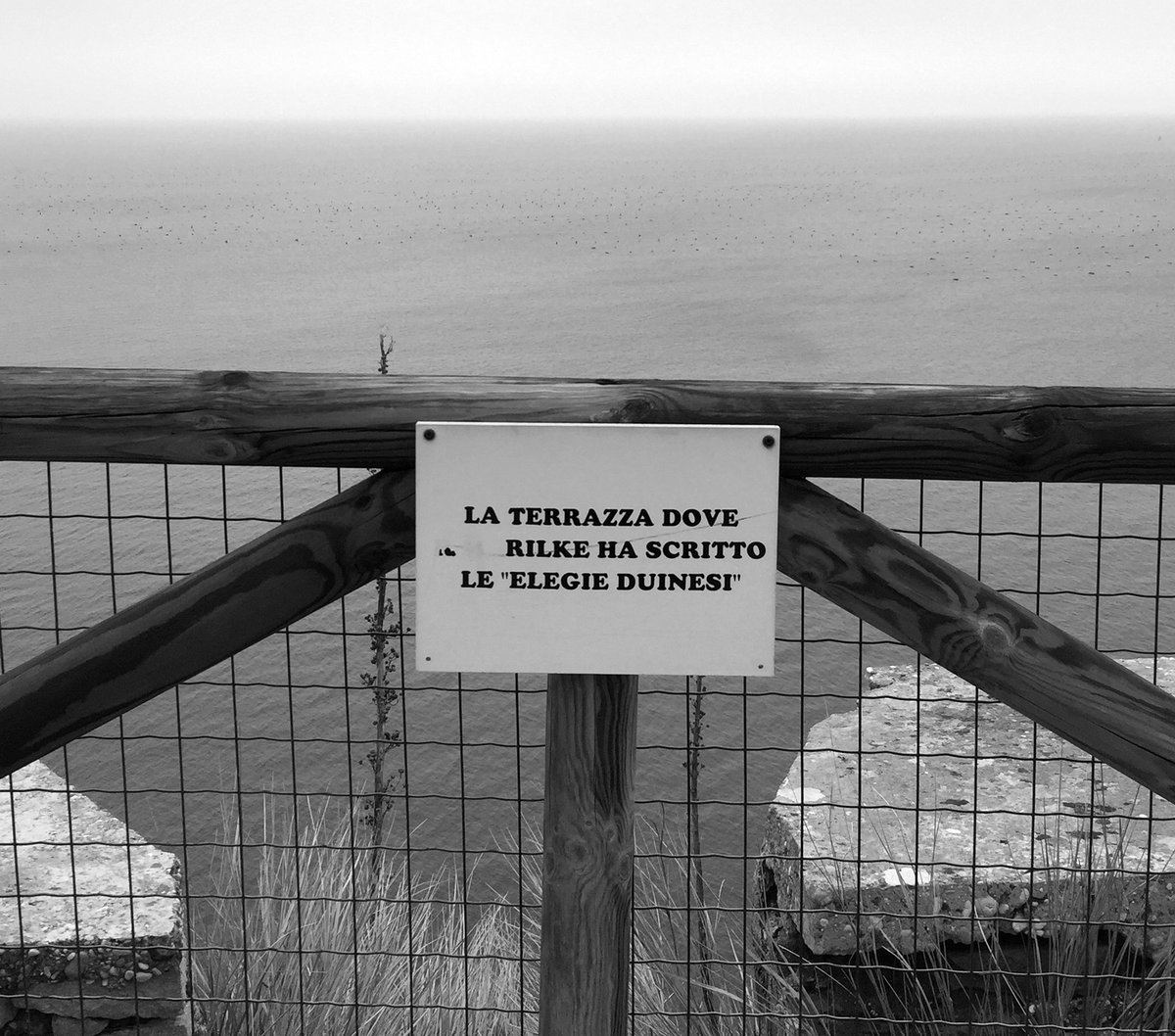
If the signage is to be believed, Rilke wrote the first bits of the Elegies sitting here, between two mythical beasts, under no ceiling at all, his back to a yellow castle, facing the infinite distance beyond. That the castle was all but destroyed during WWI would explain the deep crack across the massive stone tabletop and its one missing corner, disappeared from the rest of the stone like a bite from a sandwich.
Drafted for military duty in 1914, Rilke would spend two years in service at the War Archive in Vienna. By that time Salomé had met Freud there and undergone psychoanalysis with him. She and Rilke reunited periodically between 1913 and 1915, seeing each other for what would be their last time in summer of 1919—half a life, in Rilke's years, since their first encounter. Rilke published the completed Elegies in 1923. He was by then experiencing worrisome health issues, but the significance of these was partially obscured, at least for Salomé, by ongoing concern for his mental issues. In his last letter to her, sent December 13, 1926, from Sanatorium Valmont, overlooking Lake Léman in Switzerland, Rilke describes immense physical pain, beyond the hells, "how many hells," he had previously known. "Where to find courage?" he asks, concluding, "There is something malign blowing through the end of the year, something menacing." He signs off in Cyrillic, an alphabet they shared, which Rilke had acquired during their first chapter together, when the two traveled extensively in Russia. "Farewell, my love." He died of leukemia two weeks later, on December 29.
The Trauergruppe graphic I saw in Wolfratshausen grabbed my attention in part because it was almost identical to something I had seen exactly a year earlier at Taawaki, near the Grand Canyon in present-day Arizona. Taawaki, also known as Dawa Park, is the ancient archive of the Hopi, who have lived continuously in its vicinity for a thousand years. Access to the park, which consists of a natural enclave of large rock faces covered in petroglyphs, is currently restricted, as vandals have jeopardized the site over the past half-century, defacing the glyphs, some of which are up to 2000 years old. But we were invited there by our guide, Gary, a Hopi man, who explained that the signs carved into the rocks are thought to have been made by people passing through the area on pilgrimage to the Grand Canyon, a sacred site, and that Taawaki itself may have been a market or other significant meeting point along this path. Glancing over the rocks, I asked Gary about the maze of concentric rings that immediately caught my eye, as targets will. His reply was uncharacteristically vague. I gleaned only that its meaning had something to do with the cycles of life.
A gas station gift shop I browsed the next day rendered a more extensive answer via The Book of the Hopi, written by Frank Waters in collaboration with thirty elders of the tribe. The book, first published in 1963, recounts the history and particularly the mythology of the Hopi, and in this it represents a milestone of some kind. Before Waters' book, the Hopi had been known to elude anthropologists by providing false histories and bogus explanations in an attempt to protect their culture, which makes perfect sense, considering that for generations their children had been forcibly removed from them by the federal government and interned at so-called boarding schools—a purported effort at assimilation that entailed suppressing native languages, among other brutal physical and emotional abuses. Not until 1978, with passage of the Indian Child Welfare Act, did Native American parents gain the legal right to refuse government abductions.
According to The Book of the Hopi, the symbol I spotted first at Taawaki and again in Wolfratshausen stands for the idea of emergence. In plan view, it is the image of a mother embracing a child. It is equally an architecture, a map, and a universe. To the Hopi, it represents the journey of life, like Gary said.
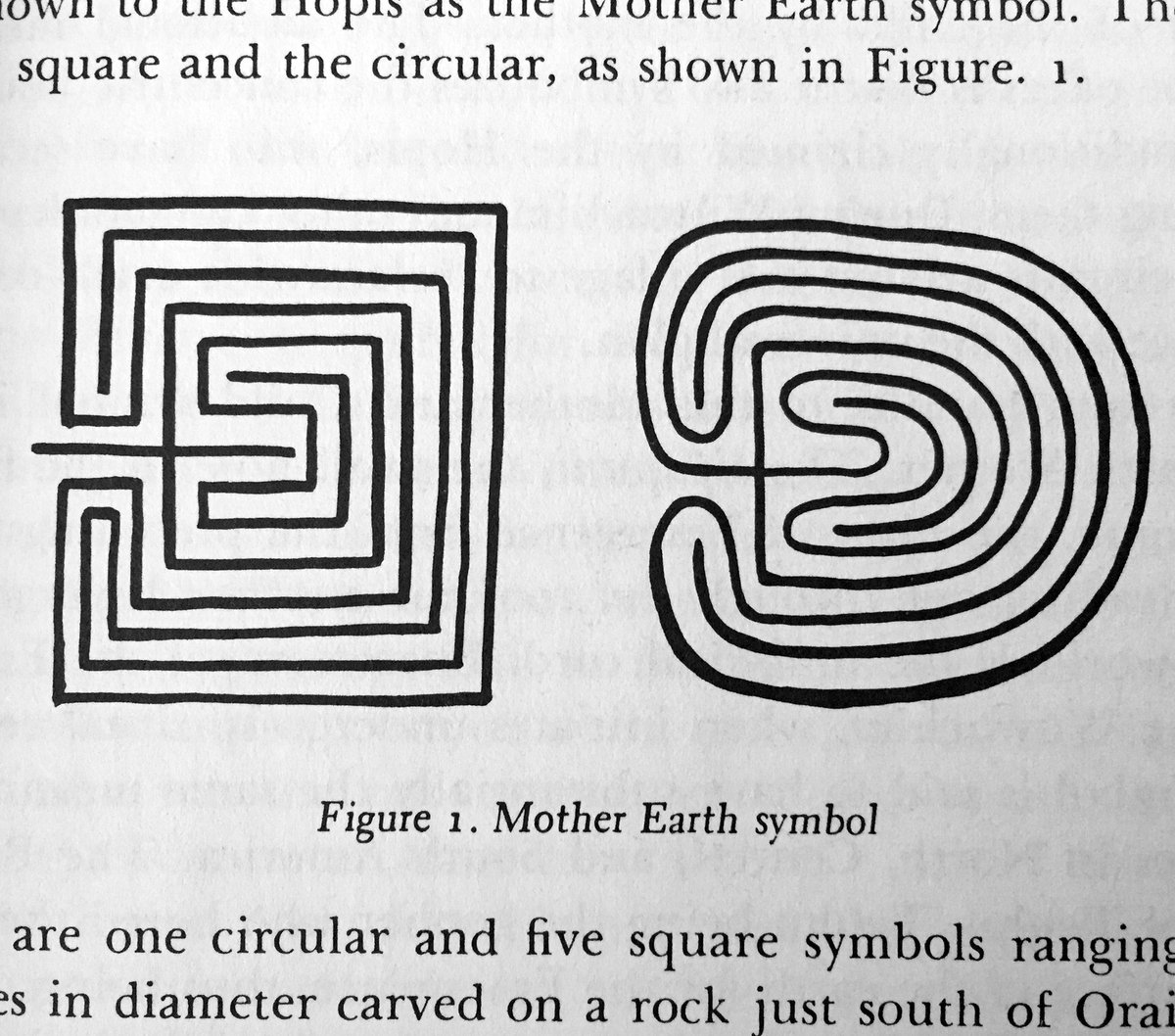
As Gary also explained (and Waters approximately corroborated), Hopi mythology relates a cyclical universe in which human society repeatedly destroys itself through violent conflict every several thousand years. The few remaining survivors are led to inhabit a new phase of being by a humble bird who flies through a hole in the sky, emerging on the other side from a hole in the ground of what will become the next world. In other words, current parameters are temporary illusions, and transcending them only delivers us to a next enclosure. "Outside" and "beyond" aren't meaningful in the ultimate, Cartesian sense. Indeed, according to Gary, the Hopi believe that the site of humanity's most recent emergence exists deep inside the Grand Canyon, though Waters claims otherwise, writing instead that the river that flows through the canyon, not the supposed hole in the ground, is the important feature for the Hopi creation myth, in that it symbolizes an ancient journey across water to the Americas, which may be how the Hopi ancestors arrived millennia ago.
In any case, a worldview rooted in the metaphor of birth permeates the linguistic signs, physical architecture, and basic social structures of the Hopi, who are a matrilineal clan society, meaning not only that one's clan identity—one's name—is that of one's mother's clan, but that historically at least, only women owned property. Their ancient architectural tradition, preserved for thousands of years, includes underground structures built for sacred ceremonies, called kivas, from which one reemerges into open air as if from the womb, through what appears from the outside to be a literal hole in the ground.
If there were an architecture to embody Rilke's "Eingang"—
Whoever you are, in the evening stepout of your room, of which you know each part;yours is the last before the infinite,whoever you are.
—it would be a kiva, where the relationship between an enclosure and its beyond has less to do with shelter or resistance (inside versus outside) than with passage. Whereas a cathedral imports suprahuman space, enclosing significantly more of it than do mundane structures, thus emphasizing conclusively the small stature of people inside, the bodily proposition of a kiva isn't concerned with the minute scale of individual beings, but with the world-transformative acts of coming and going. A kiva is a pregnant space. Its ceiling culminates in a door.
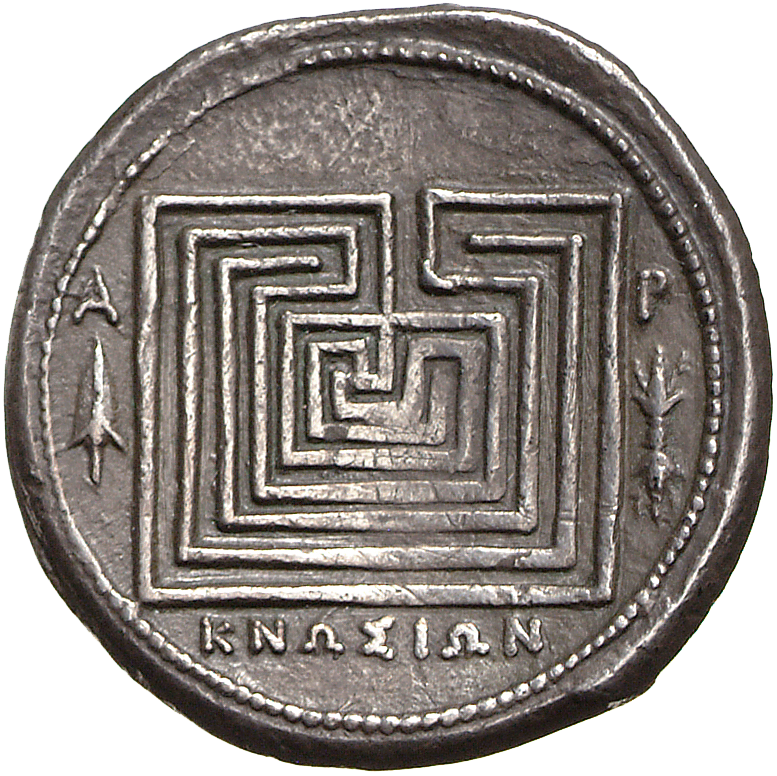
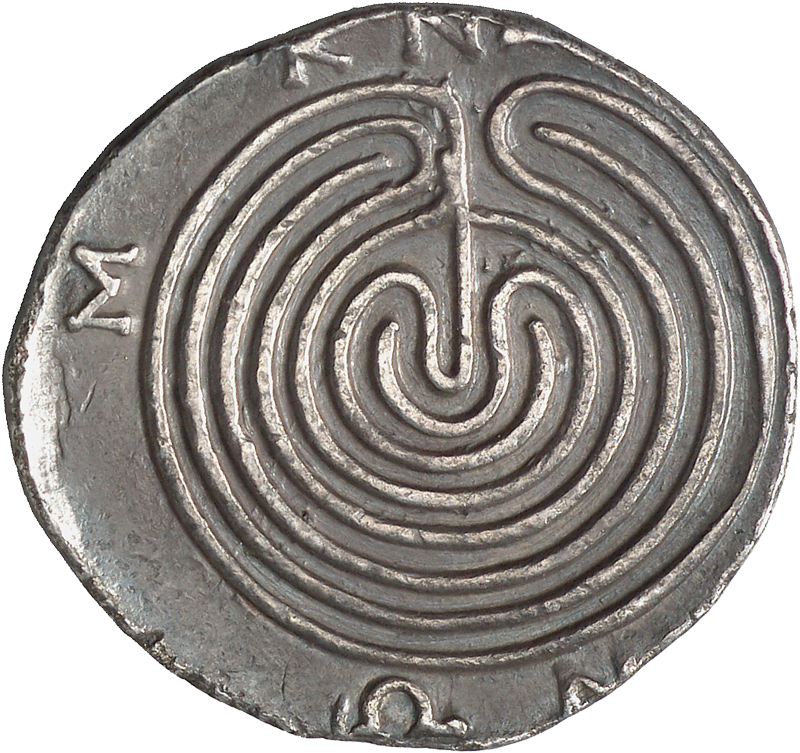
Of course, the doomsayers have been right all along. We are living in end times, up against the extent and limit of our experience, including our knowledge, indefinitely suspended at the threshold of some new unknown, which is every next moment. On off days, as Rilke understood too well, living inside awareness of finite capability plus infinite possibility can induce intolerable anxiety—the sort that won't be subdued by even Descartes' most entrancing attempts to liberate mind from matter. An abundance of information makes faith in an "essence or nature" with "need of no place" as insupportable as it is comforting. The same goes for narrative, more generally, and above all for poetry, which specializes in indefensible truth. Yet, wheels are evidently built to turn. So, an ancient symbol of emergence will travel along a maze of several millennia to confront a stranger at a brochure stand, where it will seem to thread together "distally and more abstractly related associations"—reconfirming that reality is ruled not only by physical laws, but also by the logic of our collective dreams. Then again, as Waters noted and a quick internet search confirms, the symbol of Hopi emergence is the exact same as the Labyrinth of Daedalus that appeared on ancient Cretan coins, proving instead that one woman's hole in the sky is another's prompt for some more grounded explanation.