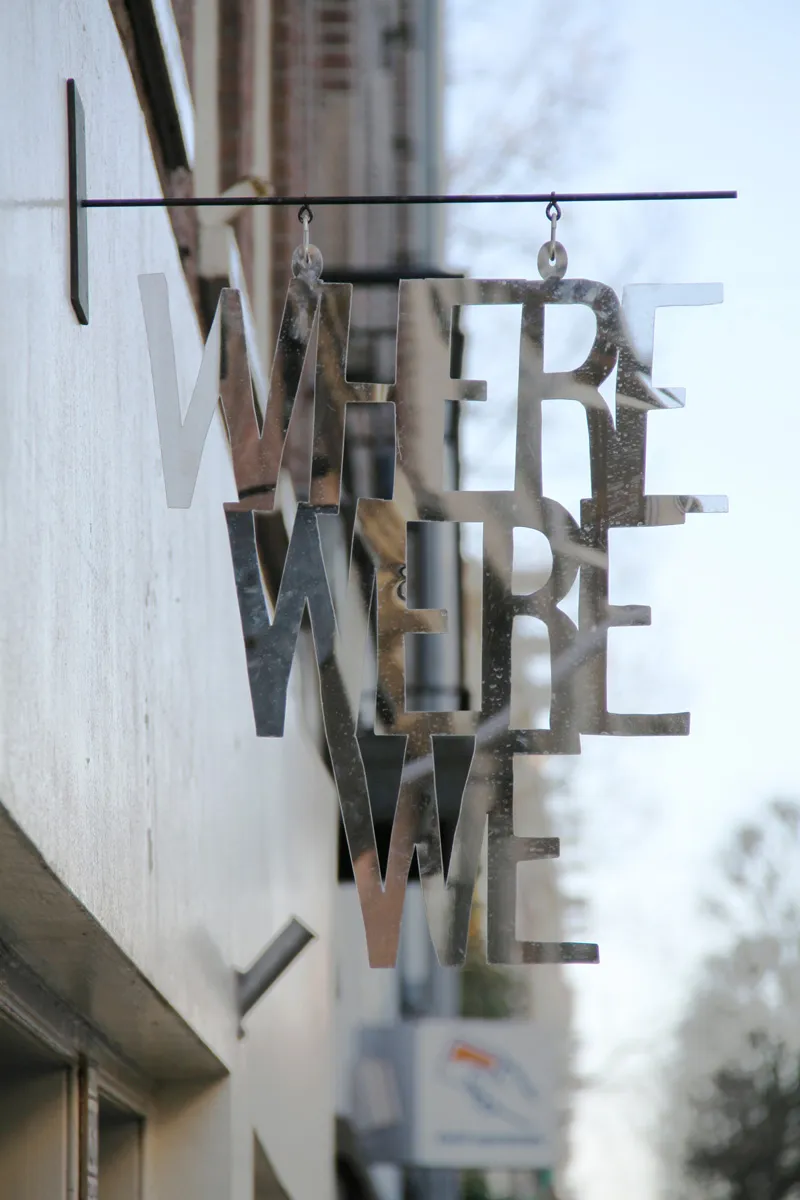
Where Were We
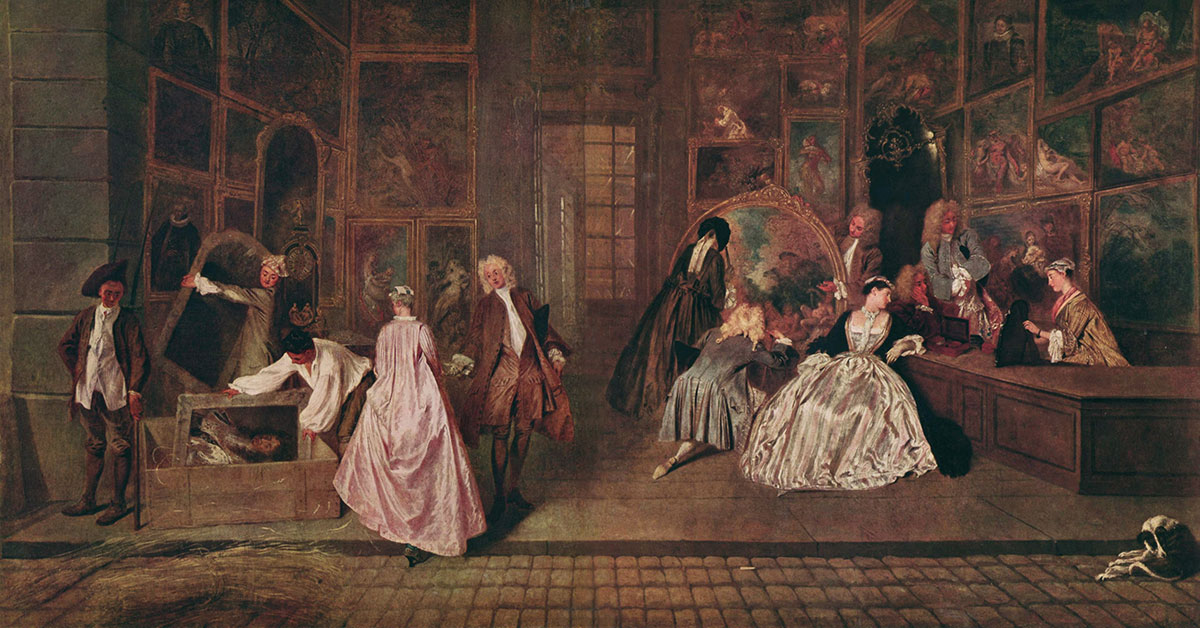
There is a pleat, or a certain type of gown, known as a Watteau Pleat or a Watteau Gown, though the painter Jean-Antoine Watteau doesn't seem to have had much to do with its invention.
He merely depicted the look repeatedly, famously, and once in petal pink satin on the back of a woman ascending a step. The latter stars in a shop sign commissioned by a man who made his living selling art and baubles to aristocrats, though it's unclear whether artist or client truly expected the painting to advertise anything other than itself. Indeed, the sign depicts aristocrats shopping for art and baubles, but a buyer acquired it from Edmé-François Gersaint, the shop owner, almost immediately; Watteau died shortly thereafter; and now the work is considered his final masterpiece, rather than, say, a watershed in the history of sign making.
Novelties browsed by the clientele in Gersaint's actual shop included ornate mirrors, articles for the vanity table, and paintings of various sizes and subjects. In Watteau's version, frolicking nudes, religious tableaux, and regal portraits line the stall, which is open on one side like a doll's house. The lady in the pleated pink sack gown steps up from a cobblestone street to enter the shop as if to cross a proscenium. One foot in the scene, the other still lingering outside, she hesitates to place her right hand in the open palm of the solicitous, curly wigged man who attends her. Instead, she looks away from him, over her left shoulder, down toward two workers who load a framed mirror and a painting of the old, dead King Louis XIV into a crate. Her silk cape extends from the gaping booth like a wet tongue while, a few feet away, at the opposite edge of the painting, a mongrel dog strains to lick his haunch.
No one in the painting makes eye contact with another. The clerks regard their customers, the customers regard the paintings, the gentleman regards the lady, the lady regards the workers, the workers regard their work, and the dog minds a flea. Distraction is their common drama.
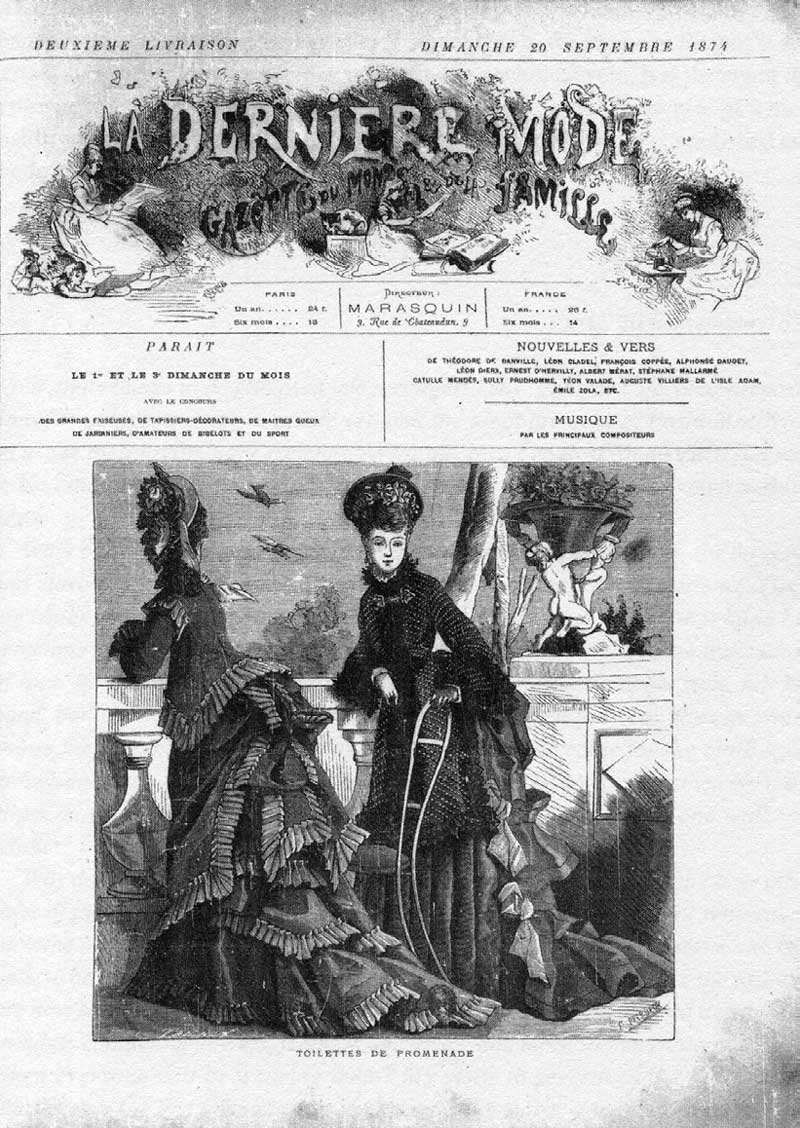
A century-and-a-half after Gersaint's sign changed hands, Stéphane Mallarmé wrote, edited, and designed several issues of a fashion magazine called La Dernière Mode. Published in 1874—as far from us in time as Mallarmé was from Watteau—the journal is categorically indistinguishable from other such contemporaneous publications, though likely better written. That is, one cannot determine on the basis of its execution whether the esteemed poet created his magazine in earnest or to parody the genre. Perhaps for this reason, La Dernière Mode was long ignored by scholars, who had difficulty integrating the apparent non sequitur with the rest of the poet's oeuvre. Under several pen names, each imparted with a different voice and agenda, he filled the pages of the magazine almost single-handedly. Marguerite de Ponty, its supposed editor, wrote a lengthy column on the topic of jewelry for the premier issue. She begins,
Too late to speak of summer fashions and too soon to speak of winter ones (or even autumn ones). Though several great Paris Houses, as we happen to know, are already busy over their end-of-season selection. Today, in fact, not having to hand the elements needed even to begin designing a new toilette, we would like to chat with our readers about the objects which serve to complete a toilette, i.e. jewels. A paradox? No: is there not, in jewels, something permanent, fitting to speak of in a fashion journal still in suspense as to what was fashion in July or will be in September?
From there, she-he continues to muse through several hundred words on the art of jewelry and its proper applications for girls and women of various ages in various circumstances.
... Who is interested in bracelets? I saw a splendid one yesterday made of gold and rubies: then several rings of brilliants, or emeralds, or with cameos (these last are coming back into fashion). I leave it to you to choose the clasp for the shawl ... Nevertheless nothing can ever rival a fan, with a setting as rich as you please or quite simple, but affirming, above all, ideality. What sort of ideality? That of a painting: an old-master one, of the school of Boucher or Watteau, or even by them ...
A footnote to "Boucher or Watteau" from this passage in the English translation, published only a decade ago by P. N. Furbank and A. M. Cain, points out that the Goncourt brothers, contemporaries of Mallarmé's who disdained his work, "had recently tried to revive an interest in these eighteenth-century painters." Some years later, Edmond de Goncourt began publishing the daily journals kept by the brothers, or eventually just by Edmond (Jules de Goncourt died of syphilis in 1870), which were full of gossip-worthy details about the lives, habits, petty behaviors, and fashions of the artists of the day, including, for example, Baudelaire, Zola, and Flaubert.
Flaubert's Madame Bovary (1856), had she been conceived twenty years hence, would have stashed issues of Mallarmé's magazine in her mental bunker, among other Parisian fashion rags, those "imaginary assuagements for her personal lusts." And the same moral ambiguity attaches to Madame Bovary as to La Dernière Mode. While we don't know whether Mallarmé intended to mock the cult of fashion along with other theaters of bourgeois aspiration, perhaps even in direct response to the frivolities and delusions of the brothers Goncourt, we do know that, like Flaubert, he lavished considerable time and care on the endeavor. This critical mass of attention itself constitutes a certain valuation; regardless of the artists' motives and whatever verdicts they may have privately passed on their subjects' indulgences, if, as Flaubert reportedly said, "Madame Bovary, c'est moi," so, too, Madame de Ponty is Mallarmé, just as that browsing, pink-robed aristocrat is Watteau.
But what did it mean (if it is true, as poets say, that a dress means something?)
Marguerite de Ponty asks the question in issue six and reiterates it in number eight, the final installment of La Dernière Mode:
In a publication studying fashion as an art it is not enough (not by any means!) to cry: "You must wear such-and-such." One needs to say: "This is why," and "We told you so!"
An online image search for "watteau" returns pictures of his major works rhythmically interspersed with contemporary bridal gowns modeled against seamless gray or blush backdrops. From the eighteenth-century Watteau Gown, assorted costumes—a "Cheap Watteau," a "Luxurious Strapless Watteau," and a "Watteau Train One Shoulder Short Dress," to name only a few—have evolved to outfit modern day wedding role-play. The style gives form to a fantasy of the good, bucolic life: a time before the Revolution (whichever one), when silk-clad haves watched the world through airy gauze on mild summer days while submissive have-nots did their bidding. But unlike Watteau's sign, a studio shot of a readymade wedding dress conveys no hint of irony—no mangy dog conducts his business in the corner, no narrator interprets the look under a winking nom de plume. The model in a Cheap Watteau wedding number is a Bovary refracted and unbound.
Just as the passive, coy half of Watteau's, Mallarmé's and Flaubert's alter-egos is memorialized in countless white garments on innumerable wedding days, the other, greedy, sexually insatiable (and often violent) half has fueled the entertainment industry for at least as long as show business has been big business. The young distributor and theater owner William Fox launched production in 1914 of A Fool There Was, a story adapted from a play based on a painting (!) by Philip Burne-Jones of a woman in a négligée, who may have been a vampire, as well. In the painting, the woman/vampire sits on the edge of a bed, dominating a ravaged male lover who is either asleep or dead beneath her. In the movie version, a seductive young woman/vampire rather warmly dressed in modern, straight-cut clothing ruins a successful family man. (More plot detail might make a better synopsis but would obscure the bottom line—that an unattached woman in sophisticated clothes spells big trouble for the stolid bourgeois.)
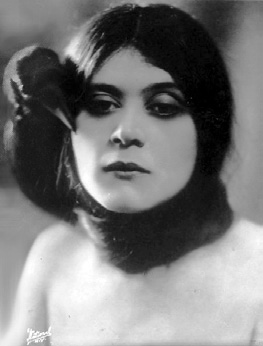
Though female vampires had begun titillating cinema audiences some years earlier, A Fool There Was created a sensation, turning its lead, an unknown named Theodosia Goodman, into a star overnight. Goodman was either a mediocre actress or a fine one who convincingly played a mediocre one. Early moviegoers knew her as Theda Bara, a fiction cooked up by the public relations people working for Fox Studios when it was still a fledgling company, before receipts from Bara's films helped Fox swell to a behemoth. Most of those films, with the exception of A Fool There Was and a handful of others, are gone now, as are most people old enough to remember seeing them. Box office accounts, reviews, and images survive, but they're ambivalent in their judgments of Bara. After her stunning debut as a bloodthirsty home-wrecker, audiences only really loved Bara when she again played the vamp, while critics occasionally respected her when she (very rarely) didn't.
According to confused immigration authorities, Bara's father, a master tailor, hailed from "Poland, Russia." Her Swiss-born mother was a wigmaker. Both eventually became owners of successful businesses in their respective costume trades, acquiring the means to raise children in upper middle-class Cincinnati comfort. Theda and her siblings were well-dressed, well-educated, and encouraged by their parents in their leisurely pursuits. After spending some time in college, Bara moved to New York, where she attempted to forge a stage career with little success. Almost thirty years old when she finally landed in front of a movie camera, she made a marketing decision to reduce her age as well as her name.
Bara is alternately captivating and plain in photographs, yet she was once considered the most famous woman in the world. That Marilyn Monroe was the Theda Bara of her generation should put things in perspective: the fact that you probably haven't heard of Bara, for one, or that you can't bring to mind an iconic image of her. All in all, she was an unlikely candidate for the office of erotic scarecrow she ultimately attained, but under the weighty caulk of garish screen makeup, she put sloe-eyes and round hips on a new, cinematic archetype—the femme fatale. And thus, like Watteau, Bara inadvertently popularized a form that grew up and away into an icon itself, outlasting her own notoriety.
"What is the meaning of a dress?" Mallarmé asked.
Unlike, "What is the meaning of a flower?" the question can be answered. Most people ponder the matter every time they put on clothes, or make or buy or even see some. But much like, "What is the meaning of a sign?" the query is so persistent in our daily experience that it necessarily disappears from conscious, critical awareness, while a thousand subtle answers register with every scanning glance of a crowd or an image.
Even fashion industry leaders, who profit directly from our fascination with our own and everyone else's attire, often dismiss the attention we give it. Madeleine Vionnet, one of the most successful and influential designers of the twentieth century, lamented of the haute couture in 1932, "How much time, thought and energy is wasted on this tyrant [...] how out of proportion is the importance of fashion in the life of most women. How they strive, poor souls, never to fall behind in this rat race!" Born outside Paris to working class parents in 1876, the young Vionnet, lived with her grandmother and then her father after her mother left them to pursue other interests. She had hoped to remain in school beyond her primary years and was striving toward a scholarship when a seamstress neighbor convinced Mr. Vionnet that the girl should be put to use instead. And so, at the age of eleven, she became an apprentice. Overworked and poorly paid at her first post, by twenty-three, she had already married, divorced, and moved to London on her own, where she lived for several years before returning to France an accomplished and well-respected artisan. She mastered much more than dressmakers' techniques in the coming decades. Following some ups and downs punctuated by the First World War, she eventually built a thriving international business of more than a thousand employees. To these workers, who were predominantly women, she also provided medical and dental care, paid vacation and maternity leave, and a path to financial independence.
Vionnet's criticism of the fashion-obsessed class was well founded, albeit surprising, considering their place in her personal economy. As Betty Kirke, costume historian and biographer of the designer, writes of that class' resort lifestyle in her 1998 book, Madeleine Vionnet, "From noon to one, women needed a bathing suit and cape for the beach; at one, a spectator-sports outfit. Around two, it was lunch; in the afternoon, it was tea at the club. If one played golf, one wore a short skirt or a jumper. If not, one dressed in an afternoon dress. In late evening, one dressed formally for private parties and the casino." Little wonder they were preoccupied—all that dressing and undressing to dress again would have left few hours to bother with much else. And little wonder, too, that Vionnet's designs appealed to them. Though Paul Poiret, a contemporary of Vionnet's whose long, straight silhouettes informed Bara's wardrobe in A Fool There Was, is generally credited with dismissing the corset from women's clothing (and the waistline along with it), in fact Vionnet pioneered the possibility. She also invented, among other innovations, the bias cut, while importing to contemporary dress such time-tested comforts as the kimono sleeve and the Greek cloak, and introducing ingenious geometric forms made to flow and drape over figures of every proportion without requiring domestic staff or sympathetic roommates to tighten and loosen one's constrictive undergirdings. The effect of Vionnet's work seems to have been liberation all around—for her clientele, as well as her employees. Of course, the clothes were also dazzling. One could wear most of her designs today without appearing outmoded, especially as her ideas have been continuously quoted and copied in the decades since her departure.
When Mallarmé began publishing La Dernière Mode two years before Vionnet's birth, his short-lived magazine was filled with hand-rendered illustrations. By the time Vionnet moved to London twenty years later, the fashion industry had evolved, along with mass media, to incorporate photography and, incidentally, to better facilitate celebrity. As actresses and socialites became recognizable to a broader public, public demand for the tastes they modeled grew, along with the proliferation of their stylized images, and the speed of fashion cycles increased accordingly. Novel circumstances like "resort" seasons and modern sports required additional ensembles. Novel cuts and techniques, many of which Vionnet developed, permitted the possibility for more streamlined fabrication processes, requiring less customization, which in turn laid the groundwork for "ready to wear" collections and industrialized garment production. Within the span of Vionnet's career, Western women moved from wearing handstitched, floor-length dresses buttoned atop corsets and bustles, and designed to cover their skin from neck to wrist to ankle, to wearing mass-produced pantsuits and bikinis, while their likenesses graduated from laboriously hand drawn lithographic plates to mechanized cinematic projections like Bara's, Dietrich's, Crawford's, and Hepburn's.
Vionnet herself wasn't especially interested in surfaces, whether literal or metaphorical. She considered herself more of an architect than a designer, insofar as "design" implied sketching visual concepts for interpretation and execution, whereas architecture involved thinking spatially in terms of mass, gravity, construction, and movement to produce dynamic, three-dimensional forms. She preferred to compose her garments directly, draping fabric over miniature wooden figures, rather than sketching on paper first, which earned her the accolade of "technician" from admiring staff. She outsourced coloring, textile design, embroidery, and other embellishments to a network of talented aides—artists and designers in their own rights—which she cultivated throughout her career. She also shirked the spotlight, resisting the imposition of a public image, and in this she differed from some of her contemporaries, like Coco Chanel, who relished personal publicity. Instead, Vionnet was more like Bara, who had disappointed press photographers and gossip columnists in search of a man-eater, reportedly living with her mother and sister during the rapid rise and peak of her career, and, for pleasure, preferring books to parties. But Vionnet, again like Bara, seemed to grasp very well the power of images in the public imagination, and she proved a skilled public relations strategist, as evinced by both the commercial success of her business, which survived until the outbreak of the Second World War, and the ongoing influence of her signature work.
Regardless of Vionnet's own aversions, her wealthy and well-heeled clientele relied on her to help themselves stand out in crowds and, increasingly as time went on, in pictures. Their collective intuition—that attention amounts to valuation—has only become more evident in the early decades of the twenty-first century, as satellite-enabled, wireless global communication and broadcast capabilities have landed in the palms of more than four billion mobile phone owners and counting, with half of these being smartphone users, who, in effect, carry on their persons compact video production and distribution facilities enabling anyone with a data plan to do the work of a modern-day William Fox. On the other hand, with the near-total dissolution of any Western taboo regarding female nudity, a woman's clothing rarely garners the same attention today that it once did in Mallarmé's or Vionnet's eras. Among would-be celebrities and aspiring social media "influencers," trend lines have long bent toward complete undress instead, from Marilyn Monroe's Norma Jean–period pinup shots to Paris Hilton's amateur porn movies and Cardi B's rapid propulsion from adult entertainer to global phenomenon.
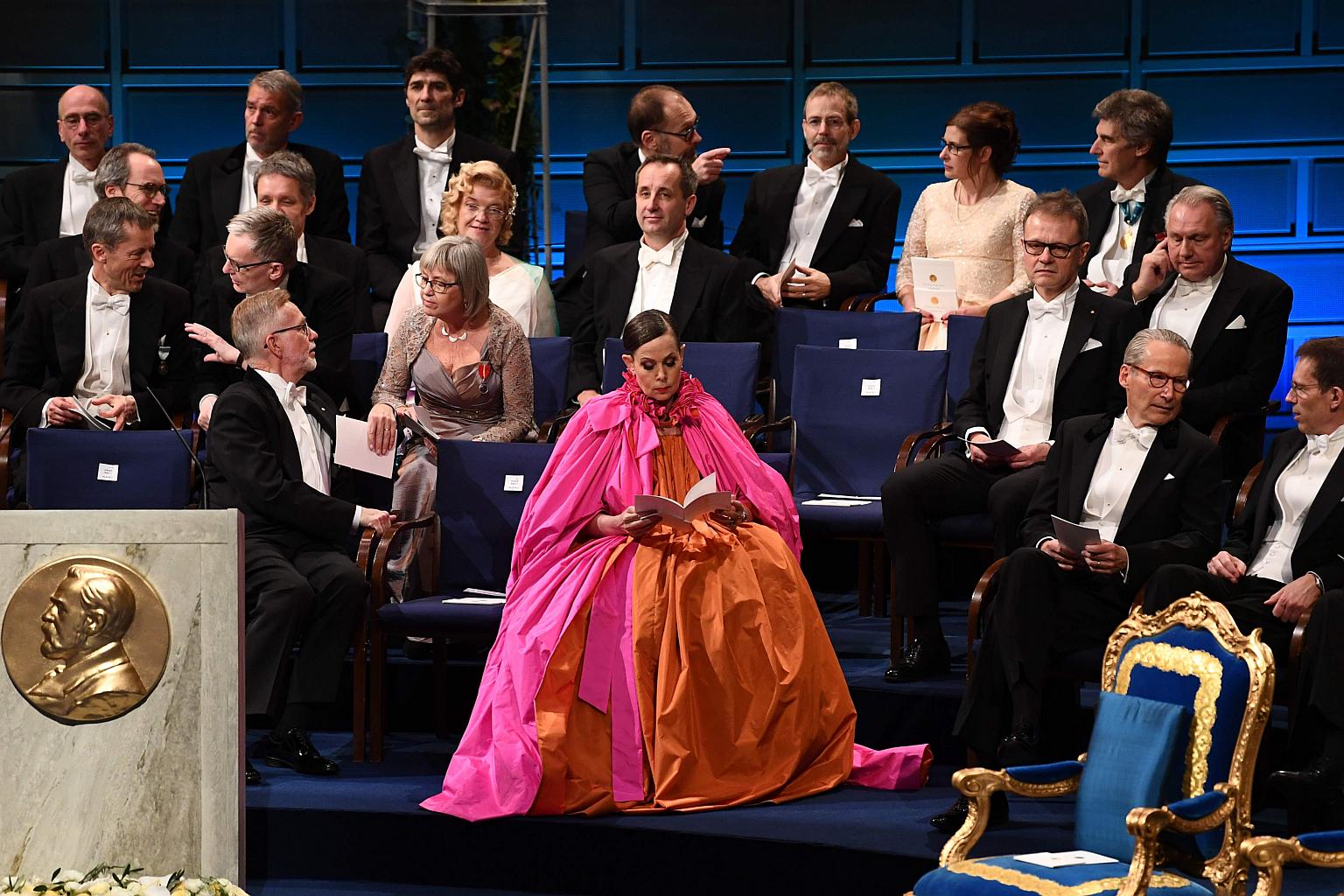
"If it is [still] true," as Marguerite de Ponty wrote, that "as poets say...a dress means something," when the potential of a clothed body of any age to compete for attention with naked, nubile, and digitally augmented ones would seem slight, then the gown worn by fifty-six-year-old literary scholar Sara Danius to the Nobel awards ceremony in Stockholm in December of 2018 should be particularly noteworthy.
Danius, elected five years earlier to the Swedish Academy, which bestows the Nobel Prize for Literature, assumed the leadership post of permanent secretary there in 2015, but was pushed out of that role over the course of 2018 during an institutional scandal involving a criminal case against the spouse of a fellow female academy member. The spouse was ultimately found guilty of rape charges brought by multiple women, whose internationally publicized cases detailed the opportunities for exploitation once afforded with impunity by his influential position as an arbiter within international literary and artistic scenes, but recently rescinded with the sea change currently underway in gender politics and social norms relating sex and power. As of the December 2018 event, Danius remained a member of the academy and the Nobel committee, a position granted for a life term, but she had by then nevertheless been sunk amid controversy surrounding the ensuing legal investigation of the Nobel foundation's activities—an investigation that she herself had called for in response to the allegations against the hence-convicted rapist, who had long been a beneficiary of foundation grants. The internecine saga split the committee, along with public opinion. Danius ultimately resigned her post in February of 2019, two months after a ceremony at which no Nobel Prize for Literature was bestowed—a direct result of the committee's preoccupation with its own dilemmas over the preceding year.
This convoluted backstory, fraught with sordid abuses and probable conspiracies, has likely undermined the power of the prize, if only by revealing the quite ordinary human "wizards" at work behind the curtain of the formerly anonymous and once-authoritative Nobel decision. But these details also seem pertinent to a description of Danius's dramatic December ceremony ensemble, which consisted of a tremendous Watteau-like gown in bright orange silk the color of a construction worker's safety vest, topped by a shocking magenta Watteau-pleated silk cape, gathered at the neck and extending the full length of the gown. Only her head, wrists, and hands emerged from the dress, while the rest of her body remained hidden, though one would be mistaken to think her presence was diminished by so many yards of cloaking. On the contrary, the bell-shaped design of the dress and cape, which must have been supported underneath by robust crinolines, increased her spatial volume three- to four-fold, making her impossible to miss.
In the images I found online, Danius sits regally, alone against a backdrop of blue upholstered chairs and carpeting, like a bold tropical flower in a florist's otherwise empty refrigerator case. The drape of her costume consumes the space of three seats. A buffer of additional empty seats beyond these separates her from her fellow committee members, who, by contrast, appear jammed together along the perimeter of her moat of chairs—the many men exclusively in black tuxedos, the few women all in beige mother-of-the-groom dresses. They speak among themselves, seemingly keen to appear occupied, as if they might therefore avoid the role in which they had been unwittingly cast by Danius's outrageously defiant gesture.
With the unmistakable intent of sheer flamboyance, Danius masterfully orchestrated a scene, as if the pink-robed woman in Watteau's painting—now hyper-saturated and acutely aware of the scrutinizing gaze at her back—had suddenly dropped the pretense of her own elusiveness, turning around to face down the crowd instead, a figure blithely refusing to recede into ground. Danius had already been deposed from her leadership role and ostracized by her colleagues for holding the committee to account, but her dress would seem to demonstrate, if nothing else, that she herself would not be cowed by a din of controversy. She had torqued a Watteau-inspired aristocratic habit to serve the audacious, scene-spinning agenda of a femme fatale, transposing and thereby subverting both clichés about women and power in the process. At least for an evening, or for the brief public lifespan of a digital image, one meaningful dress demanded its due on its wearer's terms—explicit, transcendent, and not to be ignored.