Please Add To & Return
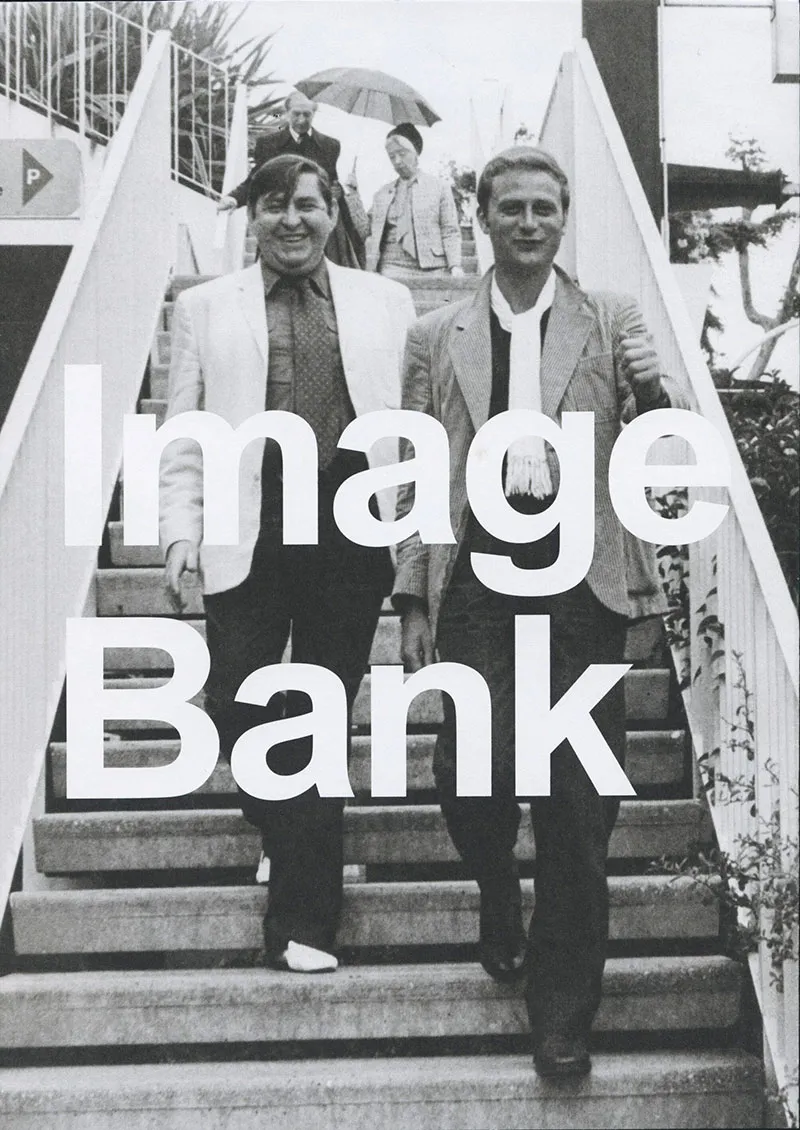
Before the verb "networking" acquired the transactional, potentially pejorative sense of "interacting with others to further one's career" (or to further some more vague will to power), mail artists—who generate and circulate artworks among themselves via the post—used the word to invoke and celebrate their burgeoning vision of a collectively determined future.
Paul Stamets, a mycologist who has spent his life studying fungi, recently suggested that a certain colony of mycelia, a dense and complex network of underground filaments spread across thousands of acres on the west coast of North America, may be the largest organism on earth. These filaments carry biochemical signals across the entire ecosystem, relaying information between interdependent organisms—trees, plants, insects and animals—that have no other direct, physical connection. Which was the original spore? Who were the colony's founders? The questions are senseless, not only because this fungal body is practically older than time, but also because what distinguishes the mycelium is not any individual part or its special role. It is the architecture, built upon the very non-specialness of every part. The same is true of all decentralized networks. Their resilience and intelligence emerge from countless active connections, which do not depend on the fate of a few extraordinary nodes. This precedence of structure over parts is the quality that makes a decentralized network decentralized.
Still, the ways we tell our stories and make sense of them together haven't caught up to our recent knowledge of successful biological structures nor to our dawning realization that we live in an information environment categorically different from the one that existed even a generation ago. The stubborn form of historical narrative demands tales that originate and progress. Readers seek beginnings and endings. Between hard stops, we expect to find protagonists and antagonists, "key players," significant episodes. We tend not to notice it is collective attention and communal belief that give these stories their power. Or I should say we have tended not to notice. Fast, portable, networked computing is quickly moving our long-standing tendency into the past tense as we discover what ubiquitous digital connection can do. So far, our fledgling networks have already toppled governments and industries that none of us nodes suspected would fall in the months, weeks, even days leading up to their demise.
The artists who pioneered networking as an art form, building mail-art networks in the 1960s and '70s, faintly grasped how much our new era of information production would reshape the existing social order. As Robert Filliou presciently noted in a 1973 article in FILE Megazine, "If it is true that information about and knowledge of all modern art research is more than any one artist could comprehend, then the concept of [an] avant-garde is obsolete. With incomplete knowledge, who can say who is in front, and who ain't?"11 Robert Filliou, "Research on the Eternal Network," FILE 2, no. 3 (September 1973): [7]. Network-oriented artists understood implicitly that top-down information control becomes unsustainable once the volume of available information reaches critical mass, and that such exponential information growth itself is both enabled by and constitutive of networks.
The hierarchical model by which most of society is (or was) ordered has been profoundly disrupted as a direct result of online information archiving and distribution systems, currently developing in tandem with an unprecedented increase in information production. As Filliou foresaw, this displacement is not a transfer of power in the familiar mode of a new guard rising to replace old leadership. Instead, the spread of decentralized networks renders moot the very principles on which our concepts of leadership rest. The presumed importance of originators and experts, whether artistic innovators or elites of any kind, no longer resonates. It follows that artists who succeed in making the network their medium necessarily succeed in reducing the value of their own specificity as artists, and of singular works along with it.
Whereas once, not long ago, we noticed separate mushrooms populating the surface of a forest floor, now we infer the presence of that vast underground mycelium from which these few representatives merely protrude or to which they connect. Some scientists, including Stamets, believe that our prior working concept of individual organisms itself has expired. If all are profoundly inseparable from complex ecosystems in which the existence of each is symbiotic, then where does one being end and another begin? Moreover, as we now (also) know, we ourselves are complex ecosystems of micro-organisms. Historical notions of autonomy and independence simply don't make sense anymore, suddenly, today, given the mass of new information quite literally at hand, always on, blinking and beeping in our palms. At the current rate of information production, knowledge cannot pin down categorical identities in the same old ways. Who can say who is in front and who ain't?
Before the verb "networking" acquired the transactional, potentially pejorative sense of "interacting with others to further one's career" (or to further some more vague will to power), mail artists—who generate and circulate artworks among themselves via the post—used the word to invoke and celebrate their burgeoning vision of a collectively determined future. Vittore Baroni, an Italian author and music critic active in the mail-art scene from 1977, wrote in 1994 that "networking, the search for a contact with other beings and the collective work on different projects, is interesting for me only when it opens the mind to new frontiers, when it does not shy away from Utopia."22 Vittore Baroni, "The Hidden Link: A Networking Fable," in Eternal Network: A Mail Art Anthology, ed. Chuck Welch (Calgary: University of Calgary Press, 1995), 158. For him, the mail-art network contributed to an artistic renaissance defined by the democratization of art, offering its participants "a kaleidoscopic landscape that is different from every point of observation."33 Baroni, "Hidden Link," 158. Only by "networking," he maintained, "the artist comes down from his ivory tower and becomes once again a functional part of our daily life."44 Baroni, "Hidden Link," 158. In the same essay, titled "The Hidden Link: A Networking Fable," Baroni wrote that "we have become saturated by mass-media communications; the brain short-circuits because there is too much data available at all times. A personally addressed message activates a direct response."55 Baroni, "Hidden Link," 157. He saw clearly the changed cognitive conditions of an information-rich environment and the distinctive demand that personalized communication places on our attention. Like the rest of us, however, he failed to anticipate how the Internet, email and social media would merge "mass-media communications" with "personally addressed messages" over the next two decades. Yet in his account of how one joins the mail-art network, users of today's social-networking applications (and everyone else who has left the house or held a conversation during the past ten years) will likely recognize an idealized depiction of the platforms we now use:
You only learn what mail art is by becoming a mail artist. To make mail art you just have to compress your own ideas into a mailable format and send it to somebody. It's as simple as that. What you will receive in exchange depends very much on what you send out: A bad idea will not stir up exciting replies; a work full of passion will not pass unnoticed. Now you only need a few addresses to start with, then your contacts will grow harmoniously while you plunge more and more into the network.
In practice, of course, "bad ideas" do stir up ample excitement online, to say nothing of the attention captured there by works "full of passion," which often enough seem to be of a bad sort, supposing your definition of "good" leans toward an open, civil and pluralistic society.
Joining the mail-art network as Baroni describes, through self-motivated participation, contrasts starkly with the protocol of most professionalized fields, art included, which traditionally require specialized education and other time-earned credentials, like the social credibility that accrues with permission and endorsement from elite gatekeepers. Network artists eschewed all that, along with the pressures and value judgments of commercial markets. Ray Johnson, the original "node" of the mail-art network (indeed, there is an original node in this narrative), notoriously balked at the prospect of exhibitions and sales of his work. Whether his reluctance had more to do with his intimate psychology or with his philosophical convictions about the rightful places of art and markets in human relations, his ethos influenced others and helped build a parallel universe for art, which did stand as a counter to concurrent market-able, if not fully market-driven, movements.
By 1973, when Filliou was writing in FILE about the obsolescence of the avant-garde, Johnson had already declared the end of his Correspondence School (also known as the Correspondance School), through which he had been circulating work by post since the late 1950s. He died of an apparent suicide in January 1995, one month after publication of Eternal Network, the book in which Baroni's essay appeared—an anthology of writing by network artists produced for the first time under the auspices of a major university press. Imagine my surprise a few weeks ago, twenty-five years on, when I came across an ad in a glossy interiors magazine for Johnson's upcoming participation in a high-dollar art fair, illustrated with new work © 2018. There, in the lower right-hand corner, Johnson's unmistakable all-caps script caught my eye—
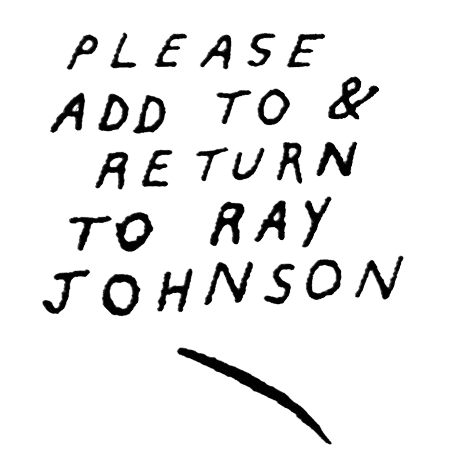
—above it, a drawing and collage of a large thumb and forefinger pulling the tongue from a relatively small, androgynous head. In this evident posthumous collaboration between Johnson and painter Sarah Faux, she will have the last word, since there's no more Ray Johnson to accept her return package. (Faux and Johnson's estate share the copyright, as the ad clearly indicates.)
On the facing page of the Faux Johnson spread, in an affront to the art and its legacy that is most likely a coincidence, the magazine runs advertorial content under the heading network (lower case, enlarged but tastefully restrained), followed by a subhead promising recommendations for the most desirable hotels worldwide. Highlights include a resort "built into the bare rock high above Elia Beach and offering stunning views over the island of Mykonos ... with exceptional design features, infinity pools, fine dining and a superb spa," another with "dedicated butler service in each room and suite" and one with a "new adults-only section" boasting "Swim-Up rooms" and "special spaces [that] allow grown-up guests peace and quiet while being within easy reach of the bar and the resort's four restaurants." The magazine's publishers and advertisers would seem to be mounting a counter-offensive against artworks like Johnson's and against the imposition of the network itself, both of which threaten the old, hierarchical order and its leaders' butler-serviced lifestyles. But while some readers of the "definitive guide to design and decoration" may relish the conceit of a "network" that offers the inside track on five-star hotels, the rest of the world has constructed a dense complex of interlacing filaments that makes insider recommendations irrelevant. And whereas twenty years ago the incredible adjacency of ads for Johnson's work and Swim-Up rooms in the Greek isles would've been read by cultural theorists as evidence of capitalism's uncanny ability to metabolize any critique and convert all related signs into commodities, today that formerly persuasive interpretation appears quaint against mounting evidence that a thoroughly networked public has literally outgrown the narrative, along with the possibility of any effectively centralized authority.